Desk Cable Management System Mistakes and Fixes
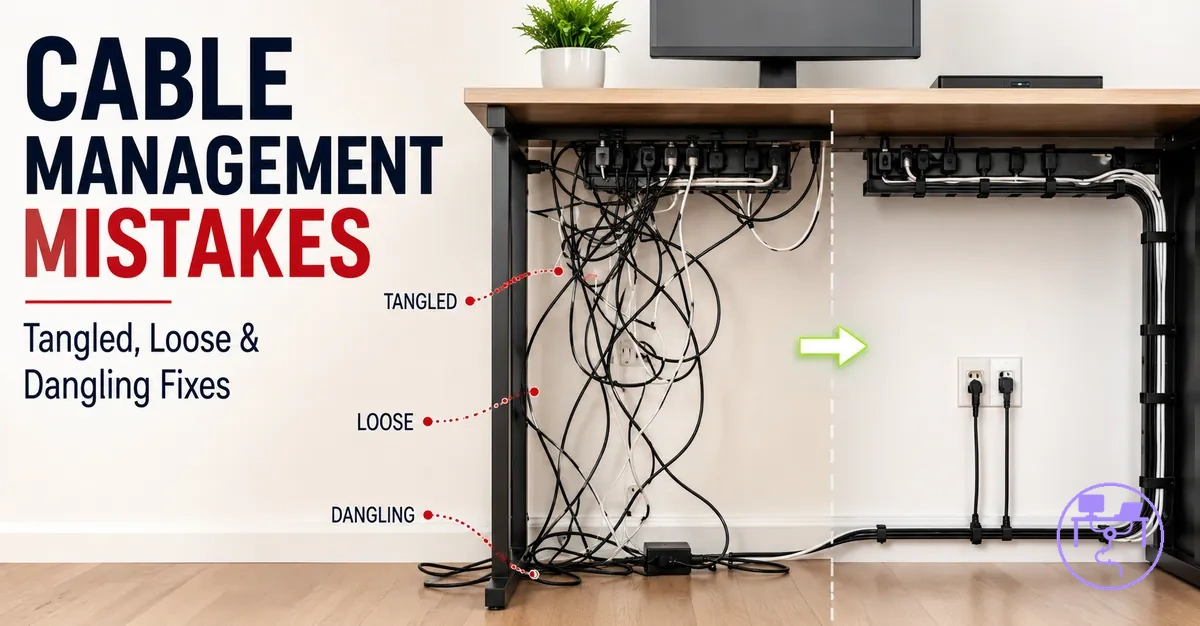
When messy cables keep returning, the cause is often a system issue rather than a single accessory problem. A desk cable management system can develop problems when cables are routed poorly, supported inconsistently, or left without enough access for adjustment. Most mistakes fall into routing, mounting, slack, load, access, and maintenance failure families.
Visible cable clutter may look like a cosmetic problem, but tangled cables, dangling wires, and cable strain can create larger usability issues over time. A cable tray, clips, ties, sleeves, and a power strip work as connected parts of the same system, so a weakness in one area can affect the others. The most useful fixes come from identifying the underlying condition first instead of adding more accessories without diagnosis. In many cases, fixes should follow diagnosis rather than accessory stacking.
For example, a desk may appear organized from the front while under-desk cables remain stretched, unsupported, or difficult to reach. A mounting issue may look like cable clutter, while poor slack management may appear to be a routing problem. Looking at visible symptoms and their likely causes makes it easier to choose proportionate fixes and avoid unnecessary changes.
Bad cable management usually develops through a combination of routing decisions, mounting choices, cable load, service access limitations, and ongoing maintenance gaps. The sections below separate symptoms, causes, risks, and corrective directions so that each problem can be evaluated within the context of the entire desk cable management system.
Bad Desk Cable Management Symptoms and Likely Causes
When bad desk cable management symptoms appear, the likely causes are often cable position, cable strain, blocked access, or unsafe power placement. Loose wires, tangled cables, dangling cables, heat, and trip risk should be read as warning signs before a fix is chosen. Symptoms should be grouped before fixes are chosen.
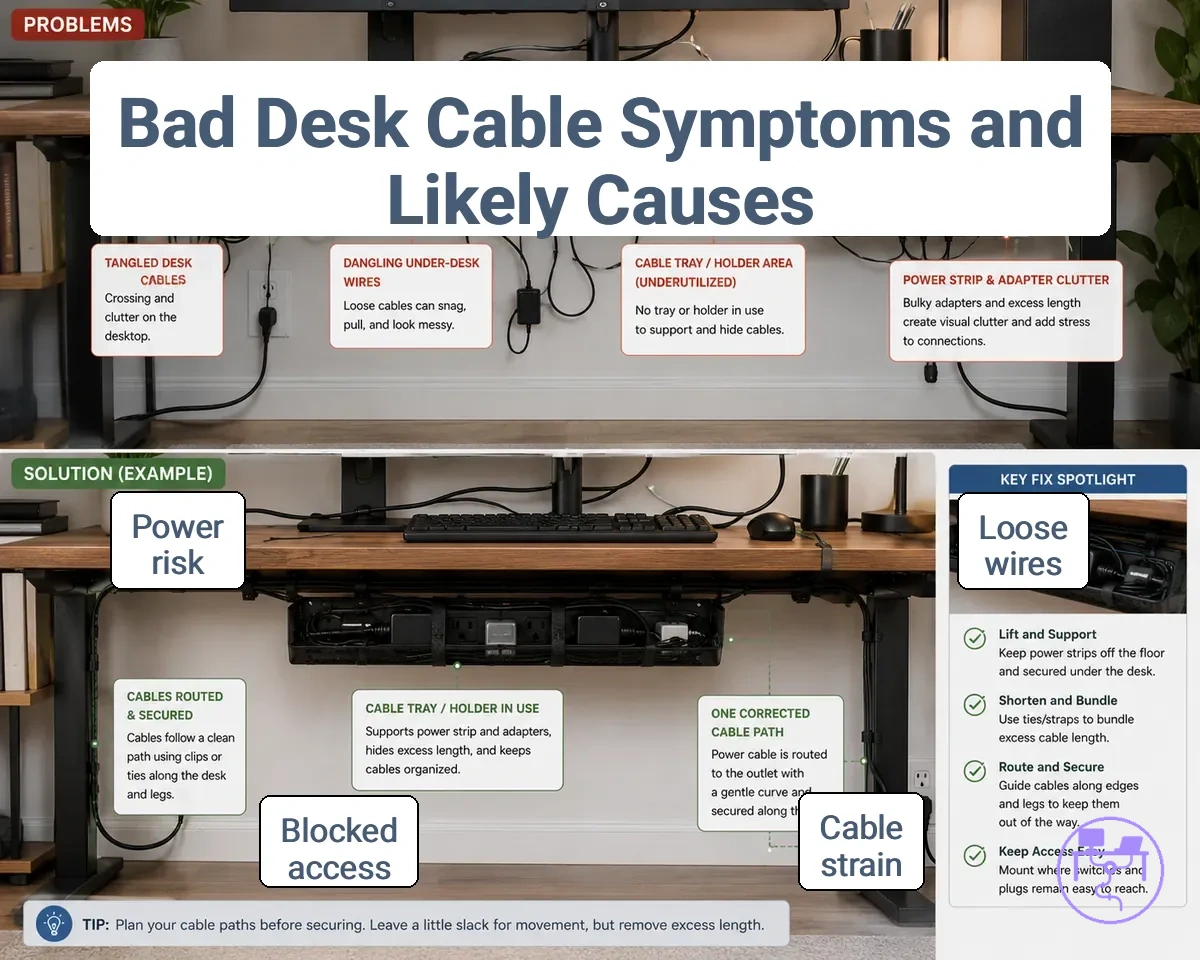
Messy cables can be a surface-level appearance problem, but the same cable clutter may also hide strain, blocked access, or a poorly placed power strip. A loose cable near the back of the desk may only need better routing, while a tight cable pulled across a desk edge can point to cable strain. For the broader page context, the desk cable management system hub separates the main system parts from local symptoms. The first split should separate appearance problems from strain, access, and safety signals.
A desk can look untidy without creating the same priority as a cord under tension or a power placement problem near foot traffic. In that case, the visible mess matters less than whether the cable path creates pull, blocks access, traps heat around adapters, or increases trip risk.
Use this checklist to group bad desk cable management symptoms by cable position, strain, access, and safety risk before choosing a fix.
- Loose wires: the likely cause is weak routing or missing support, and the practical consequence is more movement, snagging, or harder service access.
- Tangled cables: the likely cause is mixed cable groups or poor cable position, and the practical consequence is slower maintenance and harder fault tracing.
- Dangling cables: the likely cause is an unsupported run or lost slack control, and the practical consequence is cord pull, leg-space interference, or cable strain.
- Heat near adapters: the likely cause may be crowded placement or limited ventilation, and the practical consequence is a higher safety priority than simple visual clutter.
- Trip risk: the likely cause is a floor-level cable path or exposed cord route, and the practical consequence is a fix priority based on foot traffic and desk movement.
- Blocked access: the likely cause is poor power placement or hidden connectors, and the practical consequence is harder disconnection, adjustment, and maintenance.
Loose, Tangled, and Dangling Cable Problems
When loose wires, tangled cables, or dangling cables appear, each symptom reflects a different condition within the cable group. Loose wires are defined by movement, tangled cables by bundle complexity, and dangling cables by an unsupported drop. These conditions differ in their effects on visibility, strain, and access.
A hanging wire may remain visible while shifting during normal movement, whereas a tangled bundle can reduce serviceability even when it stays in place. A dangling cable is an unsupported drop, and its impact may vary depending on tension, foot space, and access needs.
- Loose wires: visible sign is a slack cable that moves freely; likely effect is reduced access control and inconsistent cable positioning.
- Tangled cables: visible sign is a wire cluster with crossed paths; likely effect is increased strain within the bundle and reduced serviceability.
- Dangling cables: visible sign is an unsupported drop below the desk; likely effect may include cable pull or interference with leg space.
- Loose cable group: visible sign is uneven cable movement across connected runs; likely effect may be reduced visibility of individual cable paths.
- Mixed tangled and dangling condition: visible sign is a tangled bundle connected to an unsupported drop; likely effect depends on strain, access requirements, and nearby movement.
Heat, Trip, Access, and Cable Strain Signals
When heat, trip risk, access problems, or cable strain are visible, they should usually be prioritized before cosmetic cable cleanup. These safety signals can change the urgency of a response depending on cable type, load, desk layout, and user movement. Urgency is often determined by access, slack, movement, and exposure conditions.
A warning sign becomes more important when it affects access or creates a pull hazard during normal use. A blocked plug can limit disconnection, while a tight strain point may restrict cable movement and available slack. For more focused guidance on power cord safety issues, access conditions and cable routing can be reviewed alongside visible warning signs. Cosmetic tidiness should not override power access or safe cable slack.
The checklist below prioritizes signals by condition and response urgency rather than appearance.
- Warm adapter: condition is limited ventilation or sustained load; response priority is higher caution and review of access and placement.
- Floor-level cord: condition is exposure to foot traffic or a walking path; response priority increases when trip risk affects normal movement.
- Blocked plug: condition is restricted power access or difficult disconnection; response priority is higher when quick access may be needed.
- Pinched cable: condition is compression between surfaces or moving parts; response priority increases when cable strain or repeated pressure is present.
- Tight strain point: condition is limited slack during desk movement or cable routing; response priority depends on tension, access needs, and cable movement.
Cable Routing Mistakes Under the Desk
When cables repeatedly fall out of place or become difficult to manage, poor cable routing is often the cause rather than a lack of accessories. Under-desk routing depends on the quality of the cable path, available slack, separation between cable types, and service access. Routing mistakes cause repeated clutter.
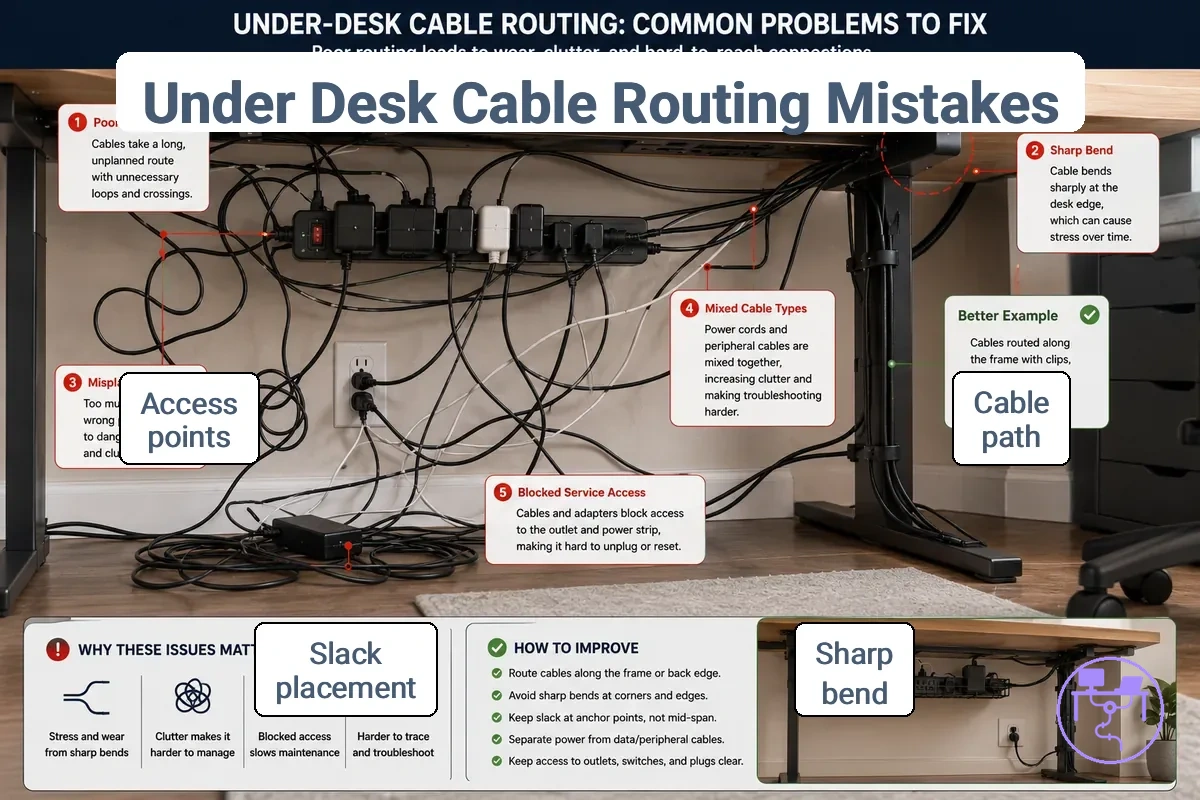
A cable routing problem can persist even when routed cables are bundled or secured. Evaluating the cable path, bend, slack placement, separation between a power cable and a peripheral cable, and available service access helps identify the underlying condition. An under-desk path that crosses access points or creates strain near a desk edge may be harder to maintain over time. These attributes are usually more important than the number of accessories attached to the cable run.
A cable run routed directly across movement areas is a different problem from a workable path that only needs better securing. In the second case, the route itself may remain usable because path, bend, and access conditions are already reasonable. For more detailed correction methods, see cable routing fixes. Routing mistakes are easier to assess when each route is reviewed by path, bend, slack, separation, and service access rather than by appearance alone.
| Route | Attribute | Condition | Outcome |
|---|---|---|---|
| Cable path | Under-desk path | Crosses movement or work areas | Recurring cable clutter and reduced path clarity |
| Bend | Cable direction change | Sharp bend near a desk edge | Higher strain and harder cable positioning |
| Slack placement | Available cable length | Slack concentrated in one location | Loose loops and inconsistent cable routing |
| Desk edge contact | Surface interaction | Cable run rubs against the desk edge | Increased snagging potential during movement |
| Power separation | Power cable and peripheral cable layout | Limited separation and poor organization | Reduced route clarity and service access |
| Access points | Service access | Connectors are difficult to reach | Slower maintenance and adjustment |
Poor Cable Path, Bend, and Slack Placement
When a cable run shows drag, pull, sag, or an inaccessible plug, the cause is often the local cable path, bend, or slack placement rather than the overall under-desk routing layout. A cable path that crosses a desk edge, a stressed bend point, or poorly managed slack placement can create visible strain and reduce access. Path, bend, and slack are the primary local checks.
A cable run may appear secure while still creating service problems. For example, a cable route with a tight bend near a desk edge can develop a kink or pull condition, while a slack loop placed in a movement area may create sag and strain. The effect can vary by cable type and manufacturer limits, so visible strain is usually a more useful diagnostic signal than a universal bend rule.
The mini-checklist below narrows the check to the exact component condition.
- Cable path check: symptom is drag against a desk edge; adjustment direction is moving the cable run to a clearer path with better access.
- Bend point check: symptom is a visible kink or stressed section; adjustment direction is reducing bend severity when the cable type allows.
- Slack placement check: symptom is sag or a loose slack loop; adjustment direction is redistributing slack closer to the service gap.
- Pull check: symptom is tension during desk movement; adjustment direction is increasing available slack where strain appears.
- Access check: symptom is an inaccessible plug; adjustment direction is repositioning the cable run to improve service access.
Mixed Power, Data, and Peripheral Cable Runs
Mixed power, data, and peripheral cable runs can make troubleshooting harder because different cable groups become difficult to identify, access, and adjust. When power cords, adapters, display cables, USB cables, and peripheral cables share the same mixed run, strain points and service paths may be less visible. Mixed runs complicate access and troubleshooting.
A practical approach is to organize cable groups using power/access risk, serviceability, and clutter control as the main criteria. Separation can improve clarity when a device cable must be traced, an adapter must be reached, or a strained cable group requires adjustment. The grouping below focuses on placement condition and its effect on organization, access, or strain.
The following cable groups are easier to assess when each group is reviewed independently.
- Power cords and adapters: placement condition is a bundled mixed run with limited access; effect may be slower disconnection and reduced visibility of strain points.
- Display cables: placement condition is routing through crowded cable groups; effect may be reduced organization and more difficult troubleshooting.
- USB cables: placement condition is crossing multiple device cables without clear separation; effect may be lower cable-group clarity and slower tracing.
- Peripheral cables: placement condition is excess cable length mixed with power leads; effect may include clutter and localized strain during movement.
- Data cables: placement condition is a shared cable path with limited separation; effect may be reduced access and more complicated service checks.
Tray and Holder Problems in Desk Cable Management Systems
When cables remain difficult to manage despite being secured, the cause is often a cable tray, holder, clips, or mounting issue rather than the cables themselves. Support hardware can fail through poor placement, weak grip, limited access, or an unsuitable mounting surface. Hardware failure should be separated from cable mess.
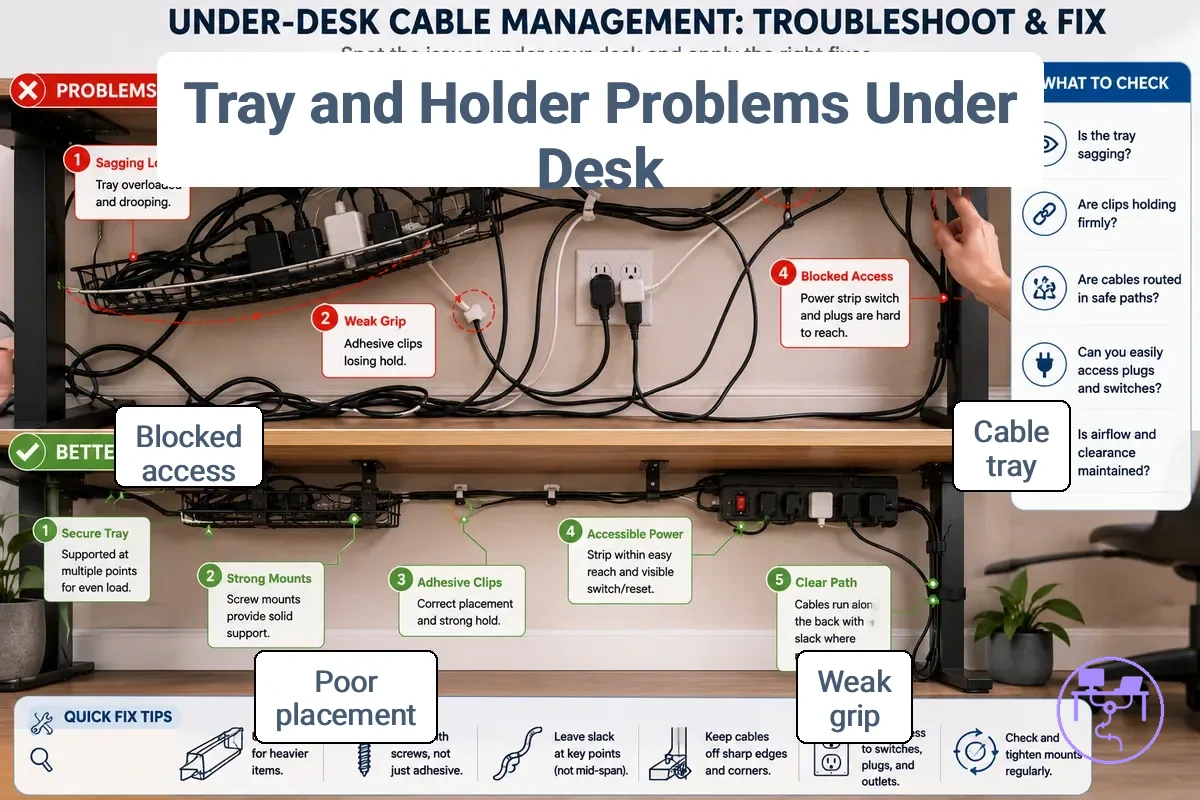
A cable tray may sag when load exceeds what the support points can comfortably manage, while adhesive clips may lose grip when the mounting surface does not support reliable attachment. A cable holder placed too far from connection points can reduce access and increase localized strain. Evaluating load, mounting surface, grip, placement, and access helps identify whether the support hardware or cable layout is creating the symptom.
Decision-making is usually based on condition rather than appearance. A mount with adequate grip may only need repositioning if access is poor, while a component that no longer holds load or maintains attachment may need replacement. For related installation problems, mounting conditions should be reviewed before choosing between repair, repositioning, or replacement.
Hardware problems are easier to diagnose when each part is reviewed by load, mounting surface, grip, placement, and access. The table below follows a part–attribute–condition–symptom pattern.
| Part | Attribute | Value or Condition | Symptom |
|---|---|---|---|
| Cable tray | Load | Excess cable weight or uneven support | Sagging and reduced cable support |
| Holder | Placement | Positioned away from service points | Reduced access and increased strain |
| Adhesive clips | Grip | Weak attachment to mounting surface | Cables slip from the intended path |
| Screw mounts | Mounting | Loose or unstable attachment | Movement of support hardware |
| Support point | Access | Blocked by equipment or layout | More difficult adjustment and maintenance |
Overfilled or Sagging Under-Desk Cable Trays
When an under-desk cable tray shows sagging, the cause may relate to overload, mounting condition, tray width, or cable grouping rather than the tray alone. Visible sagging is a clear symptom, but the underlying cause depends on how load, adapter placement, and cable support are distributed. Sagging should be evaluated through load, mounting, width, cable grouping, and access.
An adapter-heavy under-desk cable tray can become harder to access when weight concentrates in one area. In that situation, adapter placement and cable grouping may reduce stability even when the tray itself remains attached.
Tray problems are best diagnosed by checking load, mounting, width, and cable grouping together. The table below focuses on tray-specific symptoms and correction directions.
| Tray condition | What to check | Visible symptom | Fix direction |
|---|---|---|---|
| Overload | Load distribution and cable grouping | Tray sag or reduced cable support | Reduce bundle weight and redistribute cable groups |
| Sagging | Tray width and support coverage | Uneven tray position | Reposition support and review cable grouping |
| Poor mounting | Mounting condition and attachment points | Tray movement or reduced stability | Improve mounting support |
| Adapter crowding | Adapter placement and concentrated load | Reduced access and localized tray sag | Reposition adapters and balance load |
Weak Mounting, Adhesive Failure, and Loose Cable Clips
When a detached wire appears after installation, the cause is often adhesive failure, loose cable clips, or a mounting condition that no longer holds under cable tension. Clip performance depends on the mounting surface, surface texture, cable weight, and holding strength. Check adhesive, surface, weight, and tension before choosing a fix.
A loose mount should not be replaced before the cause is checked. Weak adhesive may be only one factor if cable tension is pulling across the clip or the surface texture prevents stable grip. Replacement makes more sense when cleaning, repositioning, or reducing strain would not restore reliable holding strength.
- Adhesive failure: surface condition is weak contact or reduced grip; symptom is a detached wire; fix direction is checking the surface and repositioning before replacing the clip.
- Loose cable clips: mounting condition is movement under cable tension; symptom is a wire slipping from the intended path; fix direction is reducing pull before adding new clips.
- Textured mounting surface: surface condition may limit adhesive contact; symptom is repeated clip failure; fix direction is moving the clip to a more suitable mounting area when available.
- Heavy cable group: weight condition may exceed the clip's holding strength; symptom is sagging or detachment; fix direction is reducing cable weight on that support point.
- Poor clip placement: mounting condition is too far from the strain point; symptom is cable pull near the holder; fix direction is repositioning the support closer to the needed cable path.
Cable Tie and Sleeve Mistakes
When cable grouping creates strain, limits service access, or restricts movement, the mistake is often in how the bundle was tied, sleeved, or organized. A cable tie, Velcro tie, cable sleeve, or label can improve cable management only when the cable group remains accessible for adjustment and maintenance. Bundling should not reduce movement or access.
Problems often develop when a bundle is tightened or enclosed without considering future changes. Cable ties, Velcro ties, cable sleeves, and labels function as service-control tools that help organize a cable group while preserving identification, maintenance access, and adjustment points.
A tidy bundle and an over-constrained bundle may look equally organized, but they behave differently during maintenance. A tidy bundle supports service access and controlled movement, while an over-constrained bundle may increase strain, limit adjustment, or make maintenance more difficult.
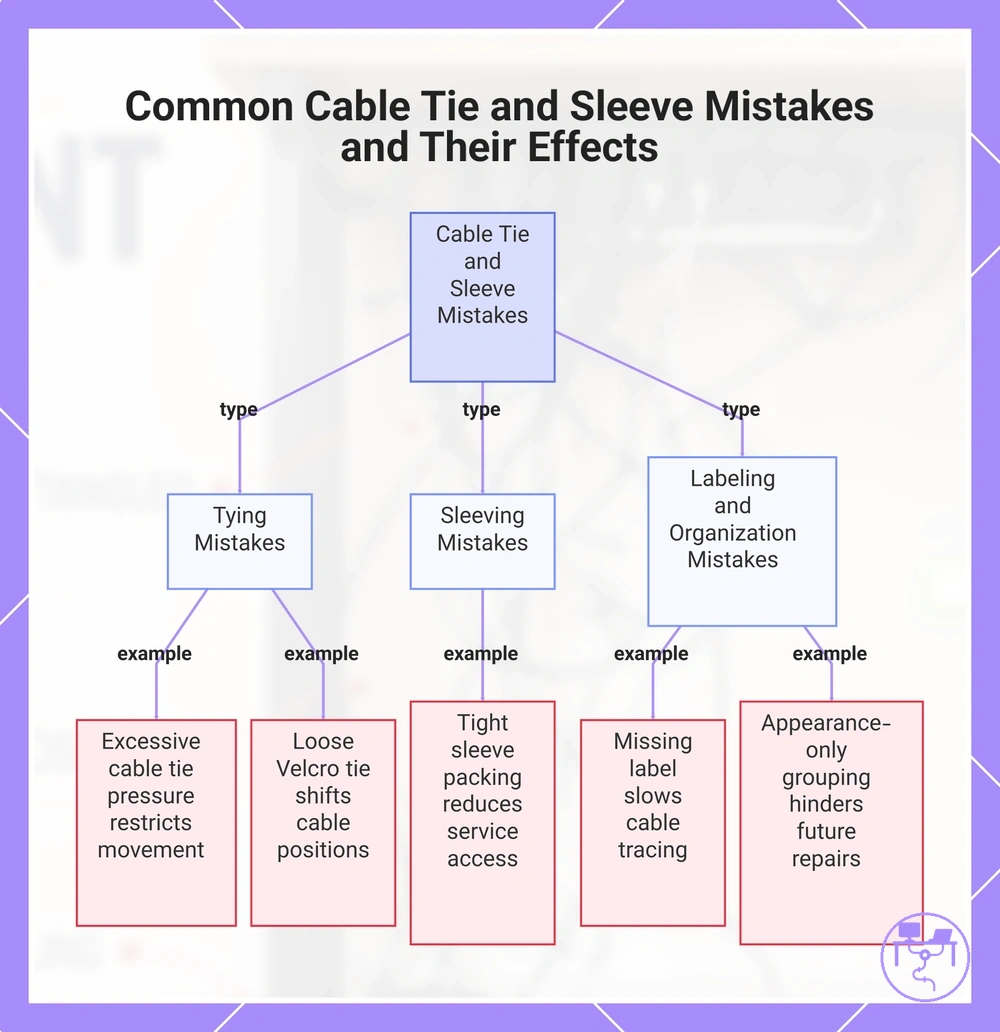
Cable Tie and Sleeve Mistakes are easier to identify when cable grouping balances neatness, movement, heat, and repair access. The checklist below helps verify grouping quality.
- Cable tie: condition is excessive pressure on the cable group; possible effect is reduced movement and localized strain.
- Velcro tie: condition is a loose bundle with limited control; possible effect is shifting cable position and reduced bundle organization.
- Cable sleeve: condition is a tightly packed bundle; possible effect is reduced service access and more difficult maintenance.
- Cable sleeve: condition is an enclosed cable group with limited ventilation; possible effect may vary by cable type, bundle placement, and heat conditions.
- Bundle label: condition is missing or unclear identification; possible effect is slower maintenance and cable tracing.
- Cable group: condition is organized only for appearance; possible effect is reduced access when future adjustments or repairs are needed.
This chart identifies common mistakes in cable tie, sleeve, and labeling practices and describes their typical effects on cable management, maintenance access, and bundle condition.
Over-Tightened Cable Bundles and Restricted Movement
When restricted movement or visible cable strain appears, an over-tightened bundle is often a contributing condition. Excess tie pressure or an unfavorable bend condition can limit cable movement, create connector pull, and make future adjustments more difficult. Concern should be based on visible strain, connector pull, and serviceability rather than a fixed tightness rule.
For example, a monitor cable or moving desk cable may need additional travel within the bundle. When tie pressure limits that travel or a bend condition concentrates stress near a connector, restricted movement can increase and serviceability may decrease.
The checklist below links visible signs to likely bundle conditions and their effect on adjustment and service access.
- Visible cable indentation: may indicate increased tie pressure; meaning is a higher likelihood of localized cable strain.
- Restricted movement during adjustment: may indicate an over-tightened bundle; meaning is reduced flexibility for future changes.
- Connector pull during cable movement: may indicate limited slack within the bundle; meaning is reduced serviceability at the connection point.
- Sharp bend condition near a tie: may indicate concentrated stress; meaning depends on cable type, cable path, and visible strain.
- Difficult repositioning of the cable bundle: may indicate a compressed cable group; meaning is reduced access for maintenance and adjustment.
Unlabeled or Hard-to-Service Cable Groups
When small cable changes become recurring cable management problems, unlabeled cables or limited service access are often part of the cause. A cable group is easier to maintain when identification is clear and connection points remain accessible. Clear cable labels support faster identification and easier maintenance.
For example, replacing a monitor cable or moving a peripheral can take longer when multiple device cables follow the same route without clear identification. Preserving service access during setup makes it easier to adjust and maintain the system when devices, chargers, or connections change.
Service access is part of a working cable management system. The checklist below connects cable-group identification conditions to maintenance outcomes.
- Monitor cable group: labeling condition is missing cable labels; maintenance outcome is slower identification during replacement or adjustment.
- Charger cable group: labeling condition is unclear identification; maintenance outcome is more difficult cable removal when devices change.
- Power cord group: labeling condition is limited identification and restricted service access; maintenance outcome is slower adjustment and connection checks.
- Peripheral cable group: labeling condition is multiple similar device cables without clear labels; maintenance outcome is increased tracing time during maintenance.
- Hard-to-reach cables: labeling condition may be adequate but service access is limited; maintenance outcome is repeated effort during future cable changes.
Power Strip and Adapter Clutter Issues
Power Strip and Adapter Clutter Issues are often a cable management concern when power equipment becomes difficult to support, access, or organize. A crowded power strip, adapter clutter, or poorly positioned power cord can make adjustments harder and reduce visibility of cable paths. Power clutter affects support, access, and cord pull.
Many power-clutter problems relate to placement condition rather than the equipment itself. A power strip without a suitable holder, an adapter block concentrated in one tray area, or a power cord exposed across the floor can reduce usability and make future changes more difficult. Organizing equipment around support, ventilation, access, and cable routing can improve maintenance and reduce recurring clutter.
This section focuses on diagnosing and organizing power-related cable management mistakes rather than detailed electrical safety guidance. More specific power cord safety issues belong in a dedicated safety context, while this section addresses placement conditions, corrective organization, and usability.
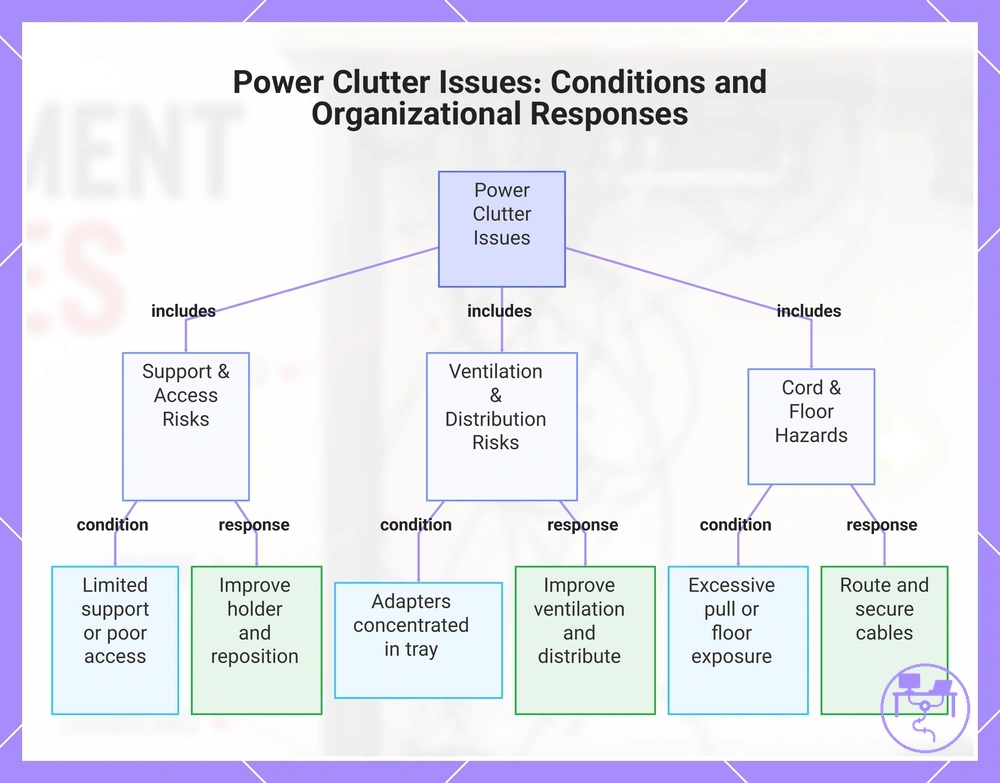
Power Strip and Adapter Clutter Issues should be reviewed through support, ventilation, access, cord pull, and floor exposure. The checklist below organizes common conditions by risk and usability outcome.
- Power strip: condition is limited support or poor holder placement; organizational response is improving support while preserving access to connections.
- Adapter clutter: condition is multiple adapters or power bricks concentrated in one tray area; organizational response is improving ventilation and distributing equipment more clearly.
- Power cord: condition is excessive cord pull between devices and connection points; organizational response is reducing tension through improved cable routing and positioning.
- Surge protector: condition is difficult access behind equipment or furniture; organizational response is repositioning for easier maintenance and connection changes.
- Floor exposure: condition is a power cable crossing open floor areas; organizational response is routing and securing the cable to reduce clutter and trip risk.
This chart identifies the main power clutter conditions related to support, ventilation, cord pull, and floor exposure, along with recommended organizational responses.
Unsupported Power Strips and Heavy Adapters
When an unsupported power strip or heavy adapter starts sagging, disconnecting, or blocking outlets, the issue is often a support condition rather than simple adapter clutter. Weight, location, mounting, and access should be checked before choosing a correction direction. Support failure usually depends on where the power strip or adapter block sits and how the weight is carried.
A heavy adapter placed at the edge of a tray may contribute to tray overload or reduce access when the support condition is already weak. In that case, repositioning the adapter block or reducing concentrated weight may be more useful than adding another unsupported strip.
The checks below connect support failure to weight, location, and access.
- Unsupported power strip: support condition is weak placement or limited mounting; symptom is sagging or shifting; correction direction is improving support and keeping access clear.
- Heavy adapter: support condition is concentrated weight in one area; symptom may be tray overload or uneven support; correction direction is redistributing weight and reviewing placement.
- Blocked outlets: support condition is crowded adapter placement near connection points; symptom is reduced usability; correction direction is changing adapter position to restore access.
- Loose surge protector: support condition is movement during cord pull; symptom may be disconnection or unstable positioning; correction direction is reducing pull and improving support.
- Adapter block in tray: support condition is poor location relative to tray support; symptom is localized sagging; correction direction is moving the adapter closer to a supported area.
Power Cords That Create Pull or Trip Hazards
Power cords can create a pull hazard or trip hazard when the cord path crosses movement areas, lacks enough slack, or reacts poorly to desk movement. A visible power cord is not automatically hazardous, but a floor-level cord in foot traffic or a tight power cable near moving equipment should be treated as a route condition to fix. Cord risk depends on path, slack, foot traffic, and movement.
The practical solution is to review how the power cord travels through the desk layout before changing accessories. A cord path that works behind a fixed desk may create strain when the desk moves, while a route near walking space may increase snagging risk if slack falls into the floor area. Organization should preserve access while reducing cord pull, exposed floor routing, and strain.
The checklist below identifies route conditions that can turn a power cord into a pull or trip concern.
- Floor-level cord: route condition crosses foot traffic; hazard is a possible trip hazard; response is rerouting the cord away from walking paths when the desk layout allows.
- Tight power cord: route condition has limited slack between connection points; hazard is cord pull and strain during desk movement; response is adding controlled slack near the moving section.
- Snagging cord: route condition passes near chair legs or moving equipment; hazard is pull against the connector; response is moving the cord path behind a more protected route.
- Loose slack loop: route condition leaves excess slack on the floor; hazard is floor exposure and snagging; response is lifting or securing slack while keeping access available.
- Blocked access path: route condition hides the plug behind furniture or cable clutter; hazard is harder disconnection and adjustment; response is repositioning the cord path so access remains clear.
Standing Desk Cable Management Problems
When cables pull, snag, stretch, or hang unexpectedly during desk adjustment, the cause is often a standing desk cable management issue rather than a cable defect. A standing desk introduces movement that changes cable position throughout the height range, and many cable problems appear only when the desk moves. Vertical travel is the cause of many standing desk cable issues.
A fixed cable route can become a problem when a height-adjustable desk moves through its full range. Cable slack, a service loop, clearance, and each moving contact point should be checked together because pulling or snagging may occur only at specific heights. The goal is to maintain cable movement without creating excess vertical drop, strain, or contact with desk components.
A fixed-desk cable fix may not work on a moving desk when the cable route remains stable at one height but develops pulling, snagging, or stretching during movement. If the cable path changes significantly throughout the height range, the solution should be evaluated as a standing desk condition rather than a fixed-desk condition. For a more detailed review of movement-specific setup decisions, see standing desk cable mistakes.
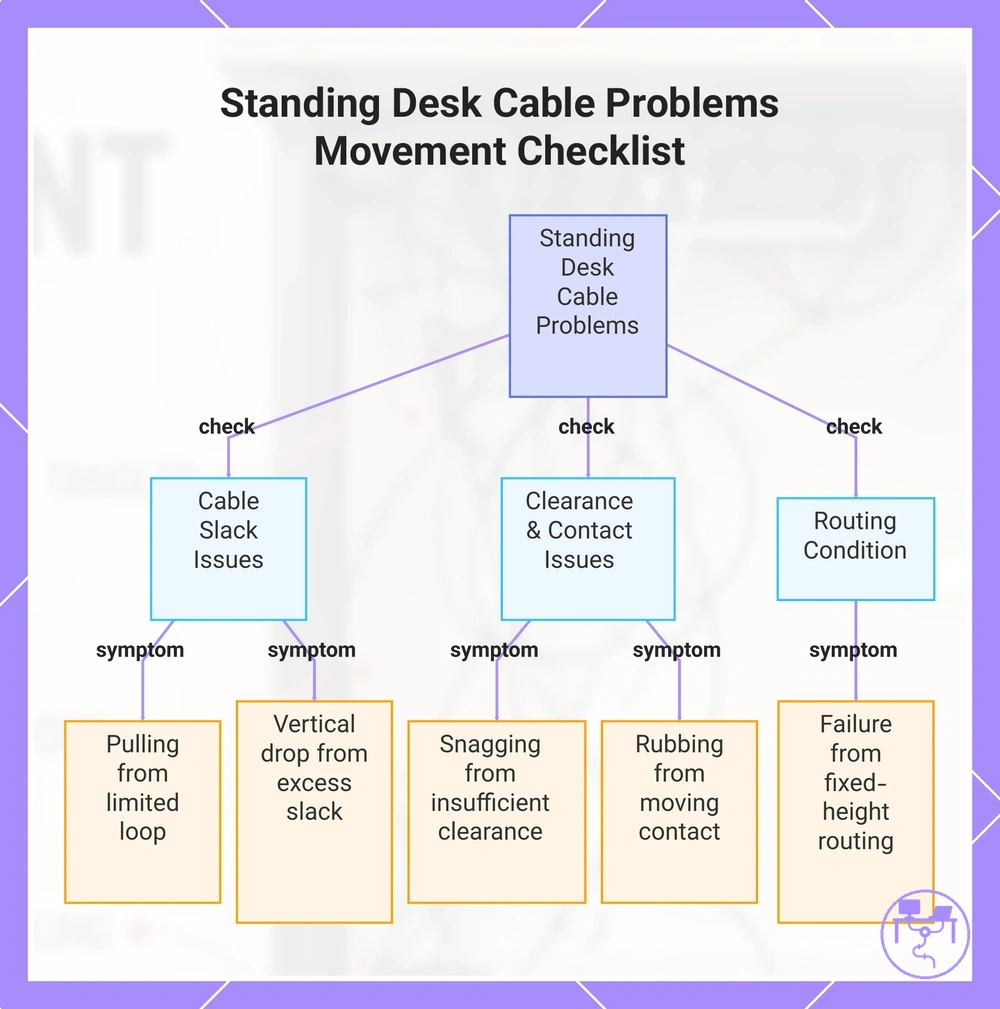
The movement checklist below helps diagnose route conditions that are specific to a height-adjustable desk.
- Limited service loop: cable slack is insufficient for vertical travel; symptom is pulling or connector strain during desk movement.
- Excessive cable slack: route condition allows too much free cable movement; symptom is vertical drop or contact with surrounding equipment.
- Insufficient clearance: movement clearance is restricted near the desk frame; symptom is snagging during height adjustment.
- Moving contact point: cable route crosses a part that changes position during movement; symptom is repeated rubbing, pulling, or route disruption.
- Fixed-height routing solution: route works at one desk position only; symptom appears when the desk moves through a larger height range.
This chart shows specific cable management problems that occur during desk adjustment and their symptoms, helping diagnose route conditions unique to height-adjustable desks.
Missing Service Loop and Movement Clearance
Service loop and movement clearance depend on the standing desk height range, cable length, and cable route. When a service loop is missing or movement clearance is limited, cables may pull, restrict movement, or lose routing flexibility during desk adjustment. Compatibility between cable slack and the desk height range is the key condition to evaluate.
If a cable pulls when the standing desk reaches full height, the slack condition may not match the available vertical travel. Service loop length, movement clearance, and cable length should be reviewed together because movement outcomes depend on the cable path and adjustment range.
The checklist below connects cable route conditions to likely movement outcomes.
- Power cable: route condition has a limited service loop; slack condition may not support the full desk height range; movement outcome may include pulling during adjustment.
- Monitor cable: route condition passes through a restricted area; slack condition provides limited movement clearance; movement outcome may include connector pull or restricted movement.
- Peripheral cable: route condition follows a longer path across moving sections; slack condition may be insufficient for adjustment; movement outcome may include intermittent pulling.
- Power cable: route condition allows little cable allowance near a moving point; slack condition may reduce routing flexibility; movement outcome may include increased tension as height changes.
- Monitor or peripheral cable: route condition varies by cable length and path complexity; slack condition may not match the required movement range; movement outcome may include restricted travel when clearance is limited.
Snagging, Stretching, and Vertical Cable Drop Issues
Snagging, stretching, dragging, and vertical cable drop are movement symptoms that should be checked through the cable route and slack before assuming hardware failure. A symptom that appears during a desk height change often points to a contact point, limited slack, or an unsupported hanging section. Test movement symptoms across the desk's usable height range.
If snagging appears only at one height, the likely cause may be a route conflict at that position rather than a failed accessory. The corrective direction should start with route and slack checks, then hardware support only when the symptom remains tied to a specific holder, tray, or mount.
- Snagging: likely cause is a route crossing a moving contact point; corrective direction is moving the cable path away from the contact area.
- Stretching: likely cause is limited slack during a desk height change; corrective direction is adding controlled slack where cable pull appears.
- Dragging: likely cause is excess slack or a low-hanging route; corrective direction is lifting the cable path while keeping movement clearance.
- Vertical cable drop: likely cause is an unsupported hanging drop through the height range; corrective direction is adjusting slack and support before treating it as hardware failure.
Fixing Messy Desk Cables Without Rebuilding the Whole System
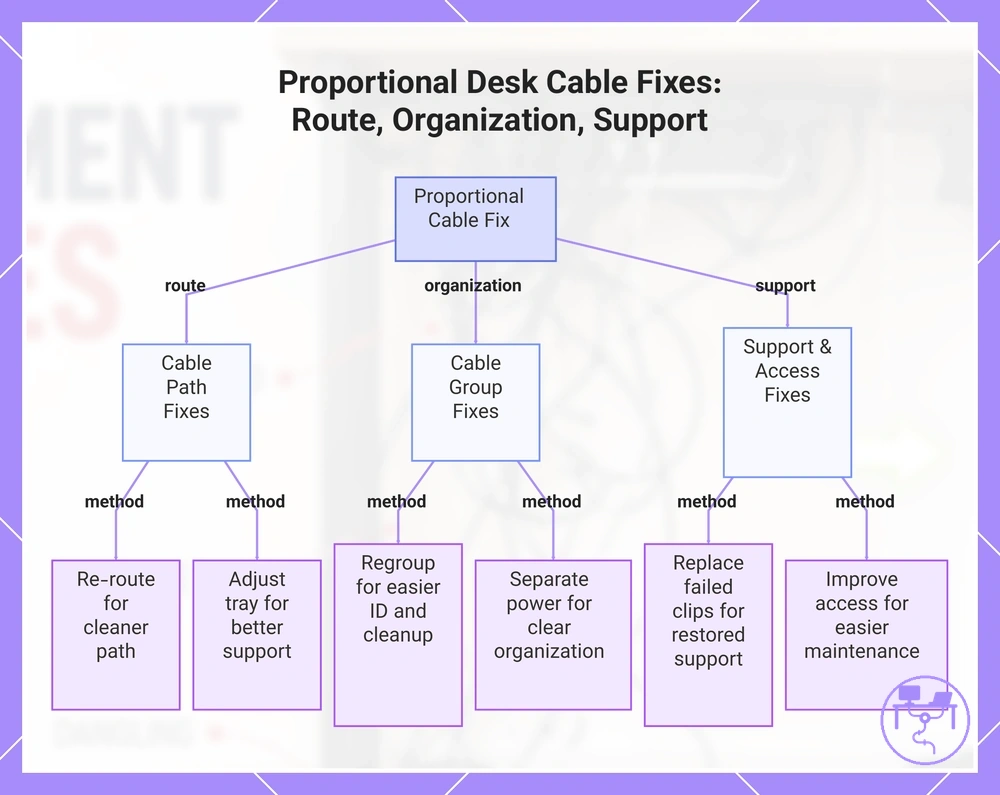
Fixing messy desk cables starts with a proportional fix based on diagnosis rather than a full cable reset. The goal is to correct the condition creating clutter while preserving parts of the setup that already work. The fix should match the confirmed cause.
When messy cables come from one or two identifiable conditions, a targeted fix is often enough. Re-routing can improve cable paths, regrouping can improve organization, and failed clips can be replaced without disturbing the entire setup. For route-related problems, cable routing fixes may help before additional accessories are considered.
A partial fix is usually appropriate when support, slack, and service access remain functional after a small correction. A deeper correction may be necessary when repeated adjustments fail to improve cable management, support conditions remain unstable, or service access continues to be restricted.
- Re-routing: condition is a cable path that creates clutter, strain, or poor access; outcome is a cleaner route and improved service access.
- Regrouping: condition is mixed or poorly organized cable bundles; outcome is easier identification, adjustment, and cable cleanup.
- Replacing failed clips: condition is local support failure at a clip or holder; outcome is restored cable support without broader reinstallation.
- Adjusting trays: condition is poor tray position, sagging, or restricted access; outcome is improved support and easier cable management.
- Separating power: condition is crowded power cables, adapters, or mixed cable groups; outcome is clearer organization and better service access.
- Improving service access: condition is limited reach to plugs, adapters, or cable groups; outcome is easier maintenance and a clearer decision between a partial fix and deeper correction.
This chart shows three categories of targeted fixes for messy desk cables, each with specific actions and outcomes based on diagnosis.
Re-route Cables Before Adding More Accessories
Re-route the cable path first when strain, poor slack, limited access, or repeated tangling comes from the route itself rather than a lack of accessories. Clips, ties, trays, and sleeves can support cable organization, but they work best after the cable path is corrected. Accessories support a correct route but cannot replace it.
If repeated tangling returns after adding organizer parts, the cable path may still be creating unnecessary crossings or movement conflicts. The criteria below help determine when route correction should come before accessory-first changes.
- Cable path creates strain: condition is pulling near connectors or movement points; decision outcome is to re-route before adding support accessories.
- Slack is poorly distributed: condition is excess slack in one area and limited slack in another; decision outcome is rerouting the cable run before adding more ties or sleeves.
- Access remains restricted: condition is difficult reach to plugs, adapters, or cable groups; decision outcome is correcting the cable path before expanding tray or clip use.
- Repeated tangling continues: condition is cables crossing or twisting despite existing add-ons; decision outcome is reviewing the route condition before adding more organizer parts.
- Accessories already provide support: condition is clips, ties, trays, or sleeves remain functional but clutter persists; decision outcome is prioritizing route correction and using accessories as support after the path is improved.
Replace Clips, Ties, Trays, or Holders When the Cause Remains
Replace clips, ties, trays, or holders only when the cause remains after checks confirm that the existing part can no longer support, organize, or manage the cable load. Replacement is justified when the failure condition belongs to the component itself rather than the cable path, routing, or desk layout. Replacement follows confirmed part failure.
Replacement may not be the right decision when poor routing, unsafe power routing, or limited desk movement clearance is creating the problem. Check the failure condition first, then decide whether the component needs replacement or whether the underlying condition still requires correction.
- Adhesive clip: failure condition is repeated loss of support after surface and placement checks; replacement cue is a clip that no longer holds the cable load reliably.
- Tie: failure condition is a worn tie that no longer organizes the cable group; replacement cue is loss of bundle control after adjustment.
- Tray: failure condition is sagging or reduced support that remains after load and positioning checks; replacement cue is a tray that can no longer organize the cable load effectively.
- Sleeve: failure condition is reduced cable organization caused by wear or loss of containment; replacement cue is a sleeve that no longer keeps the cable group together.
- Power strip holder: failure condition is a failing holder that no longer supports the mounted load; replacement cue is continued movement or poor support after mounting checks.
- Boundary check: failure condition relates to unsafe power routing or poor desk movement clearance; replacement cue is deferred until the routing or clearance issue is corrected.
Preventing the Same Cable Management Mistakes From Returning
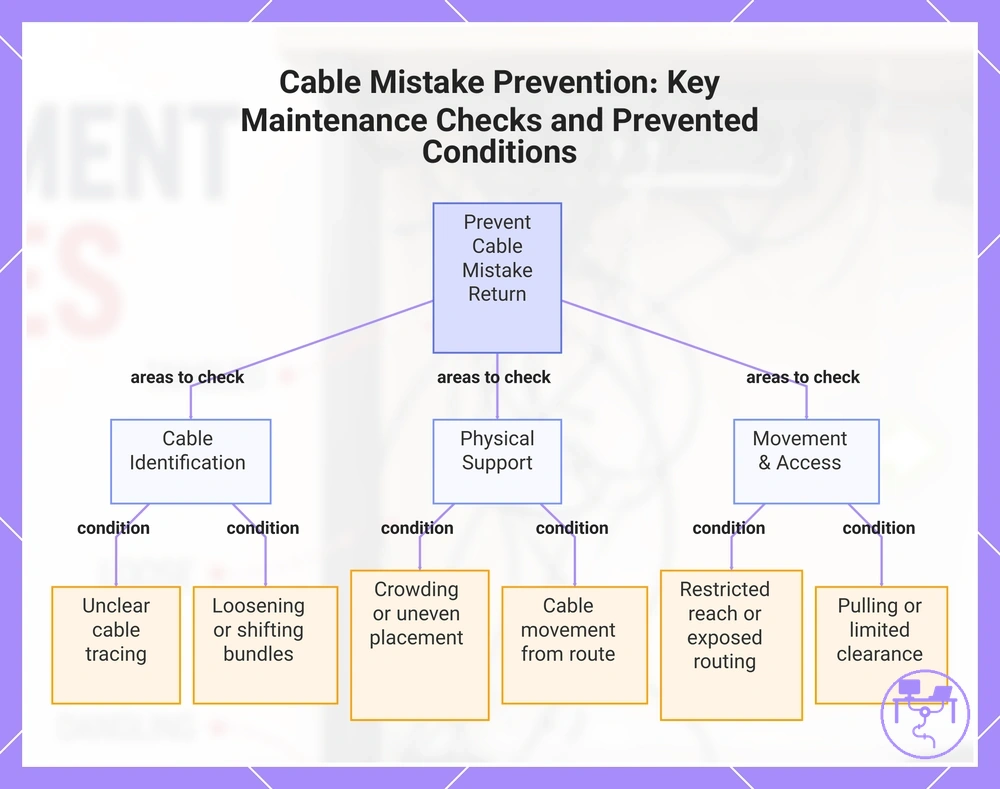
Preventing mistakes depends on turning one-time fixes into a maintainable system instead of waiting for clutter to reappear. A cable setup is usually easier to manage when small checks become part of a regular maintenance habit. Prevention depends on access, slack, labels, load control, and periodic adjustment.
Recurring problems often develop when cable groups change over time without review. A recurring check can help identify changes in trays, clips, ties, power cords, and cable organization before they create repeat clutter or access issues. The checklist below focuses on maintenance habits that support prevention.
Criteria for a maintainable system should focus on whether the setup continues to support organization, movement, and access after everyday changes. When recurring problems continue after repeated small corrections, it may be time to adjust and maintain the system rather than apply another quick fix.
The recurring-check checklist below connects each maintenance habit to the condition it helps prevent.
- Cable groups: maintenance habit is reviewing organization and labels; attribute checked is identification; condition is unclear cable tracing; prevented problem is repeat confusion during changes or maintenance.
- Trays: maintenance habit is checking cable distribution and support; attribute checked is load control; condition is crowding or uneven cable placement; prevented problem is recurring cable congestion.
- Clips: maintenance habit is checking retention and positioning; attribute checked is support stability; condition is cable movement from the intended route; prevented problem is recurring cable drift.
- Ties: maintenance habit is reviewing bundle control; attribute checked is cable grouping; condition is loosening or shifting bundles; prevented problem is repeated tangling.
- Power cords: maintenance habit is checking routing and access; attribute checked is accessibility; condition is restricted reach or exposed routing; prevented problem is recurring adjustment difficulty.
- Standing desk movement: maintenance habit is reviewing cable travel through the height range; attribute checked is slack; condition is pulling or limited movement clearance; prevented problem is recurring strain during desk adjustment.
If recurring problems continue despite regular checks, the cause may involve the overall routing logic or system adjustment rather than a single component. In that situation, reviewing the broader desk cable management system hub can help determine whether the system needs adjustment instead of another localized correction.
This chart shows the main areas to check regularly and the specific conditions that each check prevents, helping to avoid recurring cable management problems.