Desk Cable Management System Types Compared
Desk cable management system types differ by how they hold, hide, route, and position cables, so the right type depends on cable load, concealment needs, desk fit, mounting tolerance, and how often cables must be changed.
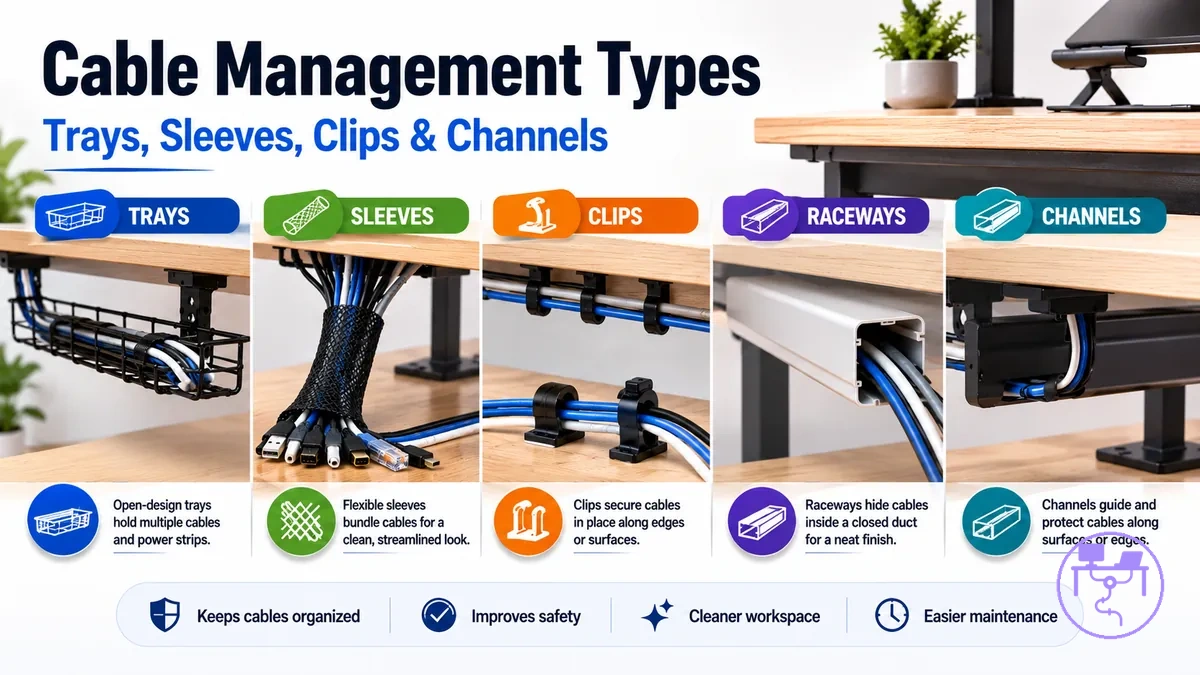
Under-desk trays and baskets usually support larger cable bundles and power accessories, while raceways and channels guide cables along cleaner paths. Sleeves and wraps bundle flexible cable runs, and clips or holders keep individual cords reachable when frequent access matters.
Desk cable management system types compared by function show that no single type fits every workstation. A tray may suit bulk storage when the desk underside allows mounting, a raceway may suit cleaner visible edges when the route is stable, and clips may suit light routing when cables need to stay accessible.
Use the comparison as type → attribute → condition → decision logic: choose the form that matches the cable problem first, then check mounting surface, cable weight, visibility preference, access frequency, and future adjustment needs before treating any option as suitable.
What defines a desk cable management system type
A desk cable management system type is a category of cable organizer defined by its physical form, mounting method, cable-control behavior, and intended desk use. The type matters because the same cable problem can require holding bulk, guiding a route, hiding a visible run, or keeping one cord accessible.
Trays and baskets define a type when they hold larger cable groups under the desk, while raceways, channels, and J channels define a type when they guide or conceal cables along a set path. Sleeves define a type by bundling flexible cable runs, and clips define a type by positioning individual cords or small groups where access is still needed.
The boundary is not always strict because a part can also act like a type when its function changes capacity, access, concealment, or fit decisions. For that reason, this comparison focuses on type-level behavior, while parts of a desk cable management system covers the individual components in more detail.
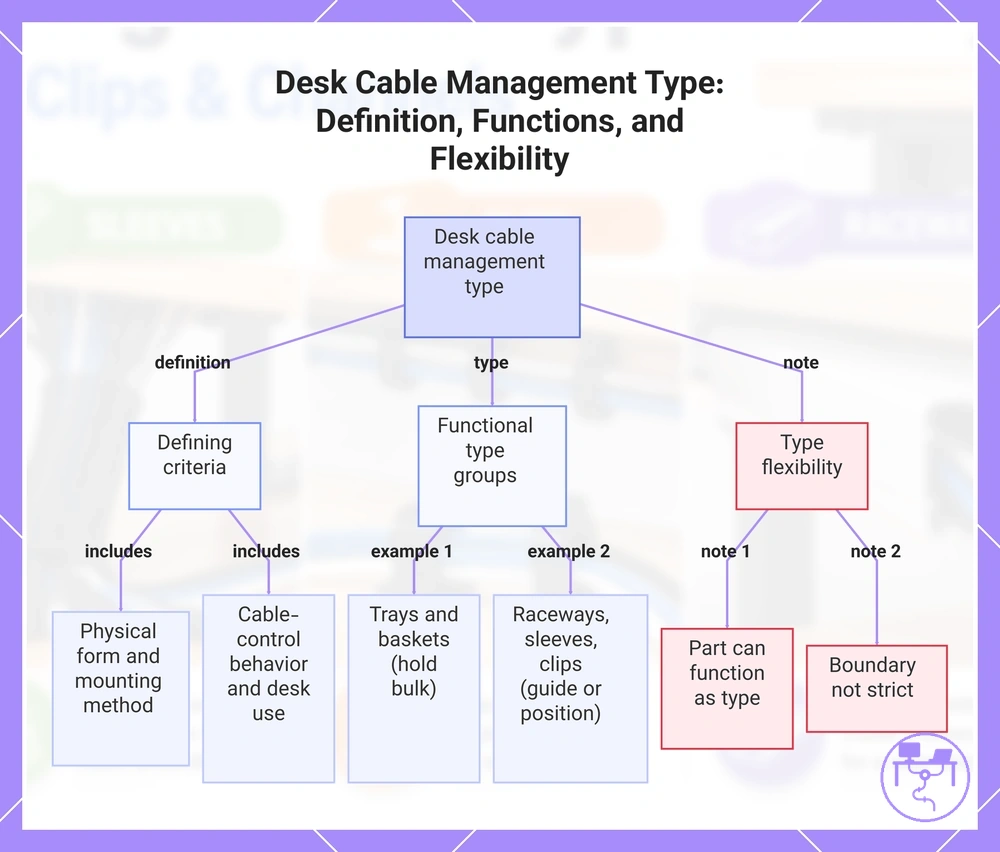
This chart shows how a desk cable management system type is defined by physical and behavioral attributes, organized into functional categories, and notes the flexible boundary between part and type.
Main types of desk cable management systems
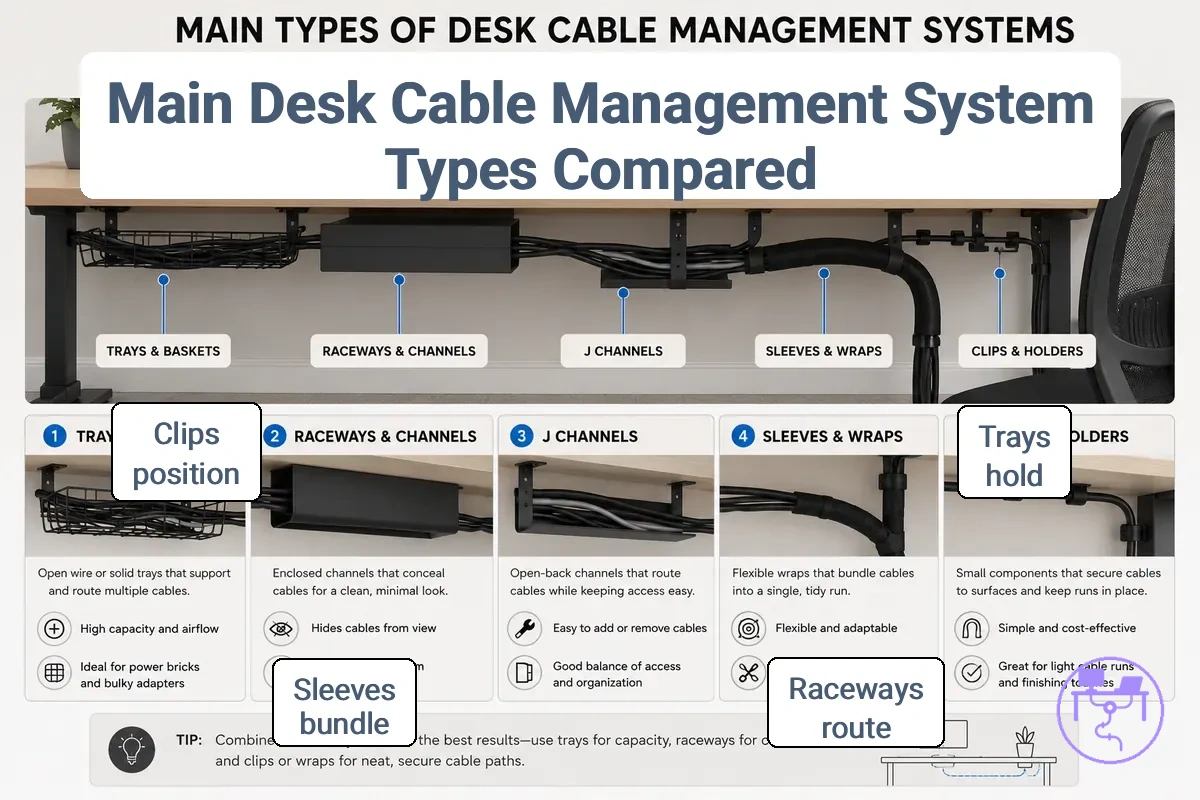
Main types of desk cable management systems are grouped by how they hold, hide, route, or position cables. This grouping creates a clear map of cable-control methods before comparing suitability, access requirements, or desk-specific conditions.
Main types of desk cable management systems can be compared by their physical form and primary use. The image below clarifies these type families and demonstrates how different forms organize cable bundles, conceal cable paths, or keep cords within reach.
| Type Family | Physical Form | Primary Use |
|---|---|---|
| Trays and baskets | Open under-desk holders | Hold grouped cables beneath a desk |
| Raceways and channels | Structured cable pathways | Route and conceal cables along a defined path |
| J channels | Open-sided channel form | Guide cables while allowing easier side access |
| Sleeves and wraps | Flexible cable coverings | Bundle multiple cables into a single run |
| Clips and holders | Cable-positioning devices | Keep individual cables accessible and organized |
Type families define the primary cable-control behavior, while individual variants may differ when access needs, concealment preferences, or routing direction change within a specific desk setup.
Under desk cable trays and baskets
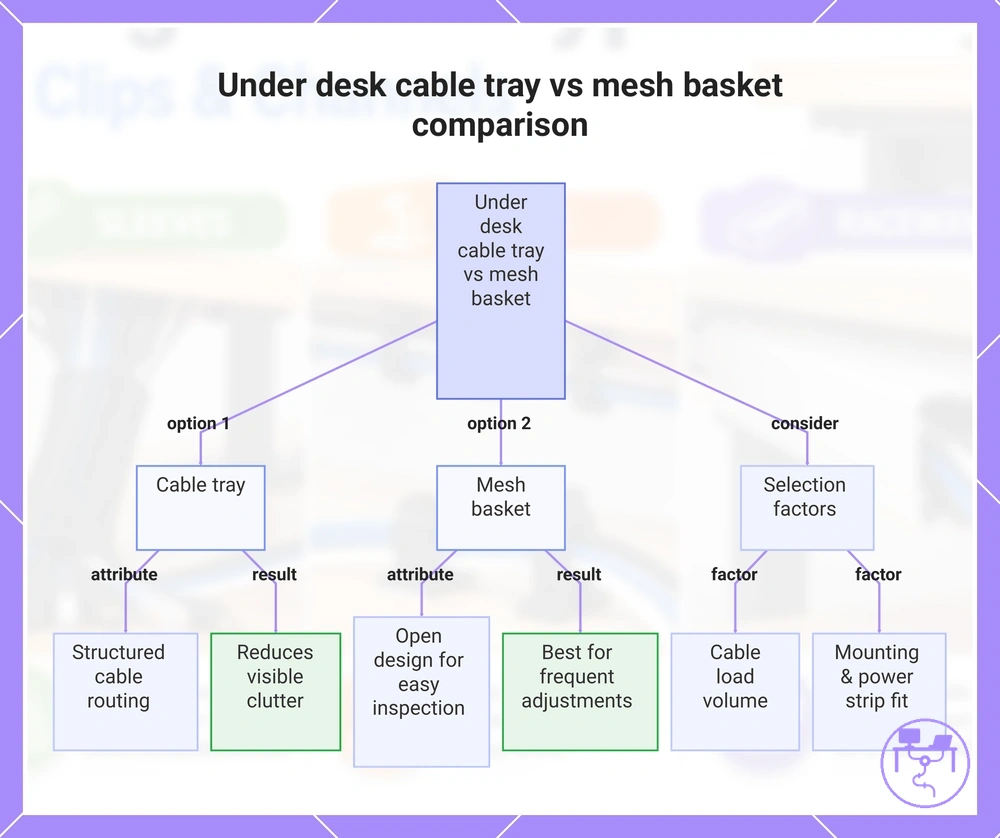
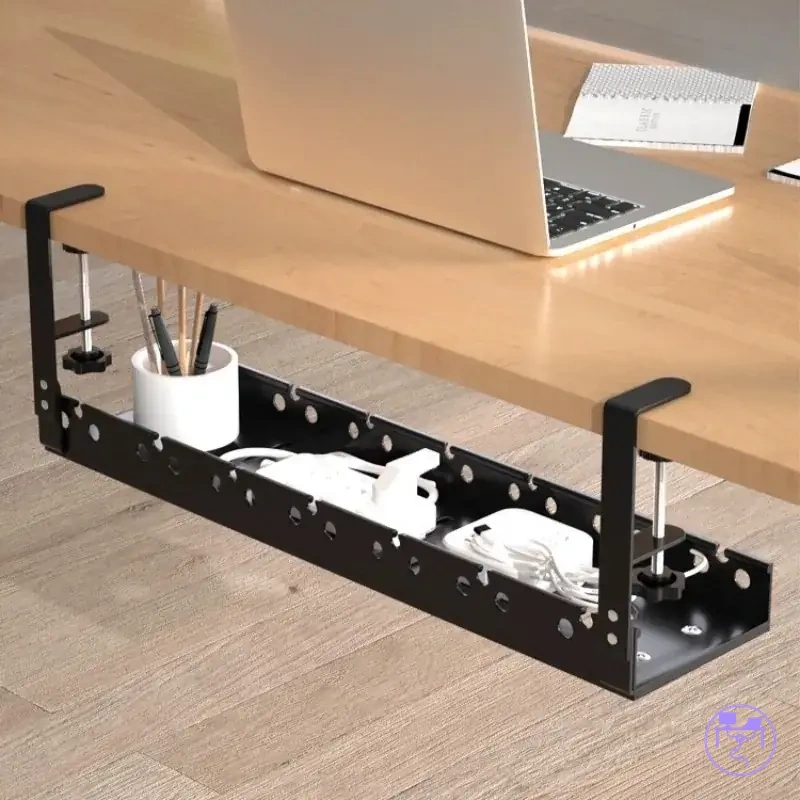
Under desk cable trays and baskets depend on cable load, access needs, and available mounting space. Both types are intended to hold larger cable bundles and power accessories beneath a desk, but the more suitable option often depends on storage requirements, cable-change frequency, and the amount of open access preferred.
- Under desk cable tray: A tray typically provides a structured area for cable organization and may suit setups that benefit from defined cable routing beneath the work surface.
- Mesh basket: A basket uses a more open design that can make cable visibility and access easier when cables are adjusted regularly.
- Metal tray: A metal tray may provide organized cable support, although suitability depends on desk construction, mounting method, and cable load.
- Open storage: Open designs can simplify cable inspection and changes, while less open designs may reduce visible cable clutter under the desk.
- Power strip support: Certain tray and basket designs may accommodate power strips or adapters, but fit and capacity depend on product dimensions and installation conditions.
- Cable load: Larger cable groups often require more storage volume, while lighter cable runs may need less under-desk containment.
Tray capacity, openness, access, and mounting style should be considered together. A tray may suit denser cable organization when structured storage is preferred, while a basket may suit setups where cable accessibility and adjustment are higher priorities.
This chart compares cable trays and mesh baskets for under desk cable management, highlighting their key features and selection factors.
Cable raceways, channels, and J channels
Cable raceways, channels, and J channels depend on how much cable concealment, route control, and access a setup requires. These types guide cables along defined paths and help create cleaner visible edges, but the more suitable option often depends on route direction, cable quantity, desk surfaces, and how frequently cables need to be accessed.
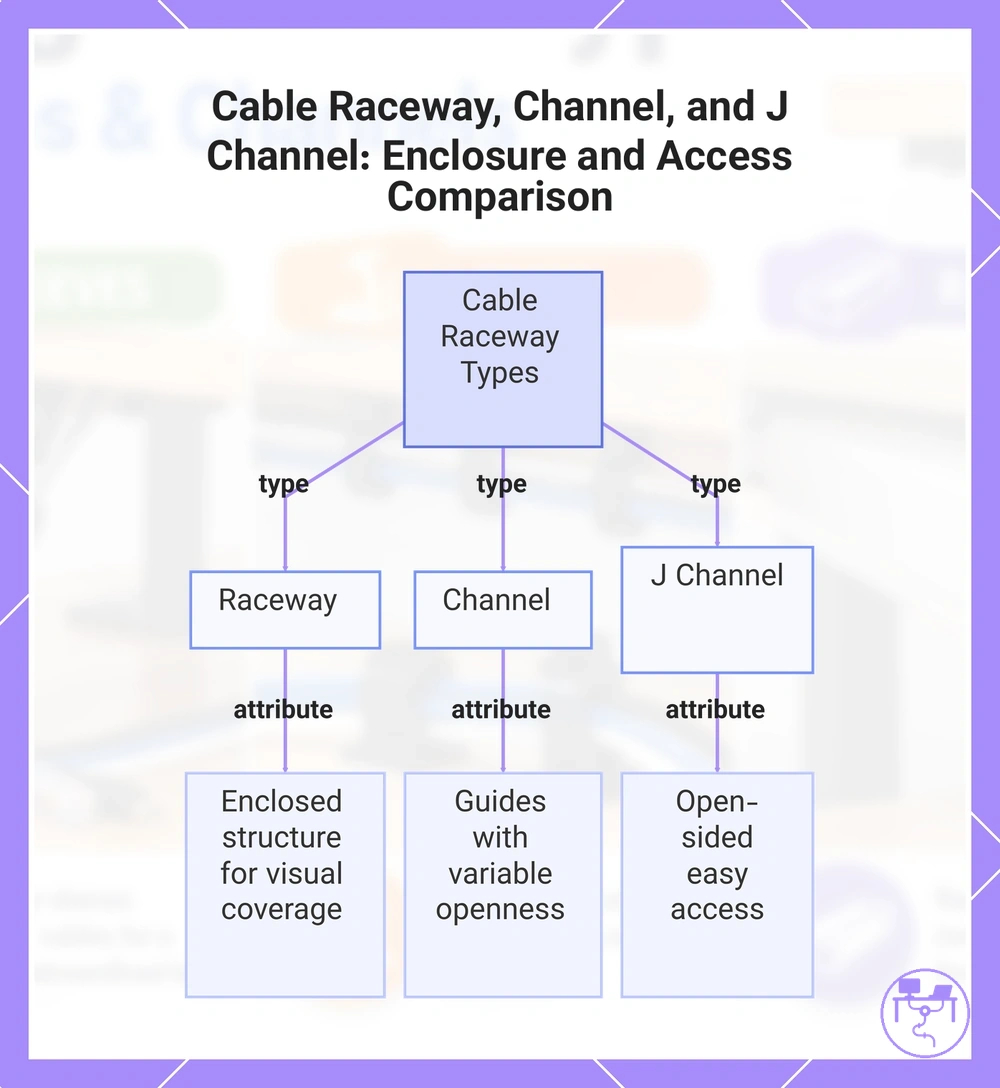
The comparison below separates enclosure and access characteristics. For a broader comparison across cable-routing approaches, compare cable trays raceways sleeves and clips.
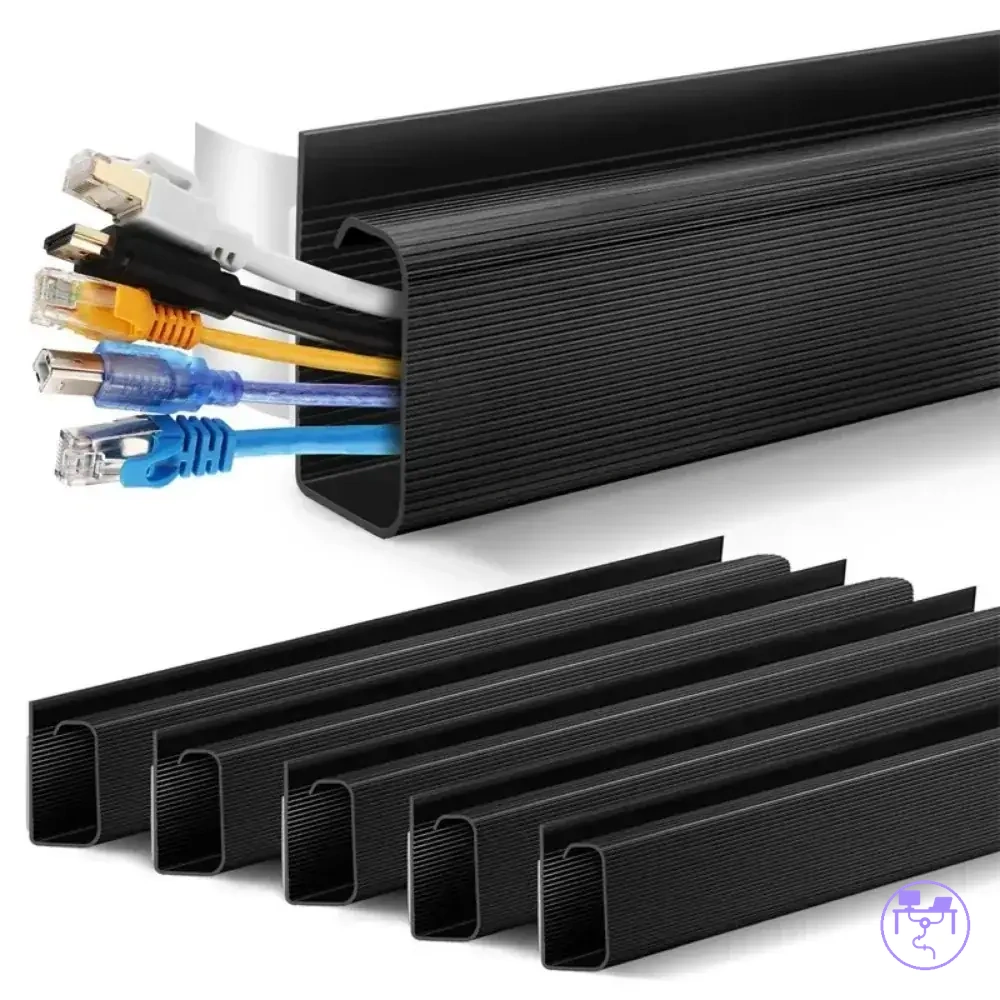
- Raceway: A raceway typically uses a more enclosed structure that can conceal cables along a defined route when visual cable coverage is a priority.
- Channel: A channel guides cables through a designated path and may vary in openness depending on design and access requirements.
- J channel: A J channel uses an open-sided profile that can make cable access easier while still maintaining guided cable routing.
- Mounting style: Adhesive and screw-mounted designs are available, but suitability depends on desk material, surface condition, cable load, and product design.
- Route direction: Straight, vertical, or edge-following cable paths may influence which type provides a cleaner routing arrangement.
- Visual concealment versus access: More enclosed designs may improve cable concealment, while more open designs can simplify cable changes and inspection.
This chart compares the three main types of cable raceways—raceway, channel, and J channel—highlighting their enclosure and access characteristics.
Cable sleeves and wraps
Cable sleeves and wraps depend on cable flexibility, bundle shape, and access requirements. Both types bundle cables along a flexible path and can help organize movable or exposed cable runs, but the more suitable option often depends on whether cable accessibility or a more enclosed appearance is the higher priority.
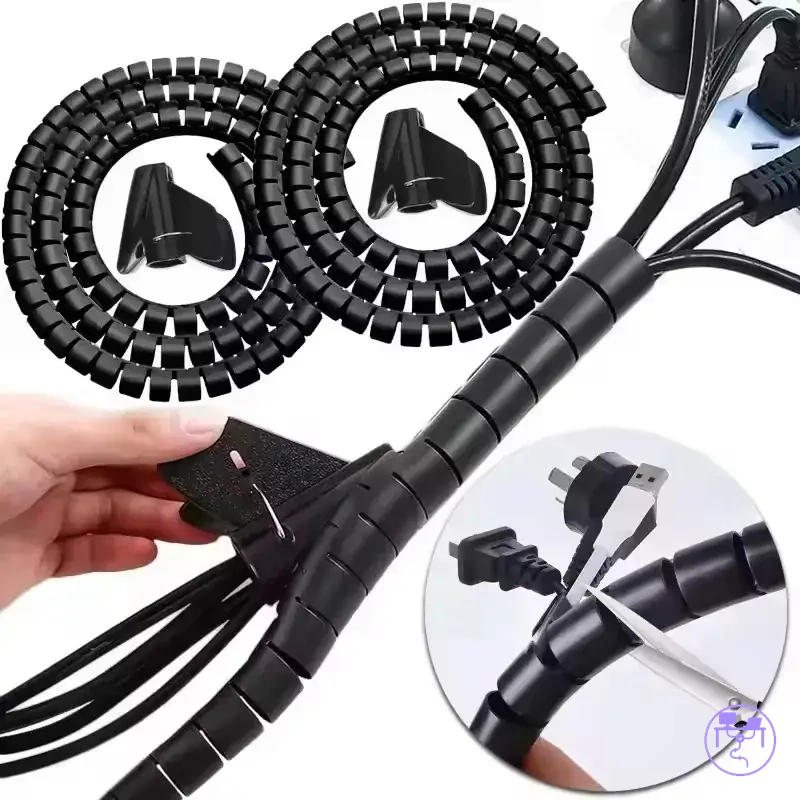
- Zipper sleeve: A zipper sleeve encloses a cable bundle more fully and may provide a neater visible appearance when cable layouts remain relatively stable.
- Split sleeve: A split sleeve allows cables to enter or exit at multiple points and can make adjustments easier when cable arrangements change.
- Wrap-style organizer: A wrap-style organizer secures cables around a bundle and may suit flexible routing where cables move frequently.
- Flexibility: Sleeves and wraps generally follow curved or movable cable paths more easily than rigid cable-routing systems.
- Cable bundle shape: Bundle size and shape can influence how closely a sleeve or wrap conforms to the cable group.
- Visible neatness versus access friction: More enclosed designs may create a cleaner appearance, while designs with easier entry points can reduce the effort needed to add or remove cables.
- Movable or exposed cable runs: Sleeves and wraps are often used where cables remain visible or move with adjustable desks, although they may not replace under-desk storage solutions when larger power accessories require physical support.
Cable clips and holders
Cable clips and holders depend on cable size, mounting surface, removability needs, and access frequency. These types position individual cords or small cable groups rather than managing large bundles, so the more suitable option often depends on whether cable retention, repositioning, or quick access is the primary requirement.
The checklist below highlights the main comparison points for clips and holders.
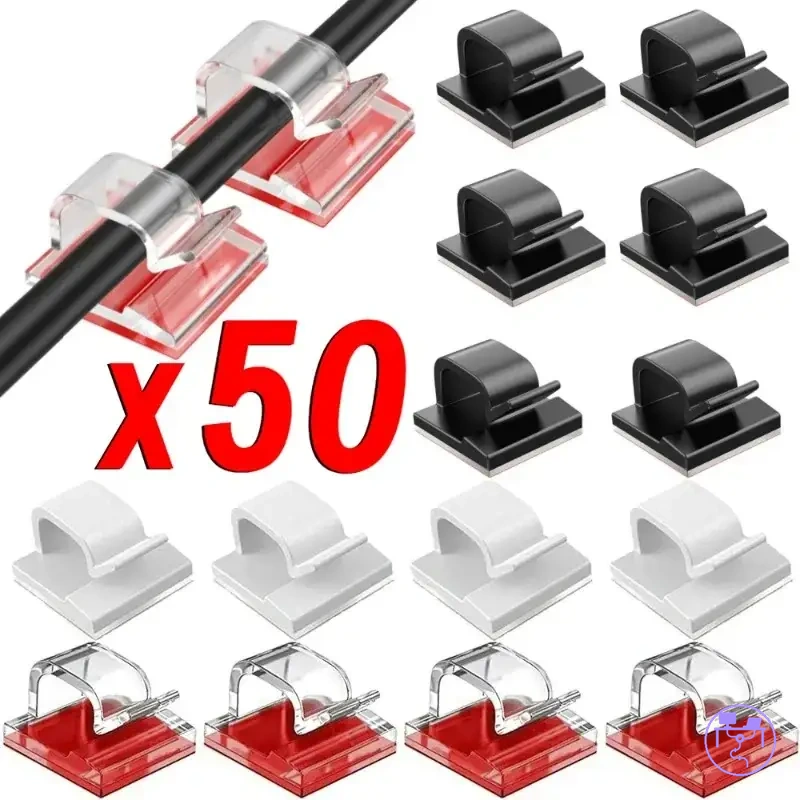
- Adhesive clips: Adhesive clips can allow flexible placement, but holding performance may depend on surface texture, cable tension, heat exposure, dust, and future removal needs.
- Screw clips: Screw clips typically provide a more permanent attachment method when desk modification is acceptable.
- Magnetic holders: Magnetic holders may support easier repositioning when a compatible metal surface is available.
- Edge clips: Edge clips attach along desk edges and can help keep frequently used cords accessible.
- Cable size: Clip and holder suitability often depends on whether the cord diameter matches the intended cable path.
- Single-cord control: Individual cable positioning is often the primary advantage of clips and holders compared with larger cable-management types.
- Light routing: Clips and holders can guide light cable runs, but suitability may decrease as cable weight, bundle size, or routing complexity increases.
- Access frequency: Higher-access setups may benefit from holder designs that allow cables to be removed and replaced with less effort.
How cable management types differ by capacity, access, concealment, and mounting
How cable management types differ by capacity, access, concealment, and mounting depends on cable load, access requirements, visible cable-hiding goals, and available desk space. A type that supports larger cable groups may require more mounting space, while a type that improves accessibility may provide less concealment.
How cable management types differ by capacity, access, concealment, and mounting becomes clearer when the same decision criteria are compared across type categories. The image below compares capacity, access, concealment, mounting conditions, and typical fit scenarios for each cable-management type.
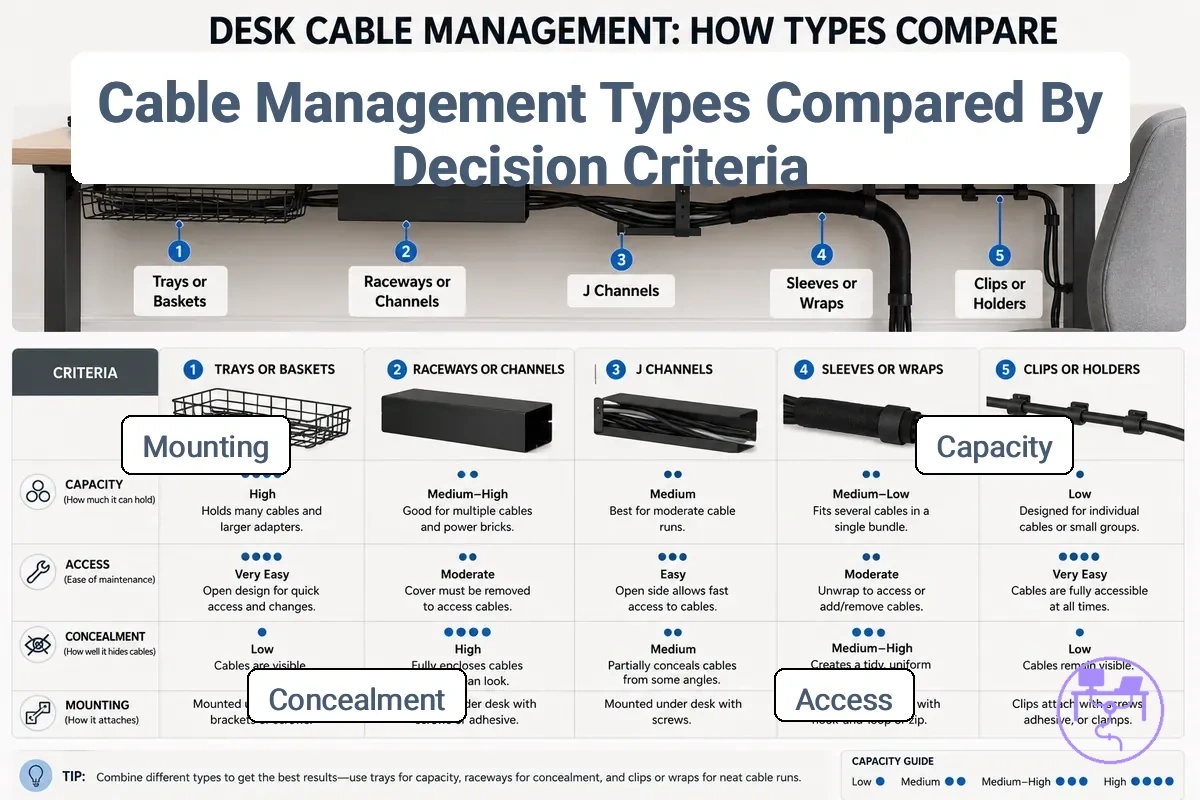
| Type | Capacity | Access | Concealment | Mounting Condition | Best-Fit Outcome |
|---|---|---|---|---|---|
| Tray or basket | Often accommodates larger cable loads and may hold power strips or adapters | Access varies by tray openness and placement | Usually moderate | Typically requires underside desk space and may use screw or clamp mounting | Managing larger cable groups beneath a desk |
| Raceway or channel | Usually suited to routed cable runs rather than bulk storage | Access may decrease as enclosure increases | Often higher | May use adhesive or screw mounting depending on design and surface conditions | Reducing visible cable exposure along a defined route |
| J channel | Typically supports organized cable routing | Usually provides easier cable access than more enclosed pathways | Often lower than enclosed raceways | Depends on desk underside conditions and installation method | Balancing cable access with guided routing |
| Sleeve or wrap | Depends on bundle size and product design | Access may require opening or adjusting the cable bundle | Moderate for exposed cable runs | No desk mounting may be required | Bundling movable or visible cables |
| Clip or holder | Usually suited to individual cords or small cable groups | Often higher | Typically limited | May use adhesive, magnetic, edge-mounted, or fixed attachment methods depending on the surface and design | Positioning frequently accessed cables |
Capacity, access, concealment, and mounting often involve trade-offs. Trays may accommodate larger cable loads but require more underside space, while clips may improve cable access but provide less concealment. The more suitable type depends on which criterion has the greatest influence on the desk setup.
Cable load and power strip capacity
Cable load and power strip capacity depend on cable count, cable thickness, adapter bulk, and the usable space within the cable-management type. As cable volume increases, storage depth, routing width, and support structure can become more important because larger bundles and power accessories may place additional strain on the cable path.
- Light cords: Individual cables or small cable groups may fit within clips, holders, sleeves, or narrow routing paths when cable bulk remains limited.
- Medium bundles: Multiple cables often require more routing space, and bundle thickness can influence whether a channel, sleeve, or tray remains practical.
- Adapters: Adapter bulk may require additional storage volume because larger power accessories can occupy more space than the cables alone.
- Power strips: Power-strip accommodation depends on tray depth, basket openness, available clearance, and product-specific dimensions that should be verified individually.
- Tray depth: Greater tray depth may provide more room for cable bundles or larger accessories, although usable space varies by design.
- Basket openness: A more open basket can make bulky accessories easier to position, inspect, or rearrange.
- Channel width: Channel width influences how easily cables can be routed, particularly when cable thickness or cable count increases.
- Strain risk: Higher cable density or unsupported accessory weight may increase strain on routing paths, mounting points, or cable bends when available space is limited.
Open access versus hidden cable routing
Open access versus hidden cable routing depends on whether easier cable access or stronger cable concealment has a greater influence on the setup. Easier access can simplify cable changes and cleaning, while stronger concealment can reduce cable visibility along the routing path.
- Open trays: Open trays can make cable inspection, cleaning access, and cable adjustments easier because cables remain more visible and reachable.
- Mesh baskets: Basket openness may improve access to cable bundles, adapters, and power accessories when cable layouts change frequently.
- Enclosed raceways: Enclosed raceways often provide greater route concealment, but cable access may require opening the routing path.
- Sleeves: Sleeves can reduce route visibility by grouping cables into a single bundle, although cable changes may require reopening the sleeve.
- Clips: Clips typically keep individual cables accessible and easier to reposition, but they usually provide limited concealment.
- Route visibility: More open designs generally leave cables easier to see, while more enclosed designs can reduce visible cable exposure.
- Cable-change frequency: Frequent cable additions, removals, or rearrangements may favor easier-access designs, while stable cable layouts may place greater value on concealment.
Clamp, screw, adhesive, and magnetic mounting conditions
Clamp, screw, adhesive, and magnetic mounting conditions depend on desk thickness, underside material, surface texture, cable load, and removal tolerance. A mounting method may be suitable only when these conditions align with the desk structure and the weight of the cables or accessories being supported.
- Desk thickness: Clamp-on trays depend on available edge or underside clearance and may require sufficient space for the clamp design.
- Underside material: Screw-mounted trays depend on whether the desk material can accommodate a fixed mounting method.
- Surface texture: Adhesive raceways and adhesive clips may depend on surface condition, texture, and intended cable load.
- Cable weight: Higher cable weight or larger accessory loads may require mounting methods that better match the intended support requirement.
- Removal tolerance: Adhesive-based options may be more suitable when drilling is undesirable, although removal results can vary by surface material and adhesive type.
- Magnetic holders: Magnetic holders depend on the presence of a compatible metal surface and may not suit every desk construction.
- Desk material: Wood, metal, composite, and other desk materials can influence which mounting methods are practical or require additional qualification.
Which cable management type fits different desk situations
Which cable management type fits different desk situations depends on cable volume, access requirements, desk construction, and how visible the cable path should remain. A type that suits one setup may require a different trade-off when cable density, mounting limitations, or adjustment frequency changes.
Which cable management type fits different desk situations becomes easier to evaluate when the desk scenario is matched to the cable problem and the limitations of each type. The image below clarifies these situation-based matches, and it can help select the right cable management type when desk conditions vary.
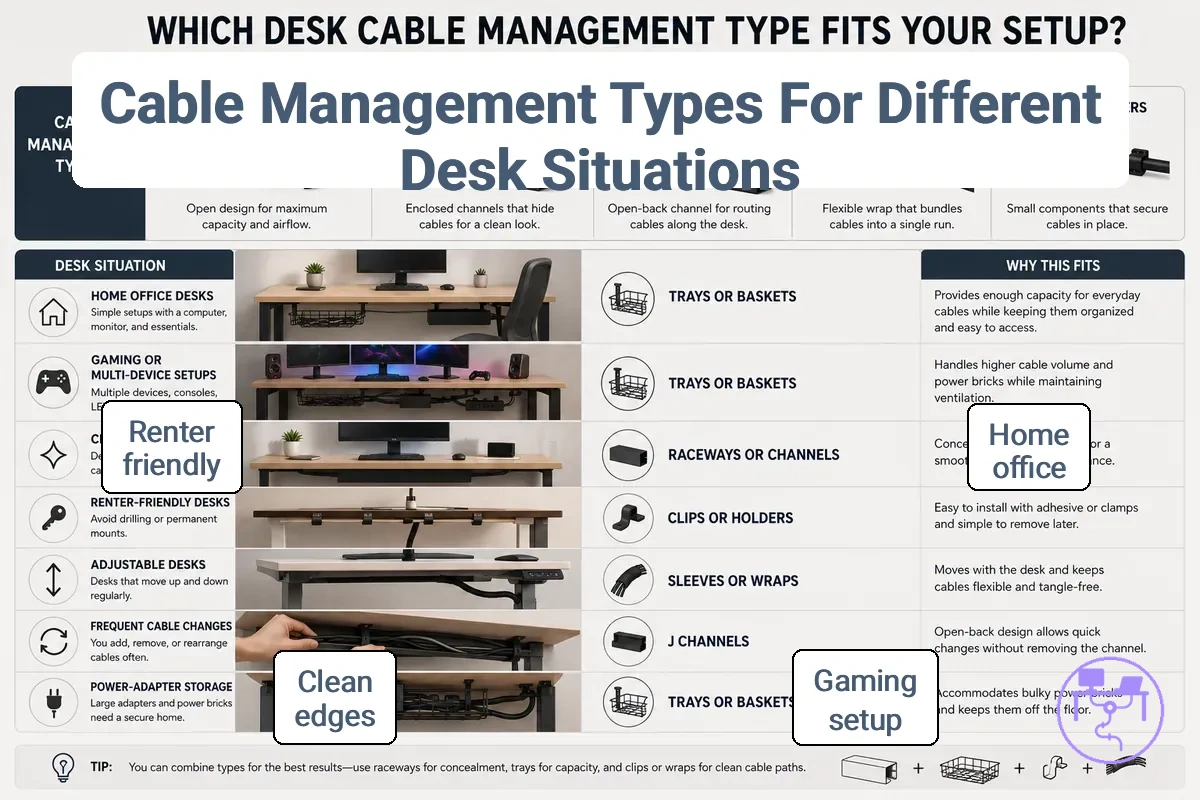
| Desk Situation | Cable Problem | Suitable Type | Main Trade-Off |
|---|---|---|---|
| Home office desk | Moderate cable clutter beneath the work surface | Tray or basket may suit grouped cable organization | Access and concealment depend on openness |
| Gaming or multi-device setup | Higher cable volume and accessory storage needs | Larger trays or baskets may accommodate bundled cables and adapters | May require more mounting space |
| Clean-edge desk | Visible cable routes along desk edges | Raceway or channel may reduce cable visibility | Access may decrease as enclosure increases |
| Renter-friendly desk | Limited tolerance for permanent mounting changes | Adhesive-based routing or clips may be considered when surface conditions allow | Suitability depends on surface and removal requirements |
| Adjustable desk | Moving cable paths | Sleeves or wraps may suit flexible cable runs | Cable changes may require reopening the bundle |
| Frequent cable changes | Regular additions or removals | Open trays, baskets, or clips may improve accessibility | Usually provide less concealment |
| Power-adapter storage needs | Bulky accessories beneath the desk | Trays or baskets may provide additional storage volume | Fit depends on available space and accessory size |
High-cable-load and power-adapter setups
High-cable-load and power-adapter setups depend on cable count, adapter size, power strip presence, and how much cable bulk needs support beneath the desk. Trays, baskets, larger channels, and supportive clips can suit different high-density arrangements, but the more suitable choice often changes with tray capacity, mount strength, airflow needs, and cable-access frequency.
- Tray: A tray may suit larger cable bundles, adapters, or power strips when sufficient capacity and mounting support are available.
- Basket: A basket may suit bulky cable groups when easier access and airflow are preferred over tighter concealment.
- Large channel: A larger channel may suit routed cable runs with higher cable counts, although available internal space can limit suitability.
- Supportive clips: Supportive clips may help guide heavier cable runs and reduce dangling cable sections when paired with another cable-management type.
- Cable count: Higher cable density may favor solutions with greater storage volume or routing space.
- Adapter size: Larger adapters can influence whether a tray, basket, or channel provides enough usable space.
- Power strip presence: Power-strip accommodation depends on available space, mounting conditions, and the dimensions of the selected cable-management type.
- Mount strength: Heavier cable loads may require mounting methods that match the intended support requirement.
- Access frequency: Frequent cable changes may favor more open designs, while stable cable layouts may place greater value on containment.
Clean visible edges and enclosed wire paths
Clean visible edges and enclosed wire paths depend on cable visibility goals, enclosure preferences, and route direction. Raceways, channels, J channels, and sleeves can each reduce exposed cable lines, but the more suitable choice often changes with cable access needs, wall-to-desk routing, surface conditions, and how visible the cable path remains.
- Raceway: A raceway may suit cable runs where greater enclosure and a defined routing path are preferred.
- Channel: A channel may suit organized cable routing when visibility reduction and cable access both matter.
- J channel: A J channel may suit setups that require easier cable access while still limiting visible cable exposure.
- Sleeve: A sleeve may suit exposed cable runs by grouping multiple cables into a more unified cable path.
- Edge routing: Edge routing may suit desks where cables follow visible desk borders and benefit from guided positioning.
- Wall-to-desk transitions: Enclosed routing options may help organize cables that travel between wall areas and the desk surface.
- Adhesive surfaces: Adhesive-mounted options depend on surface condition, texture, and the intended cable load.
- Color matching: Color-matched routing components may reduce visual contrast when cable-management parts remain visible.
Quick-access cables and single-cord control
Quick-access cables and single-cord control depend on access frequency, cable movement, and how easily a cord needs to be removed or repositioned. Clips, holders, small channels, and sleeve exits can help keep individual cables reachable, but the more suitable choice often changes with cable slack, grip requirements, surface placement, and removal needs.
- Charging cables: Cable holders may suit charging cords that are connected and disconnected frequently when easy reach is a priority.
- Laptop power leads: Clips or small channels may help guide power leads when regular access is needed but cable movement remains limited.
- Headset cables: Holders may suit headset cables that benefit from a dedicated resting position between uses.
- Keyboard cables: Small channels or clips may help control cable slack while keeping the cable path accessible.
- Temporary accessories: Removable clips may suit accessories that are connected when needed and removed afterward.
- Access frequency: Higher access frequency may favor holders or clips that allow easier cable retrieval and replacement.
- Cable movement: Frequently moved cables may benefit from routing methods that reduce tension during repositioning.
- Grip strength: Clip suitability depends on cable size, retention needs, and how firmly the cable should remain in place.
- Surface placement: Placement location can influence whether a holder, clip, channel, or sleeve exit remains easy to reach.
- Cable slack: Controlled slack may help keep excess cable available without creating long exposed loops on the desk surface.
Material and form trade-offs across cable management types
Material and form trade-offs across cable management types depend on cable load, access needs, desk surface conditions, and how often the setup changes. Metal, mesh, plastic, fabric, and adhesive-backed forms can each provide different value conditions, but durability, removability, and long-term usefulness often vary with product quality, installation method, and use intensity.
Material affects structural support and long-term adjustment potential, while form affects cable access, routing flexibility, and removal effort. The practical trade-off is usually less about a material being universally better and more about whether its strengths match the intended cable-management task.
| Material or Form | Practical Strength | Limitation | Suitable Use Case |
|---|---|---|---|
| Metal tray or channel | May support larger cable loads | Removal or repositioning can require more effort | Higher cable-density setups |
| Mesh basket | Often provides easier cable access | Usually offers less enclosure | Frequent cable adjustments |
| Plastic raceway or channel | May reduce visible cable exposure | Suitability depends on mounting conditions and cable load | Defined cable-routing paths |
| Fabric sleeve | Can group cables into a flexible bundle | Adding or removing cables may require reopening the sleeve | Movable cable runs |
| Adhesive-backed form | May avoid permanent desk modification | Removal results depend on surface condition and adhesive type | Surface-mounted cable routing |
Load tolerance, access, and removability often influence long-term adjustability more than material alone. For a broader interpretation of related desk cable management cost factors, material value should be judged against desk fit, cable volume, and expected adjustment frequency.
Perceived value depends on how well material and form align with desk conditions, cable load, and future changes. A durable-looking form may still be less useful when access is difficult, while an easier-to-remove form may trade structure for flexibility.
The products below are useful examples for comparing available options. Before buying, check that the compatibility criteria, key features, and product details match your needs.
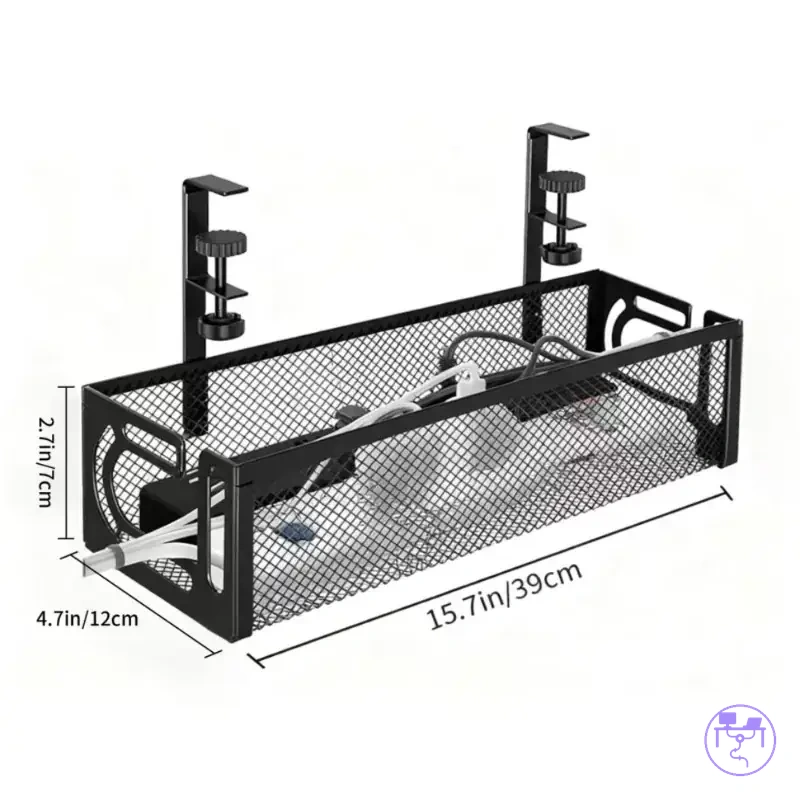
Metal, mesh, plastic, and fabric organizers
Metal, mesh, plastic, and fabric organizers change cable-management behavior because material affects strength, flexibility, appearance, airflow, and cable access. The better material depends on cable weight, desk style, surface conditions, and removal needs.
| Material or Form | Practical Effect | Limitation | Suitable Use Case |
|---|---|---|---|
| Metal tray | May provide stronger support for heavier cable groups | Stiff form can be less flexible during repositioning | Under-desk cable loads that need structured support |
| Mesh basket | Can improve airflow, visibility, and cleaning access | More open form may expose cables visually | Setups that need access to bundles or adapters |
| Plastic raceway | May create a cleaner enclosed wire path | Durability and fit depend on product quality and cable load | Visible edge routing or defined cable paths |
| Fabric sleeve | Can follow flexible cable runs and soften the visible bundle | Access may require opening or adjusting the sleeve | Movable or exposed cable groups |
| Adhesive plastic | May allow surface-mounted routing without screws | Attachment and removal depend on surface texture and load | Light routing where surface modification is limited |
Durability, removal risk, and long-term adjustability
Durability, removal risk, and long-term adjustability depend on cable load, desk surface conditions, installation method, and how often the cable layout changes. A cable-management type may provide better long-term value when its material, mounting method, and access level remain suitable after the initial setup.
- Permanent options: Screw-mounted systems may provide stable positioning, but removal can require additional effort and may leave visible screw holes depending on the desk material.
- Semi-permanent options: Clamp-mounted systems can allow repositioning, although clamp pressure and desk-edge conditions may influence long-term suitability.
- Removable options: Adhesive-based routing can simplify installation, but adhesive residue, surface compatibility, and removal outcomes may vary by product type and desk finish.
- Material fatigue: Durability can depend on material quality, cable weight, repeated adjustments, and overall use intensity.
- Cable-change frequency: Frequent cable additions or removals may favor solutions that provide easier access and adjustment.
- Desk surface risk: Removal risk depends on the mounting method, surface condition, finish type, and installation duration.
- Replacement effort: A system that is easier to adjust may reduce the effort required when cable layouts change, although this can involve trade-offs in structure or enclosure.
When combining cable management types works better than using one type
When combining cable management types works better than using one type depends on whether a single organizer can manage both cable storage and cable routing needs. A combined setup may solve separate cable problems more effectively when bulk storage, cable exits, visible edges, and access points require different forms of control. For broader context, the desk cable management system hub explains how these related functions fit within a complete cable-management approach.
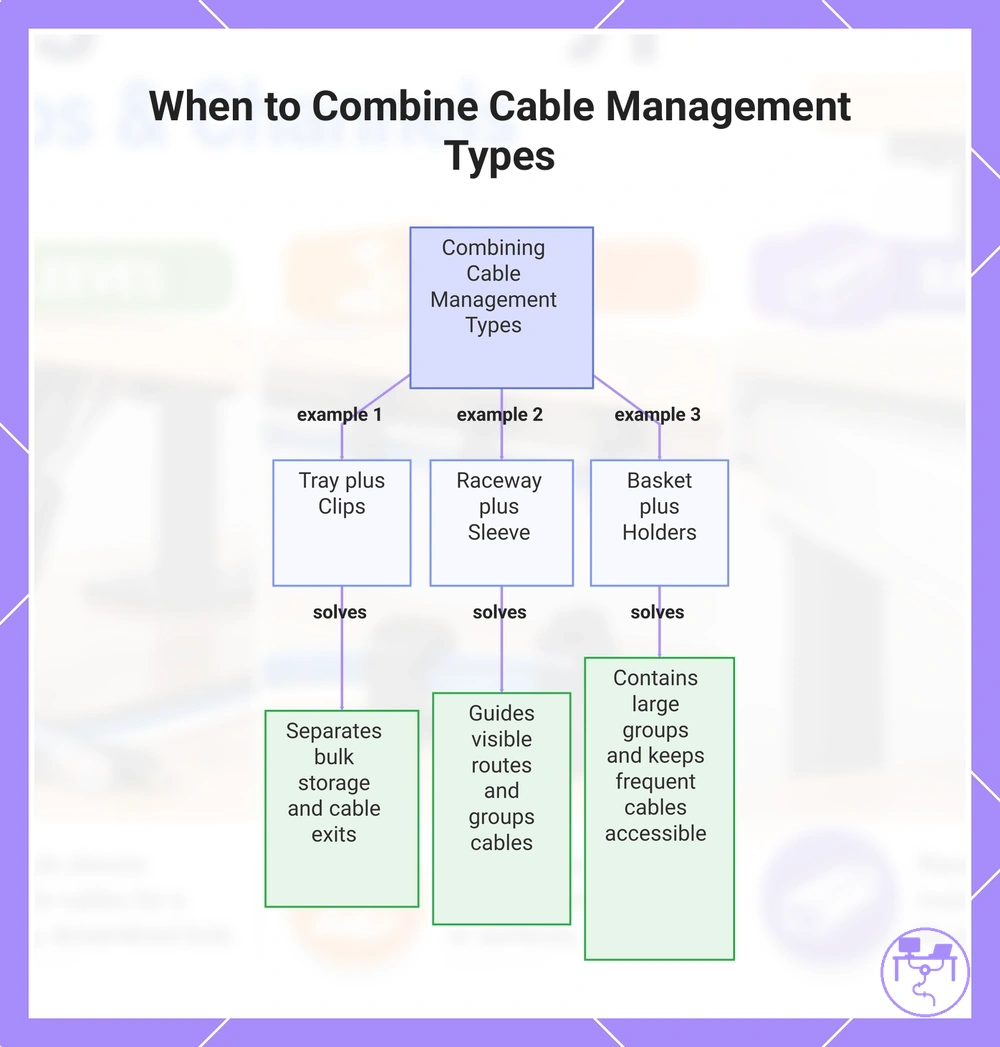
Tray plus clips: A tray may manage bundled cables, adapters, or power accessories beneath the desk, while clips may control cable exits at the desk edge. This combination can suit setups where bulk storage and quick cable access need separate solutions. Raceway plus sleeve: A raceway may guide visible cable routes along a defined path, while a sleeve may group cables before they enter or exit that path.
Basket plus holders: A basket may contain larger cable groups beneath the desk, while holders may keep frequently used cables accessible at specific access points. Combined setups may provide more flexibility when cable slack, visibility, and accessibility require different forms of management. Suitability still depends on mounting conditions, cable load, desk surface characteristics, and how often the cable layout changes.
The products below are useful examples for comparing available options. Before buying, check that the compatibility criteria, key features, and product details match your needs.
This chart shows three combined cable management setups and what each solves.
Common decision questions about desk cable management types
What type works best for heavy cable bundles?
Heavy cable bundles usually need a tray or basket when underside space and mounting support are available. Fit still depends on cable load, adapter size, desk material, and how much access is needed.
Which type keeps cables most accessible?
Clips, holders, open trays, and mesh baskets usually keep cables more accessible. These types may expose more cable length than enclosed raceways or channels.
Can one cable management type handle every desk setup?
One cable management type rarely handles every desk setup equally well. Bulk storage, route concealment, cable exits, and quick access often require different forms or combined types.
Should renters avoid screw-mounted cable management?
Renters may prefer non-permanent options when desk modification is not acceptable. Adhesive, clamp, clip, or sleeve-based options may be considered, but surface condition and removal risk still matter.
Does an enclosed raceway reduce cable access?
An enclosed raceway can reduce cable access when cables need frequent changes. It may suit stable visible routes better than setups where cords are often added, removed, or repositioned.
When are sleeves better than trays?
Sleeves are usually better when the main problem is bundling a visible or movable cable run. Trays are usually more suitable when cables, adapters, or power accessories need under-desk storage.
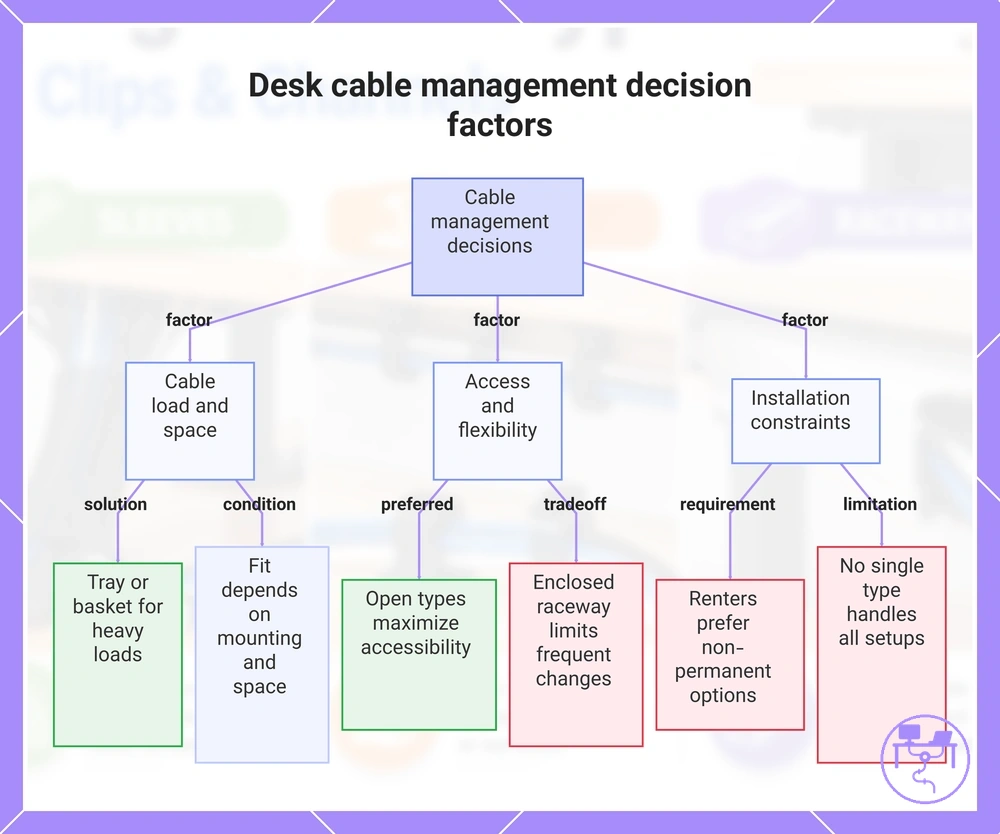
This chart shows the key factors to consider when choosing a desk cable management type, including cable load, access needs, and installation constraints.