
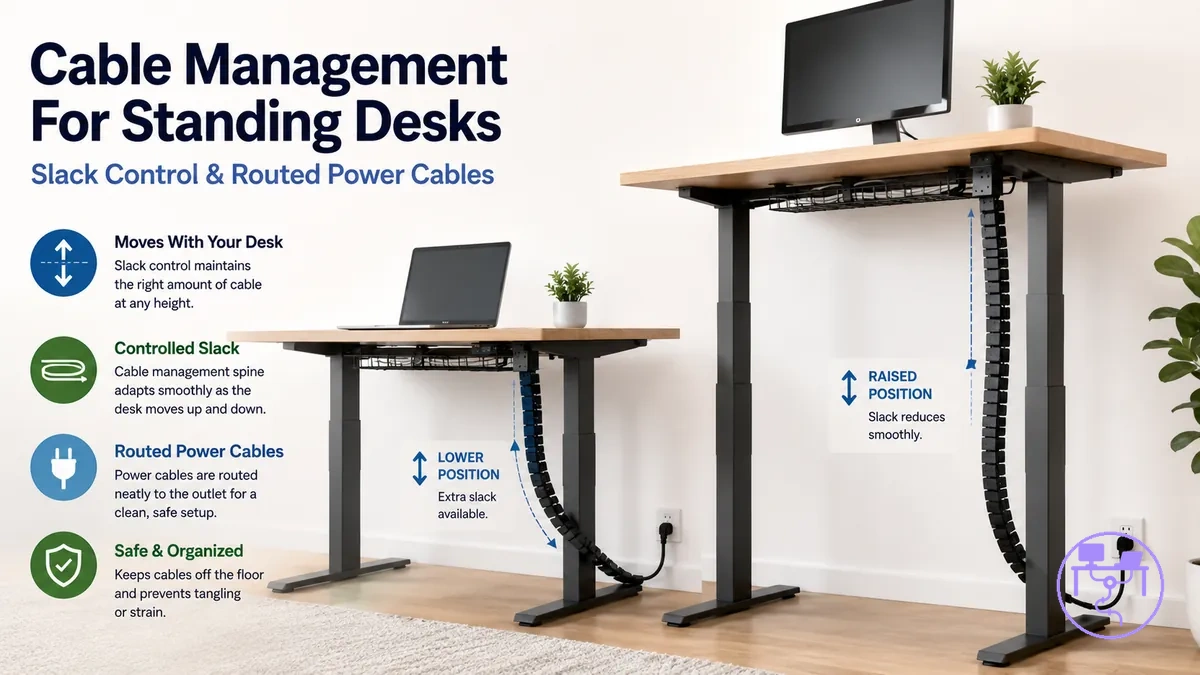
Standing Desk Cable Management System for Height-Adjustable Desks
A standing desk cable management system depends on movement range, cable slack, power routing, mounting space, cable load, and frame clearance. A height-adjustable desk changes position, so the cable path must move without pulling connectors, blocking frame parts, or leaving cords unsupported. Movement is the core difference.
At sitting height, a cable bundle may look controlled. At standing height, the same bundle may need more vertical travel. If the power cord, monitor cable, or adapter cable is too tight, the setup can create strain. That is why slack and power routing need to be checked together.
Standing desk cable management is the decision frame for matching a desk cable management system to a moving desk. A cable spine can guide vertical movement, an under-desk tray can group cords near the desktop, and sleeves or clips can support grouped routing when access is still needed. The right setup depends on desk frame shape, cable length, device load, outlet reach, and available mounting surface before the first compatibility factors are reviewed.
For a height-adjustable desk, selection should focus on whether the system can keep cables grouped, reachable, and able to travel with the desk. Fixed-desk organization may only tidy cords, while moving-desk compatibility must account for cable slack, strain relief, frame clearance, and the power path toward the outlet.
What Makes Cable Management Different on a Standing Desk
What makes cable management different on a standing desk is that the desktop moves while connected devices and the wall outlet usually remain in fixed positions. A fixed desk mainly needs cable organization, but a standing desk must also account for height travel, moving cords, and controlled cable movement. The key difference is managing movement without increasing the risk of cable pulling or dangling.
What Makes Cable Management Different on a Standing Desk becomes clearer when the cable paths for a fixed desk and a standing desk are viewed together. The image compares how vertical slack, frame clearance, and a moving desktop affect cable routing.
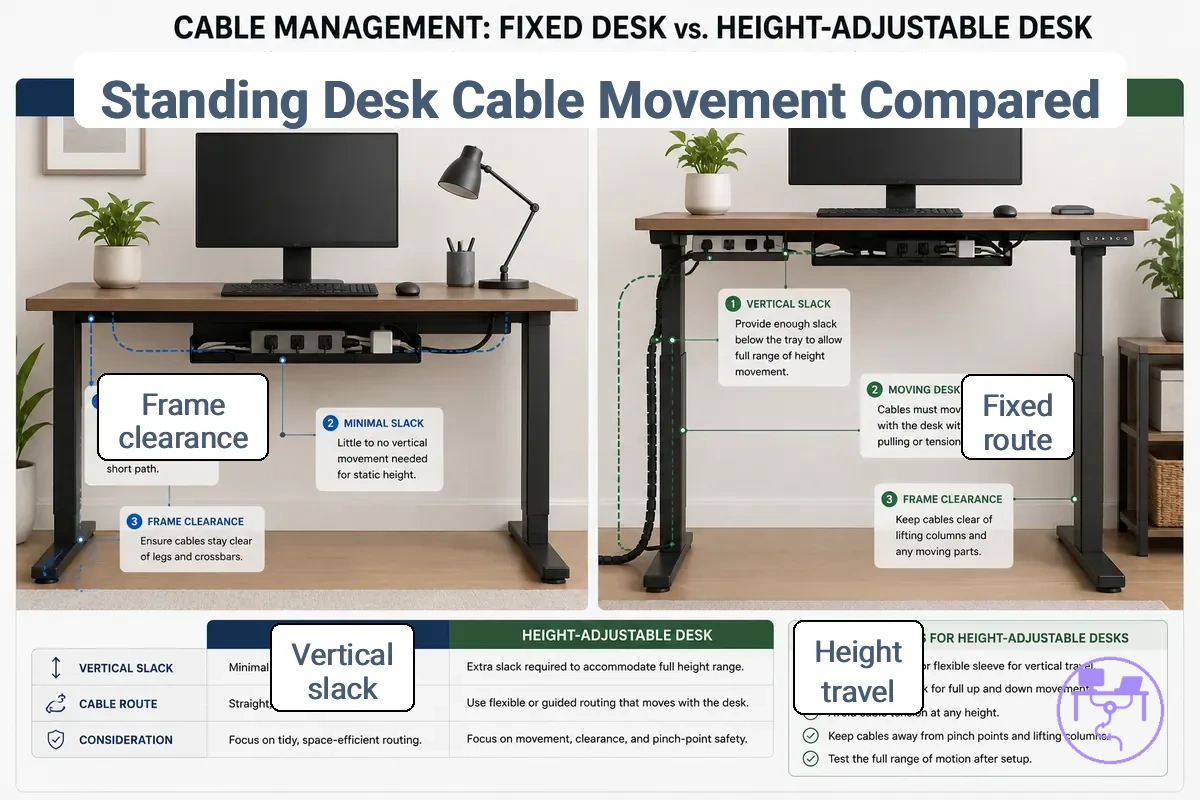
A standing desk may need additional cable travel because the desktop changes position. If cable length, outlet position, mounting surface, or device load changes, the amount of vertical slack needed may also change. Moving cords can pass near moving parts, so frame clearance may influence routing decisions. For broader context around cable organization principles, see the desk cable management system guide. A fixed-desk organizer may still be suitable when it can accommodate movement safely rather than only securing cables in a static position.
The comparison below highlights what changes when a desktop moves and what remains similar to fixed-desk cable organization.
| Fixed Desk | Standing Desk |
|---|---|
| Cable routes usually remain in the same position. | Cable routes move during height travel. |
| Limited need for vertical slack. | Vertical slack may be needed to support movement. |
| Frame movement is usually not a routing concern. | Frame clearance may affect cable routing decisions. |
| Focuses mainly on cable organization. | Focuses on both organization and movement compatibility. |
Movement Range and Cable Slack Planning
Movement range and cable slack planning depend on how far a standing desk travels between its lowest and highest positions. As height travel increases, the cable bundle may need additional cable slack to move without placing stress on connectors or routing points. The goal is to support cable travel while reducing the risk of cable pulling and strain relief problems.
Movement Range and Cable Slack Planning becomes easier to evaluate when the entire cable path is viewed across the desk's full height travel. The diagram shows how a service loop, power cord path, and potential strain point can change between sitting and standing positions.
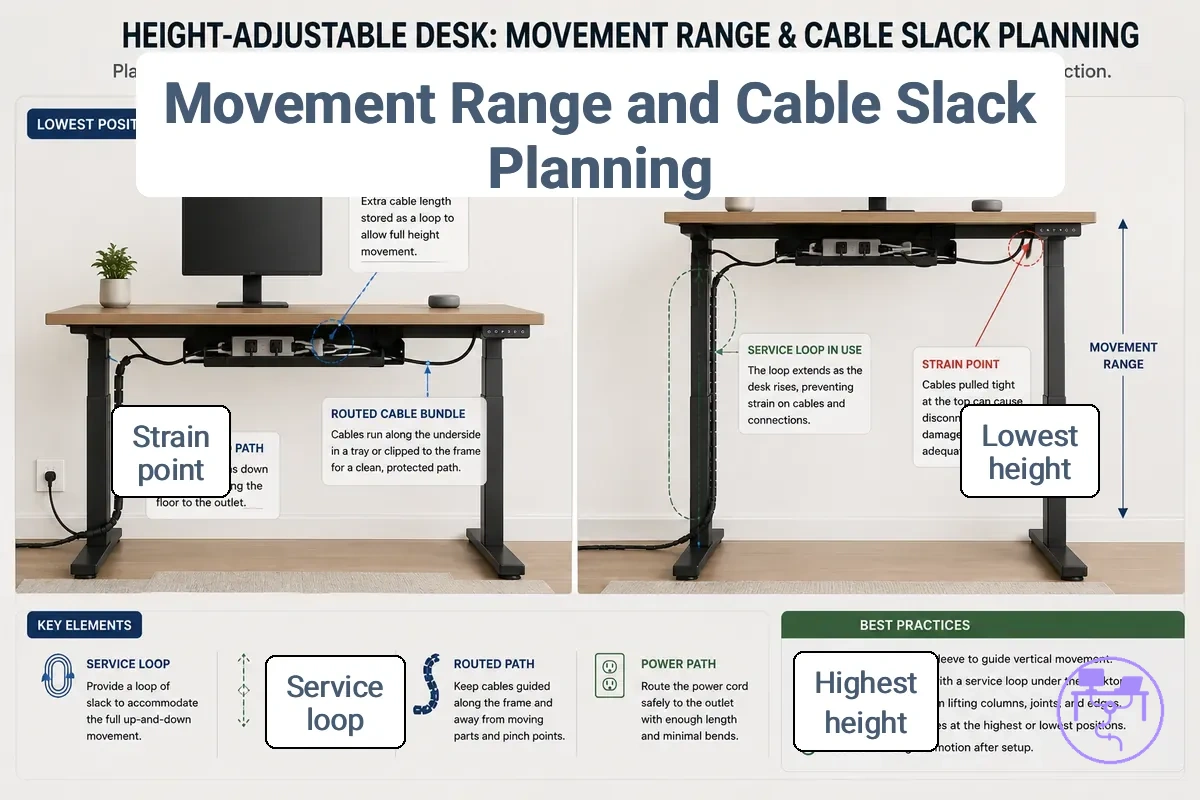
A cable bundle should be assessed across the full movement range rather than at a single desk height. If a power cord runs to a wall outlet, the required cable slack may differ from a setup that uses a mounted power strip. Monitor cables and adapter cords can create different routing needs depending on cable length and cable path. A service loop may help distribute cord movement, while strain relief can reduce connector stress when cables move repeatedly.
The checklist below highlights conditions that can influence cable slack planning and compatibility decisions.
- If height travel is large relative to available cable length, cable pulling may become a routing risk.
- If a service loop is too small for the cable path, connector stress may increase during desk movement.
- If a floor-to-desk cable spans a longer route, additional cable slack may be needed to support cable travel.
- If a wall outlet is positioned away from the desk path, the power cord route may affect slack planning.
- If a mounted power strip moves with the desk, cable travel requirements may differ from a fixed outlet connection.
- If a cable bundle passes near moving desk components, strain relief and routing decisions may require closer attention.
Full-height travel and cable length
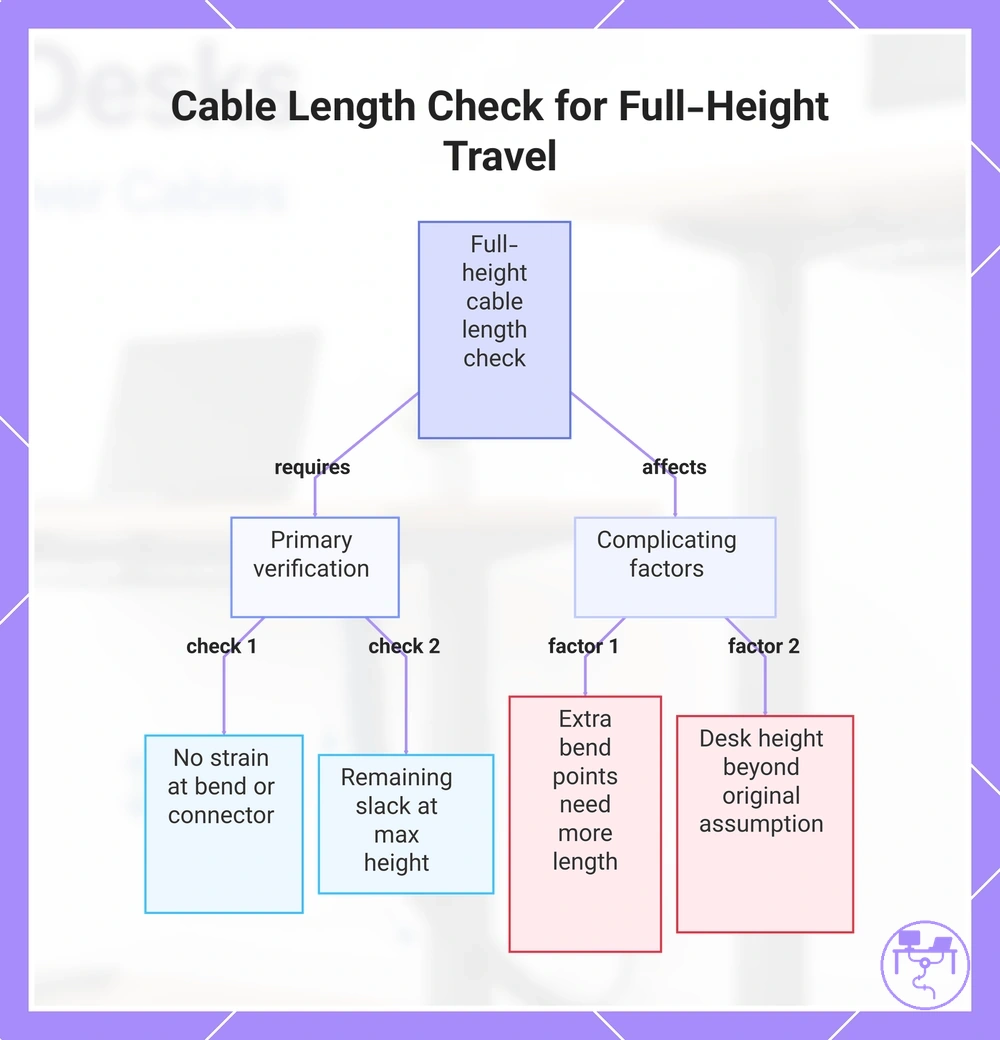
Full-height travel and cable length should be checked at the desk’s highest position before final routing decisions are made. A cable that reaches comfortably in the sitting position may have less remaining slack at maximum height. The key sizing check is whether the cable route can complete the full travel distance without creating strain at a bend point or connector.
Desk height, cable route, and cord length work together when evaluating reach. If the cable route includes multiple bend points, more cable length may be needed than a shorter path with fewer direction changes. Remaining slack should still be present at the highest position because cable movement can change as the desk travels between sitting and standing positions.
Full-height travel and cable length are easier to verify when each sizing condition is reviewed before cables are secured.
- If the highest position reduces remaining slack significantly, cable length may need further review before routing.
- If the cable route includes extra bend points, cord reach may be reduced along the travel path.
- If desk height increases beyond the original routing assumption, full-height travel may change cable length requirements.
- If remaining slack disappears at maximum height, strain may develop near connectors or routing points.
- If a cable reaches the standing position with limited flexibility, the cable route may need adjustment before final placement.
This chart shows the key conditions and complicating factors for verifying cable length at the highest desk position.
Service loop control and strain relief
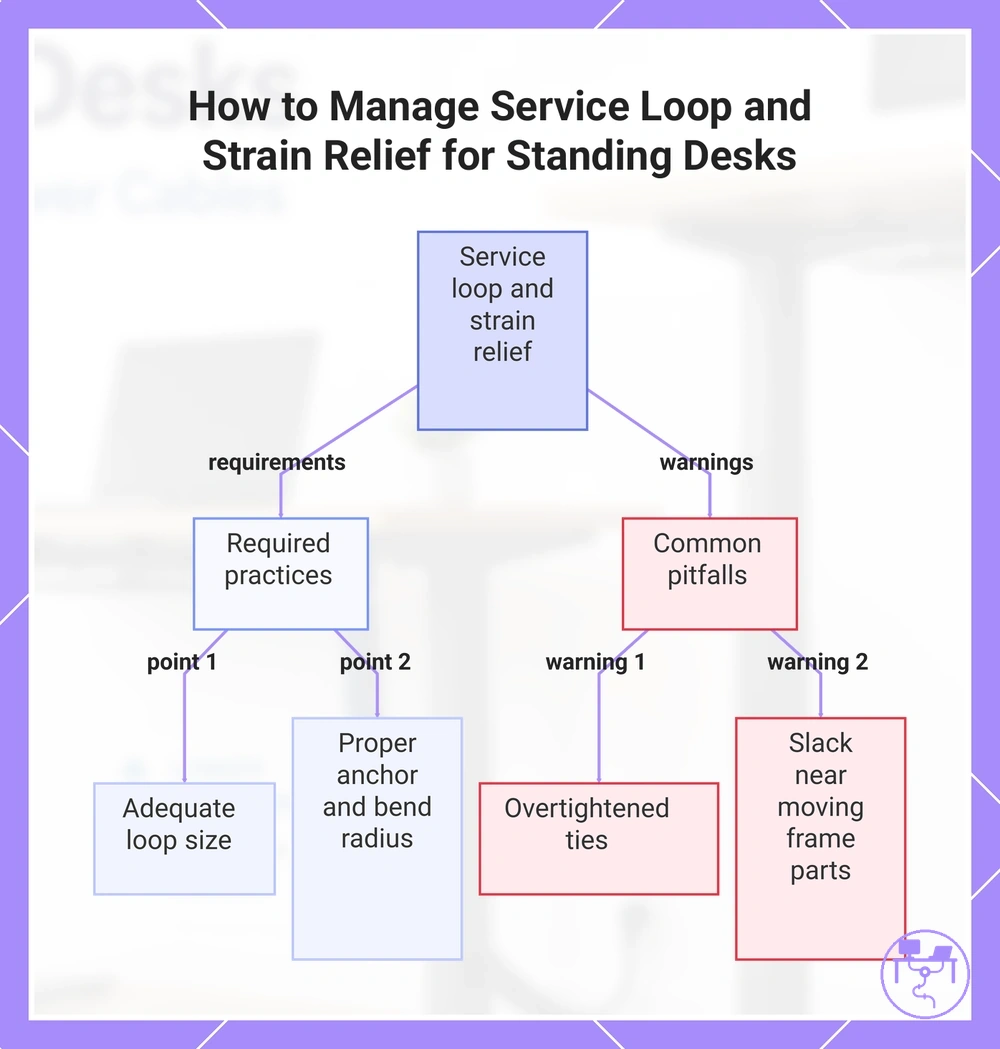
Service loop control and strain relief depend on keeping enough extra cable length for movement without letting the slack sag or tangle. A service loop can reduce cable pulling when the desk changes height, but the loop still needs a clear anchor point and a controlled path. Fit depends on the desk frame, cable length, bend radius, and connector position.
A service loop should give the cable bundle room to move while keeping connector stress low. If clips or ties are too tight, the cable may lose flexibility at a bend point. If anchor points are too loose or poorly placed, slack may drop into the movement path and create a snagging risk.
Use the points below to control slack without treating one loop shape as suitable for every standing desk setup.
- Do keep the service loop large enough for movement, but avoid loose slack that can sag below the desk.
- Do place an anchor point where the cable can move without pulling directly on the connector.
- Do check bend radius near clips and ties so the cable path does not become sharply pinched.
- Avoid overtightening ties because restricted movement may increase connector stress during height changes.
- Avoid placing the slack loop near moving frame parts where cable relief can become a snag point.
This chart shows the key requirements and common pitfalls for controlling cable slack and strain relief in a standing desk setup.
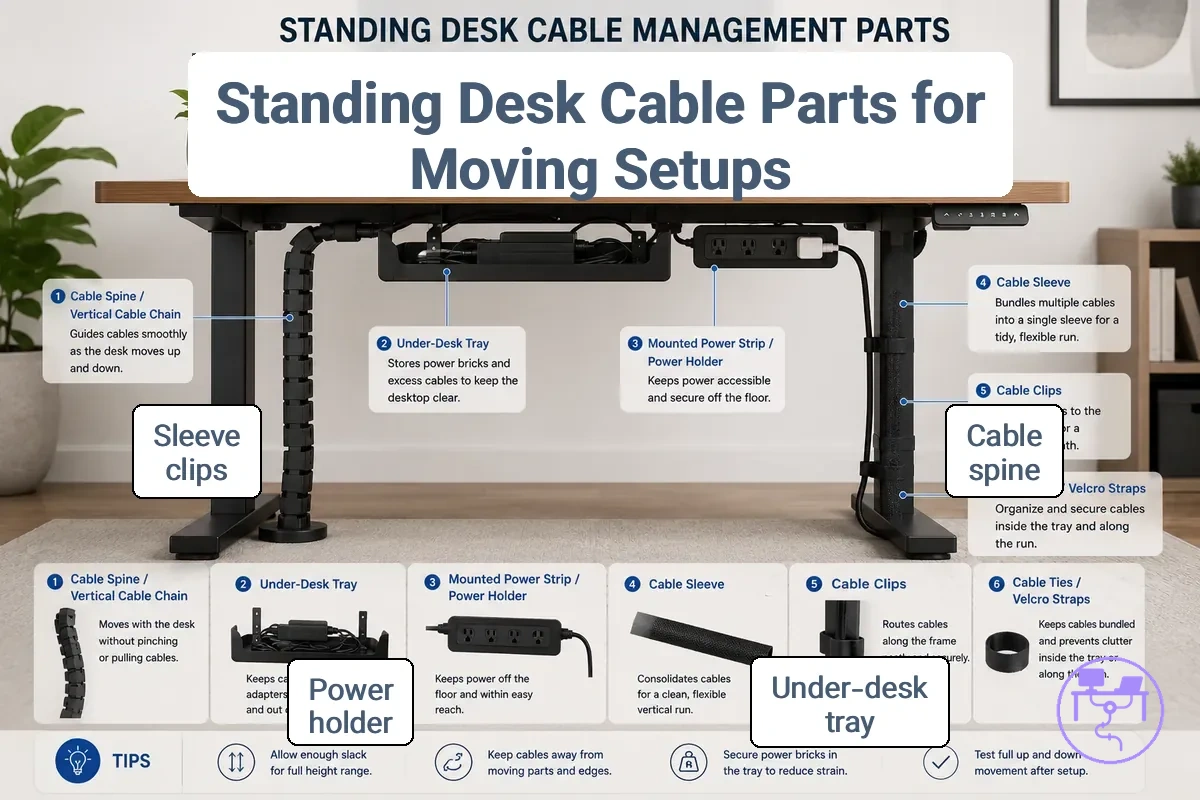
Standing Desk Cable Management Parts for Moving Setups
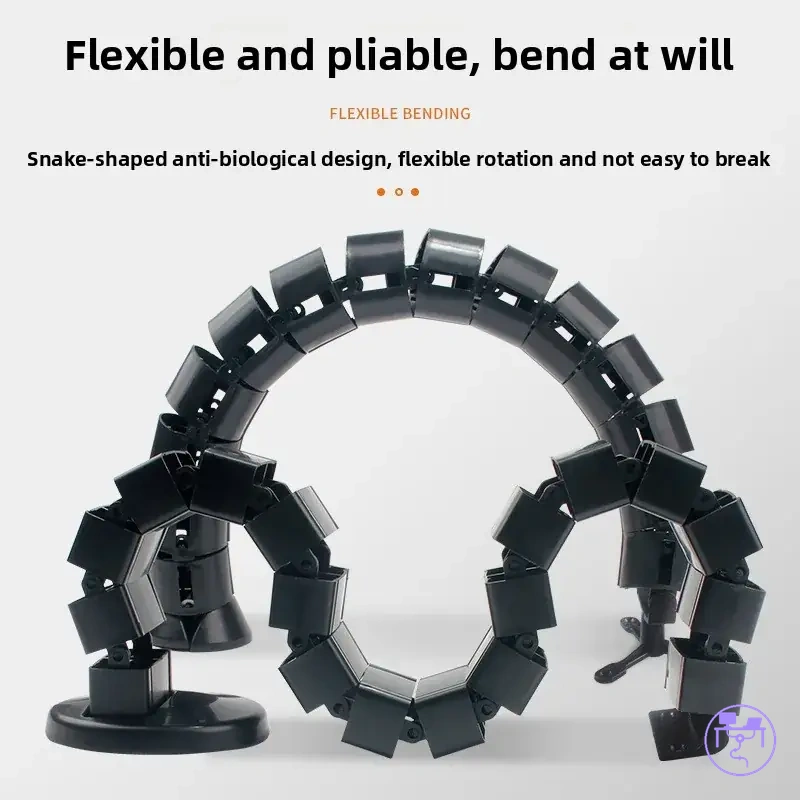
Standing Desk Cable Management Parts for Moving Setups include components that support cable movement, group related cords, or hold routing paths in place during desk travel. A cable spine or vertical cable chain helps manage cable movement between the floor and a moving desktop, while an under-desk tray and power strip holder can keep connected cables closer to the desk. Other parts focus on cable grouping and access rather than vertical movement support.
Standing Desk Cable Management Parts for Moving Setups vary by cable route, desk movement, and mounting conditions. A cable spine or vertical cable chain may be useful when cables need controlled vertical travel. An under-desk tray can group cords and adapters near the work surface. A power strip holder may reduce cable travel between connected devices and power connections when mounted to the desk. A cable sleeve, clips, and ties can help organize grouped cords, though they usually provide routing control rather than movement support.
Standing Desk Cable Management Parts for Moving Setups become easier to evaluate when the visible components are identified by function. The image labels the main parts used to guide movement, hold power connections, and organize cable paths on a height-adjustable desk.
The table below organizes cable organizer parts by movement role, suitable conditions, and common limitations.
| Part | Movement role | Best condition | Limitation |
|---|---|---|---|
| Cable spine | Guides vertical cable travel | Floor-to-desk cable routes | May not group all desktop cables |
| Vertical cable chain | Controls cable movement path | Frequent desk height changes | Fit depends on cable volume and routing |
| Under-desk tray | Groups cords near desktop | Multiple connected devices | Limited vertical movement support |
| Power strip holder | Keeps power connections attached to desk | Mounted power distribution | Depends on mounting space |
| Cable sleeve | Bundles cables together | Shared cable paths | May reduce quick cable access |
| Clips | Holds cable route in place | Defined routing points | Limited grouping capacity |
| Ties | Secures grouped cords | Cable bundle management | Can limit access if overtightened |
A useful decision signal is whether a part manages movement or mainly organizes routing. Cable spines and vertical cable chains primarily support vertical travel, while trays, cable sleeves, clips, and ties mainly support grouping and access. The appropriate combination depends on cable travel needs, device load, mounting surface, and cable access requirements.
Cable spines and vertical cable chains
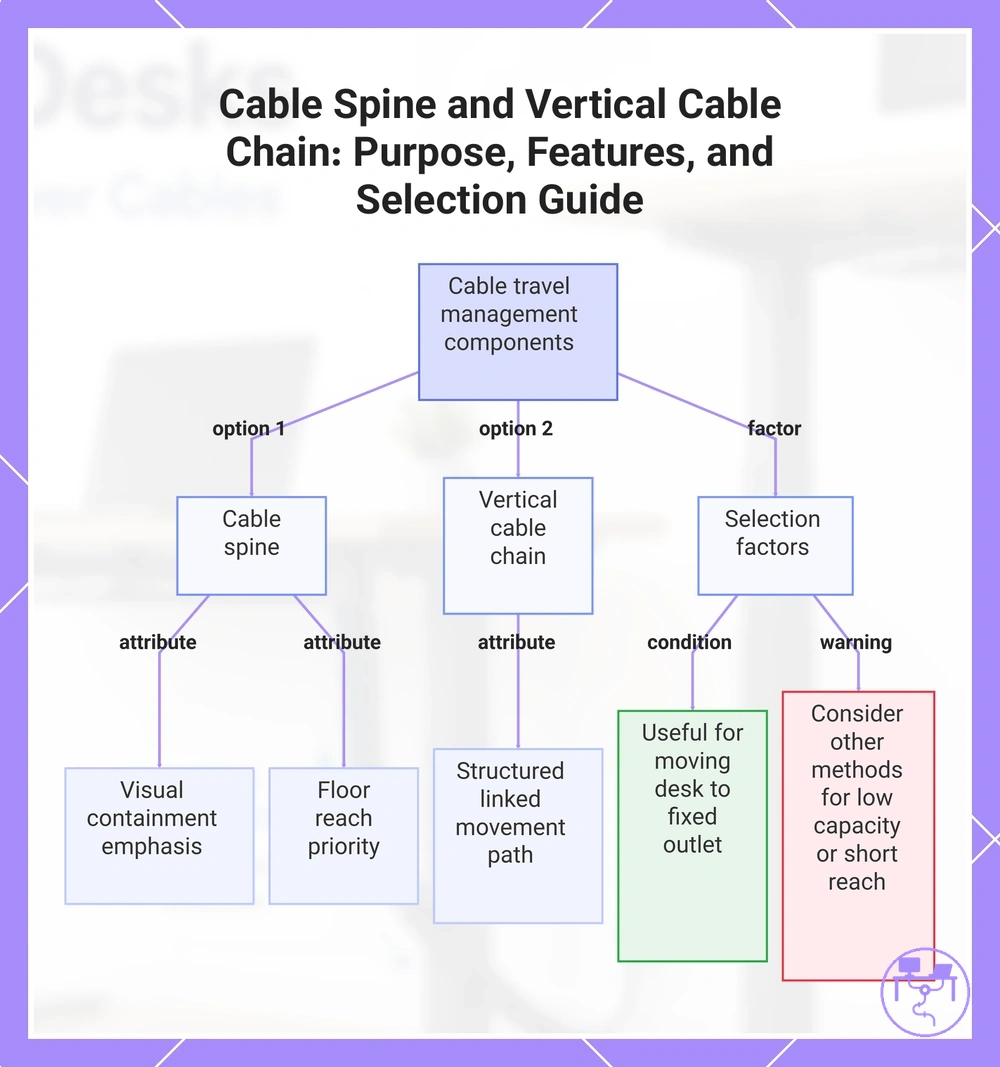
A cable spine and a vertical cable chain are components that guide cables between a moving desktop and the floor or wall area. Both support vertical movement by helping cables follow a controlled path as desk height changes. Their role is to manage cable travel rather than simply group cords under the desk.
A cable spine often emphasizes visual containment and floor reach, while a vertical cable chain may provide a more structured movement path through linked sections. The suitability of either option depends on cable capacity, cable length, and desk placement. An attachment point near the desktop and another near the floor path can help maintain controlled movement when cables travel through a larger height range. Flexibility may also affect routing choices when the cable bundle changes direction.
Suitability note: A cable spine or vertical cable chain may be useful when cables travel between a moving desktop and a fixed outlet area. If cable capacity is low or floor reach is short, other routing methods may also be suitable. The choice depends on movement needs, attachment point options, and the level of cable containment required.
This chart explains the common role of cable spines and vertical cable chains in managing cable travel between a moving desk and floor, their key differences, and the main factors to consider when choosing between them.
Under-desk trays and mounted power strips
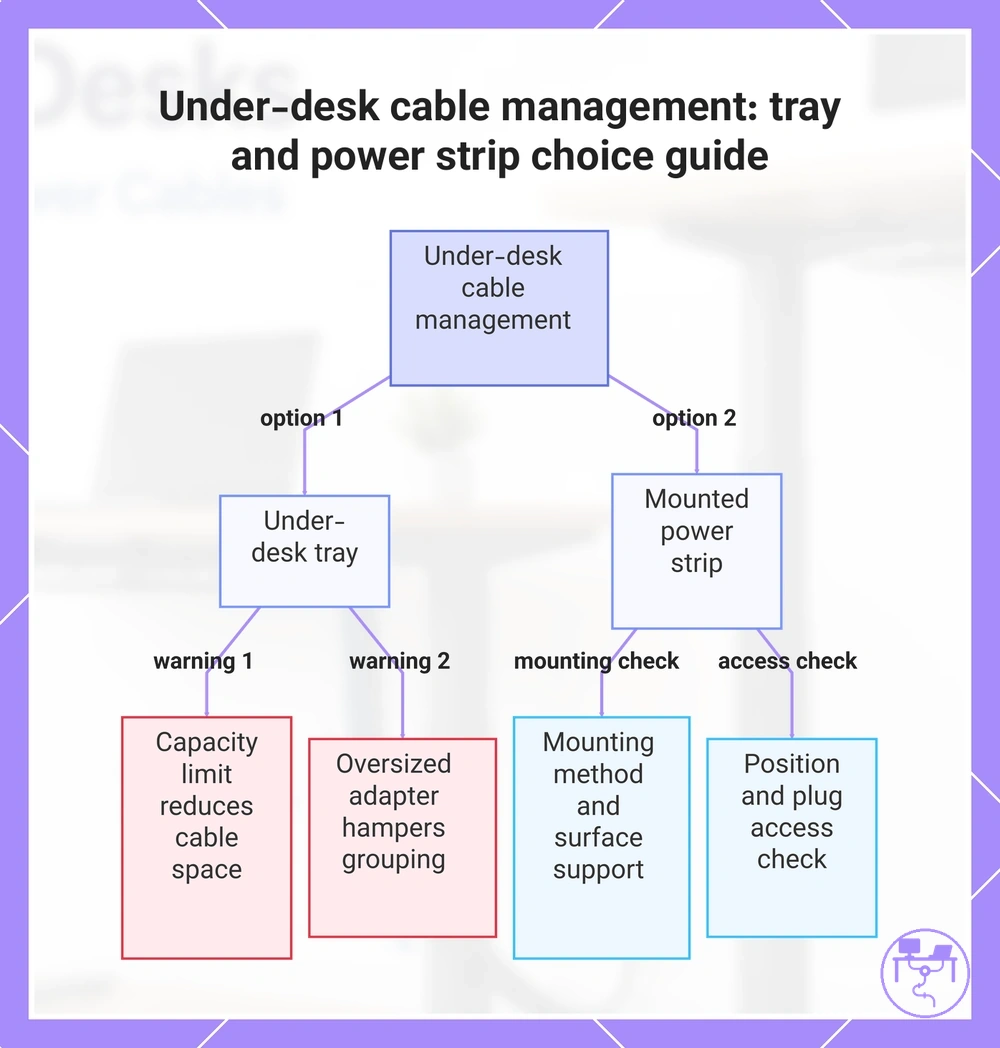
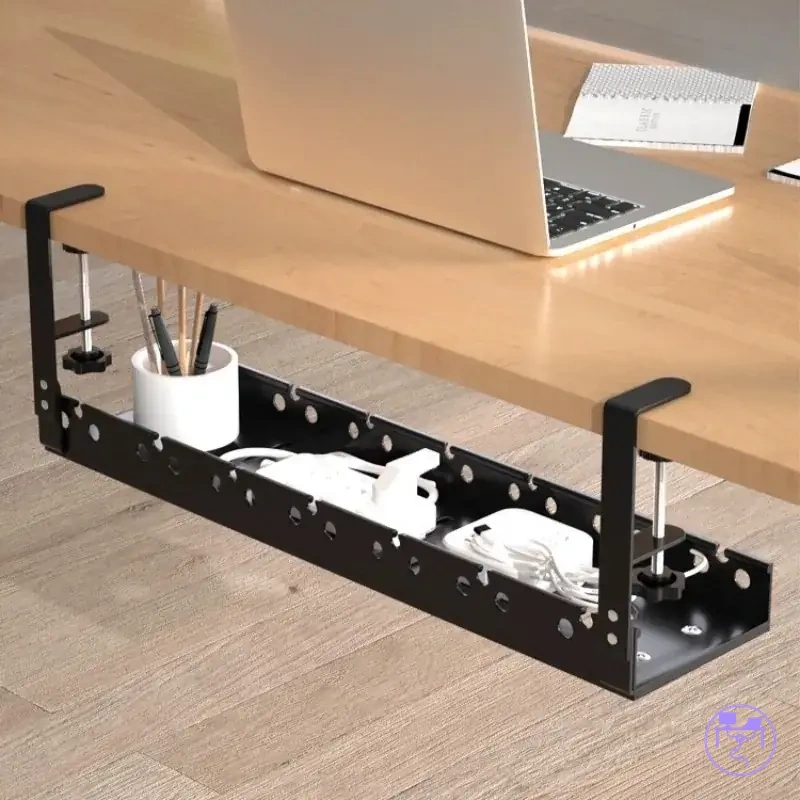
An under-desk tray and a mounted power strip can reduce the number of cords that move between the desktop and the wall. The under-desk tray groups cables, adapters, and power connections beneath the work surface, while a mounted power strip keeps power connections closer to connected devices. This arrangement can shorten the outlet path that needs to move with the desk.
Tray suitability depends on tray capacity, adapter size, and available underside space. A mounted power strip may use clamp mounting or screw mounting, depending on the desk surface and attachment options. Access is also important because devices may need to be unplugged without disturbing other grouped cords. The choice depends on cord count, power strip position, and available mounting space.
Under-desk cable grouping is easier to evaluate when the main fit conditions are reviewed before selecting components.
- If tray capacity is limited, larger adapters may reduce space for additional cables.
- If adapter size exceeds the available tray area, cable grouping may become more difficult.
- If a mounted power strip is positioned far from connected devices, the outlet path may require additional routing.
- If clamp mounting is not suitable for the desk underside, mounting options may be more limited.
- If screw mounting is used, the underside surface should support the selected attachment method.
- If access to plugs is restricted, unplugging or rearranging devices may require extra effort.
This chart outlines the key considerations and potential warnings when using an under-desk tray or a mounted power strip to reduce desk cord movement.
Cable sleeves, clips, and ties for grouped routing
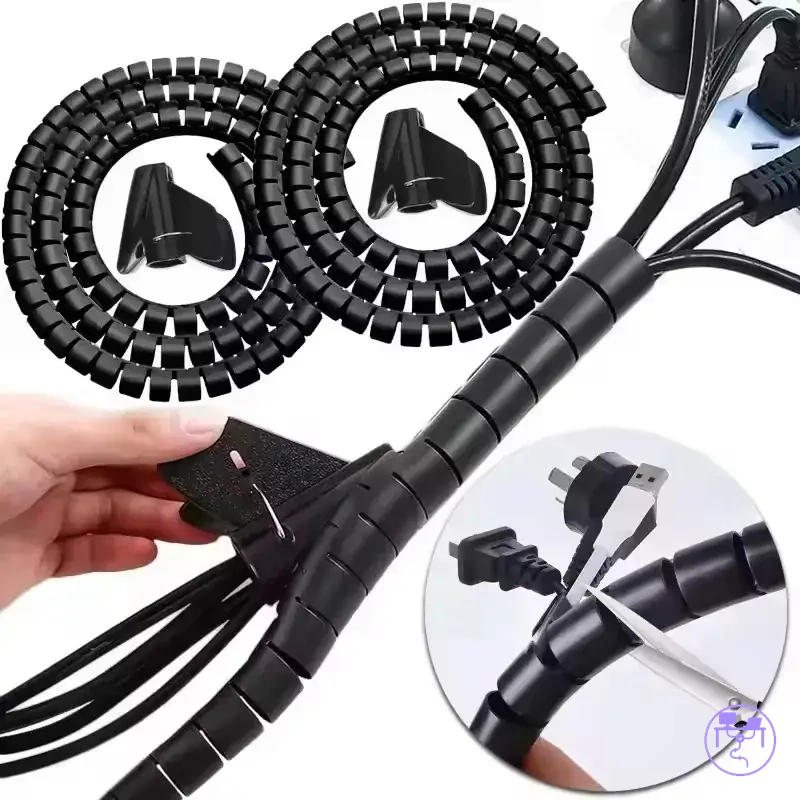
A cable sleeve, cable clips, and ties help organize grouped routing after the main movement path and power path are established. A cable sleeve groups multiple cables into a single bundle, while cable clips guide the bundle along selected routing points. Ties help keep related cables together without changing the overall routing plan.
These components support cable grouping and cable access, but they do not replace slack planning or power routing decisions. A cable sleeve may improve bundle control when multiple cables follow the same path. Cable clips depend on adhesive strength or the selected mounting surface, while ties should allow removable adjustment when cables may need to be added, removed, or repositioned later. The choice depends on cable count, access needs, and routing flexibility.
Grouped routing is easier to maintain when each component is matched to its intended function.
- If a cable sleeve contains multiple cables, cable grouping may improve while cable access becomes less direct.
- If cable clips rely on adhesive strength, mounting performance may vary by the underside surface.
- If ties are tightened excessively, over-tightening risk may reduce routing flexibility and adjustment options.
- If cables are changed frequently, removable adjustment may be more important than maximum bundle compression.
- If grouped routing includes different cable types, cable access requirements may influence sleeve, clip, or tie selection.
Power Routing From the Moving Desk to the Wall
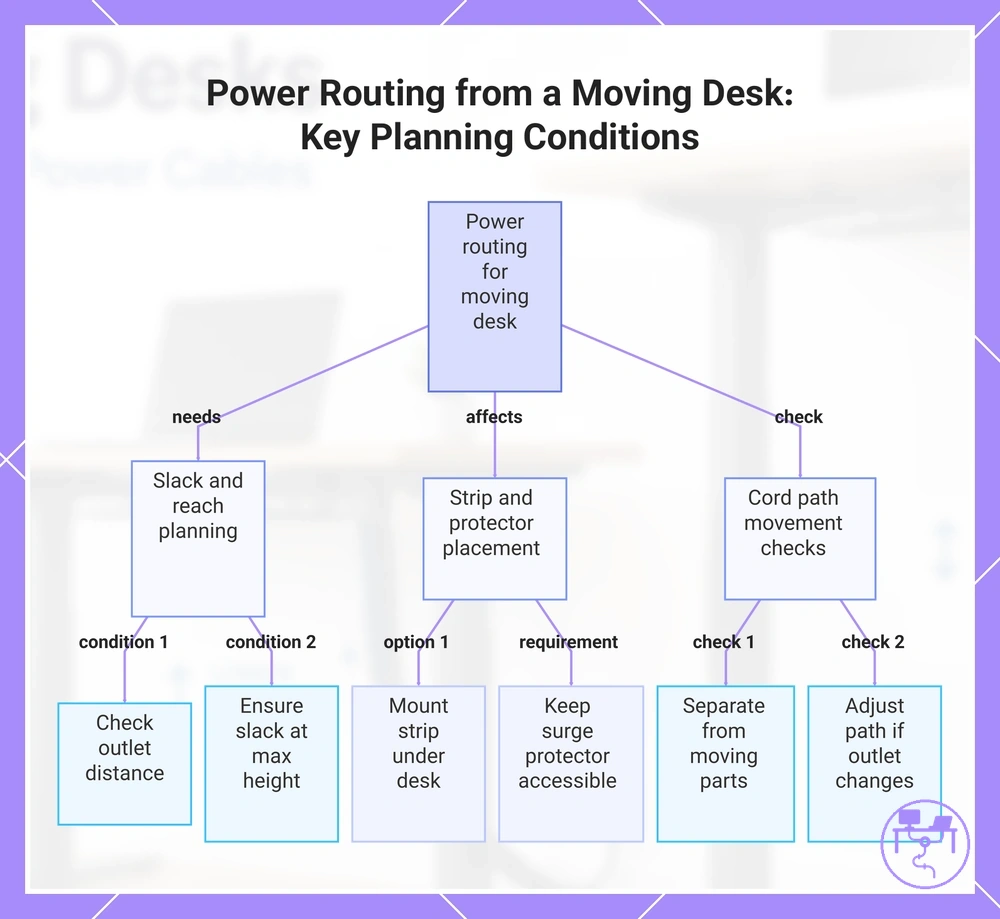
Power routing from a moving desk to the outlet depends on maintaining a cable path that can travel with desk movement without creating tension. A moving desk changes the distance and angle between the desktop and the outlet, so cord slack and the vertical path need to be planned together. The goal is to keep power routing controlled while allowing normal height adjustment.
Power strip placement can affect how many cables need to travel toward the outlet. If a power strip is mounted closer to connected devices, fewer device cables may need to cross the moving path. Outlet distance may influence the amount of cord slack needed for outlet reach. Surge protector placement should remain accessible when adjustments are needed, and the cord path may benefit from separation from moving frame parts when desk movement could affect cable travel.
Power routing decisions are easier to evaluate when movement-related conditions are reviewed before final cable placement.
- If the outlet is farther from the desk location, additional cord slack may be needed to maintain outlet reach.
- If a power strip is mounted under the desk, fewer device cables may need to travel toward the outlet.
- If cord slack is limited at maximum desk height, the power cable path may require adjustment.
- If surge protector placement limits access, cable changes may become less convenient.
- If the cord path passes near moving frame parts, additional separation may help reduce routing interference.
- If the outlet path changes because of desk placement, power routing decisions may also need to change.
This section supports movement-safe routing decisions and cable-management planning rather than replacing electrical guidance. For broader guidance focused specifically on power cable safety for movement, use dedicated electrical safety resources where appropriate.
This chart shows the main factors and checks for planning power cable routing from a height-adjustable desk to the wall outlet, ensuring controlled movement without tension.
Single-cord exit versus multiple moving cords
Single-cord exit versus multiple moving cords depends on cable routing conditions, power strip placement, and outlet reach. A single-cord exit may reduce the number of cords moving between the desk and the wall when a power strip is mounted on the desk. Multiple moving cords may still be suitable when device connections, adapter placement, or routing constraints make a one-cord route less practical.
Adapter placement and maintenance access can influence the routing decision. If adapters and power connections are grouped near a mounted power strip, a single-cord exit may simplify the power path to the wall outlet. If devices require separate cable routes or frequent changes, multiple moving cords may provide easier access. Pull risk can also vary based on cord length, outlet position, and how cables move during height adjustment.
The comparison below highlights how each routing approach may affect compatibility decisions.
| Single-cord exit | Multiple moving cords |
|---|---|
| May reduce the number of cords traveling to the wall outlet. | Allows separate cord paths for different devices. |
| Often depends on power strip mounting near the desktop. | May require additional attention to pull risk and tangling. |
| Can simplify outlet reach planning when cables are grouped. | May provide easier maintenance access for individual connections. |
| Depends on adapter placement and available mounting space. | Depends on cable routing conditions and cord management needs. |
Outlet reach across sitting and standing positions
Outlet reach should be checked in both the sitting position and standing position before final power routing. A cord that reaches the wall outlet at the lowest height may create cord tension at the highest height. The route should be tested across the full height change before cables are secured.
Wall outlet position, cord length, and the selected cable path all affect power reach. If the cord touches the floor, floor contact may increase tripping exposure depending on where the route crosses the workspace. If the cord is lifted too tightly between the desk and outlet, cord tension may affect routing decisions. The suitable route depends on desk height, outlet distance, and available slack.
Outlet reach is easier to verify when the lowest height and highest height are checked before final cable placement.
- If the cord reaches only at the sitting position, additional slack or a different route may be needed.
- If the standing position removes remaining slack, cord tension may increase near the outlet or desk connection.
- If the wall outlet sits far from the desk path, outlet reach may depend more on cord length and routing direction.
- If the cord rests across a walking area, floor contact may increase tripping exposure.
- If the cable route changes during height adjustment, the final path should be reviewed before securing the cord.
Compatibility Checks Before Choosing a Standing Desk Cable System
Compatibility checks depend on desk conditions, cable requirements, and movement behavior rather than on a single cable management component. A system may be suitable when the mounting surface, frame clearance, cable load, power path, movement range, and access needs align with the desk configuration. Checking these conditions before installation can help identify routing or fit limitations early.
Each criterion should be evaluated against how the desk moves and how cables are routed. A mounting surface may limit attachment options if hardware cannot be secured properly. Frame clearance can affect whether cables or accessories have enough space during height changes. Cable load, device count, power path, and movement range may influence how much support or routing flexibility is needed. Access needs may also affect future adjustments when devices or cables change.
These compatibility checks help turn fit conditions into practical selection criteria. For broader desk fit and mounting factors, compare the conditions below before making a routing or installation decision.
| Criterion | Condition to check | Compatibility risk | Decision signal |
|---|---|---|---|
| Mounting surface | Available hardware attachment area | Limited mounting options | Confirm attachment method first |
| Frame clearance | Space around moving hardware | Routing interference | Check movement path clearance |
| Cable load | Number of connected cables and adapters | Overcrowded routing path | Match capacity to cable volume |
| Power path | Route between desk and wall outlet | Cord tension during movement | Verify slack across travel range |
| Movement range | Lowest and highest desk positions | Restricted cable travel | Test full-height movement |
| Access needs | Frequency of cable changes | Difficult maintenance access | Prioritize reachable routing points |
Electric standing desks may require additional attention when control boxes, power connections, or moving frames share the same routing area. If these components occupy part of the available space, frame clearance and cable path decisions may need closer review before installation.
Mounting space under the desktop
Mounting space under the desktop controls whether trays, clips, holders, or channels can attach securely without interfering with the desk frame. The desktop underside needs enough usable area for the selected hardware, adhesive, screws, or clamps. Fit depends on desktop thickness, frame rails, access controls, and the available mounting area.
Frame rails can reduce usable space when they cross the same area needed for cable parts. Screws may not suit every desktop thickness or material, while clamps need an edge or surface shape they can grip. Adhesive limits may matter when the underside surface is textured, dusty, uneven, or exposed to cable load. Access controls should remain reachable if the desk has buttons, control boxes, or other underside components.
Underside fit is easier to judge when each mounting condition is checked before choosing the cable system.
- If the desktop underside has little flat area, trays or channels may have fewer secure mounting options.
- If frame rails cross the mounting space, cable parts may interfere with height movement or hardware clearance.
- If desktop thickness is limited, screws may need closer review before any attachment decision.
- If clamps cannot grip the edge or underside shape, clamp-mounted parts may not be suitable.
- If adhesive limits are likely because of surface texture or cable load, adhesive clips may need another support method.
- If access controls sit near the mount area, cable routing should avoid blocking normal desk operation.
Cable load from monitors, adapters, and peripherals
Cable load depends on the number of monitors, adapters, and peripherals connected through the same routing path. More devices can increase cable weight, expand the cord bundle, and place greater demands on tray capacity. Compatibility may change when device load approaches the limits of the available routing space and movement path.
Monitors, display cables, laptop chargers, USB hubs, power bricks, and peripheral cables all contribute to cable load. A larger cord bundle may require more grouping space and more flexibility during desk movement. Tray capacity should be evaluated against both cable count and cable weight because the load can affect routing stability and cable travel. If power bricks and adapters are grouped together, their combined weight may influence mounting suitability.
Cable load is easier to assess when each source is reviewed before selecting routing hardware.
- If multiple monitors add more display cables, tray capacity may need closer review.
- If adapters and power bricks are concentrated in one area, cable weight may affect mounting decisions.
- If peripherals connect through a USB hub, cord bundle size may increase and require more grouping space.
- If device load changes frequently, routing flexibility may be more important than tighter cable grouping.
- If peripheral cables share a movement path, added cable load may influence how the bundle travels during desk adjustment.
Desk frame clearance and moving parts
Desk frame clearance depends on how frame rails, motors, columns, and moving parts affect the available space for cable hardware. A cable management system may be suitable only when the cable path remains separated from moving parts throughout desk travel. Compatibility should be checked against the moving frame rather than the desktop alone.
Frame rails, motor housing, and control box position can reduce usable frame space under the desk. A cable path that passes too close to columns or moving parts may encounter pinch points or collision zones during height adjustment. Mechanical clearance may vary by desk design, so cable routing and hardware placement should be evaluated together.
Desk frame clearance is easier to assess when potential movement risks are reviewed before installation.
- If frame rails occupy the intended mount area, cable hardware may have fewer placement options.
- If the cable path crosses pinch points, cable movement may become restricted during desk travel.
- If motors or motor housing sit near the routing area, additional separation may help reduce interference risk.
- If a control box occupies part of the frame space, hardware placement may require a different cable path.
- If columns move close to the cable path, collision zones should be checked before securing cables.
- If cable path separation is limited, routing decisions may need closer review across the full movement range.
How to Match the System to the Standing Desk Setup
How to match the system to the standing desk setup depends on movement range, cable load, power path, and mounting limits. A suitable cable management approach should align with the conditions that create the most routing demands. The system match may change when desk movement, device count, or available mounting space changes.
Movement-heavy setups may benefit from a cable spine because the cable path travels between the desktop and a fixed outlet area. Higher cable load may increase the need for a tray or grouped routing solution. A power strip holder can help when power connections move with the desk. Sleeves, clips, and ties may be more suitable when the primary goal is cable grouping rather than movement control.
The table below connects each setup condition to a suitable system and the trade-off that should be reviewed before making a decision.
| Setup condition | Suitable system | Trade-off | Check before choosing |
|---|---|---|---|
| Frequent height changes and long cable travel | Cable spine | May require dedicated routing space | Verify movement range and cable path clearance |
| Multiple monitors, adapters, and peripherals | Tray | Available capacity may limit grouping space | Review cable load and underside mounting space |
| Desk-mounted power distribution | Power strip holder | Placement affects outlet routing | Check power path and access requirements |
| Light accessory routing and grouped cables | Sleeve, clips, and ties | May provide less movement control | Confirm routing flexibility and cable access needs |
| Mixed movement and cable-management needs | Combined kits | More components may require additional planning | Match each part to the setup condition |
Decision signals should come from the dominant setup condition rather than from a single component feature. If multiple routing demands exist, a combined approach may provide a closer system match. For a broader framework to choose a standing desk cable system, compare movement needs, cable load, power path, and mounting limits before selecting a cable management approach.
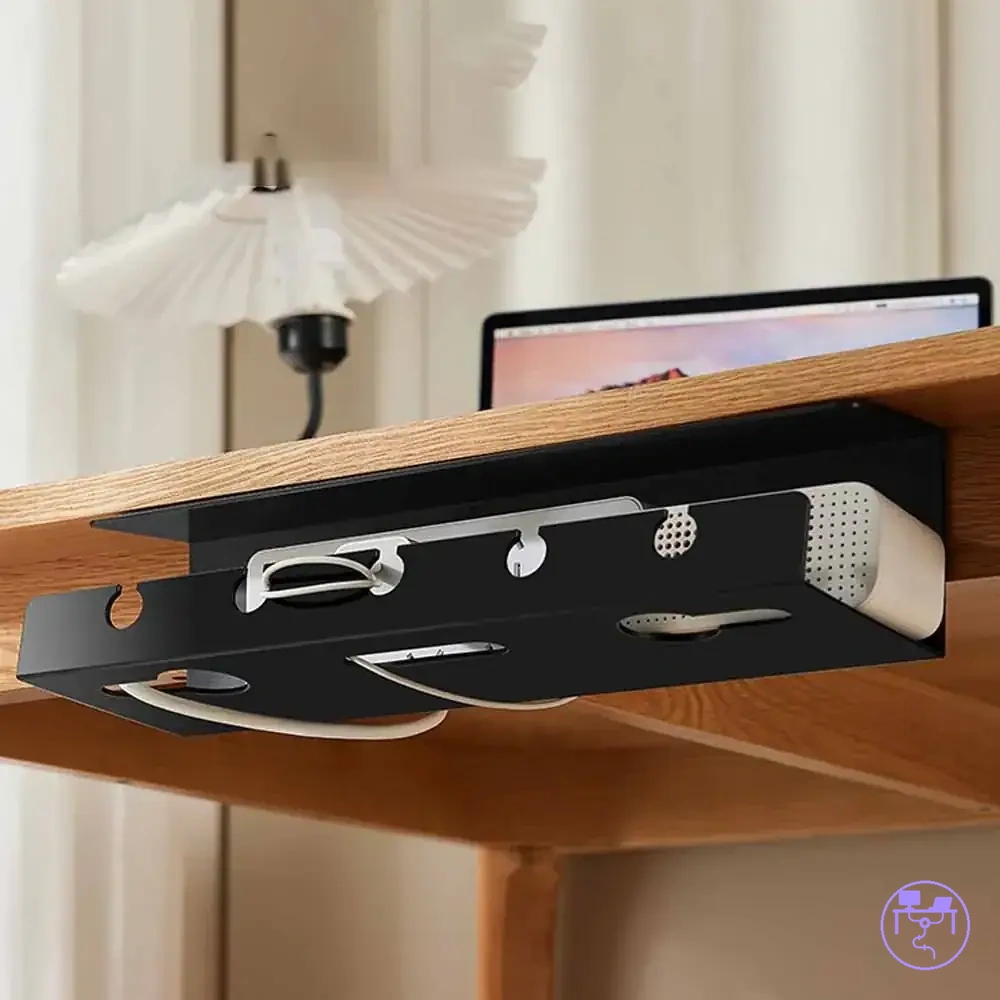
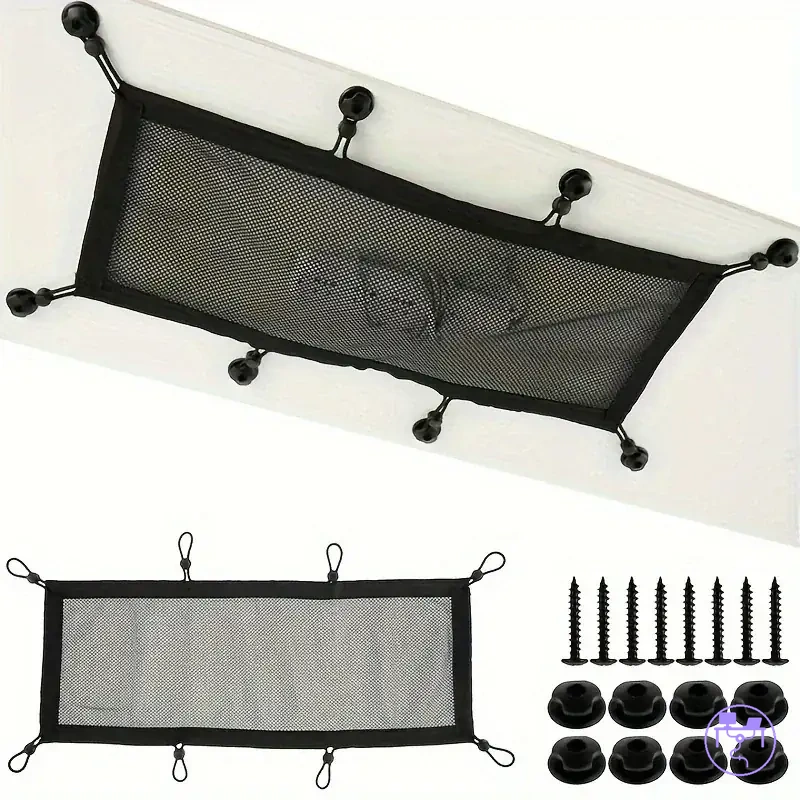
The products below are useful examples for comparing available options. Before buying, check that the compatibility criteria, key features, and product details match your needs.
When a cable spine is the stronger fit
A cable spine is the stronger fit when vertical cable movement is the main routing problem. It may suit a standing desk with long height travel, several floor-to-desk cables, or visible vertical routing that needs containment. It should be treated as a fit choice, not as a universal upgrade.
A cable spine can guide cables through a more defined vertical route than simpler sleeves, clips, or ties. Capacity matters because floor-to-desk cables need enough room to move without crowding the spine system. Desk placement also matters because a desk positioned away from the wall may leave the vertical route more exposed. The trade-off is that stronger containment may require more routing space and more attention to attachment points.
Vertical cable movement is easier to evaluate when the main setup conditions are checked before choosing a cable spine.
- If height travel is long, a cable spine may provide more controlled vertical guidance.
- If multiple floor-to-desk cables share one route, capacity should be checked before selection.
- If the vertical route is highly visible, containment may support a more controlled cable path.
- If desk placement is away from the wall, exposed cable movement may make a spine system more useful.
- If cables only need light grouping, simpler organizers may be enough without adding a cable spine.
When a tray, sleeve, or clip-based setup is enough
A tray, sleeve, or clip-based setup may be enough when cable travel is short and movement demands remain controlled. This lighter setup can work when a mounted power strip reduces the number of cables moving toward the outlet. Suitability depends on cable movement, low cable load, outlet reach, and available mounting space.
A tray can support cable grouping under the desktop, while a sleeve and clips can help manage shorter cable routes. These simple organizers may be suitable when existing outlet reach already supports desk movement and when cable travel does not require dedicated vertical guidance. The trade-off is that a lighter setup may provide less containment when cable movement becomes more complex.
The checklist below helps identify when a lighter setup may be a reasonable choice.
- If cable travel is short, a tray or sleeve setup may provide enough routing support with less hardware.
- If a mounted power strip keeps most connections near the desktop, fewer cables may need to travel toward the outlet.
- If cable load remains low, clips and sleeves may be easier to manage than larger routing systems.
- If outlet reach already accommodates desk movement, additional routing components may be less important.
- If underside space is available, a tray may improve cable grouping without adding a dedicated cable spine.
- If cable movement increases over time, the limitation of a clip-based setup should be reviewed before adding more devices.
For setups that meet these conditions, it may also help to review how to route cables under a standing desk before finalizing the cable path.
Standing Desk Cable Problems That Signal Poor Compatibility
When pulling cords, sagging loops, or pinched cables appear during desk movement, poor compatibility may be the underlying issue. These cable problems often indicate that the chosen system does not match the desk’s movement range, cable load, or routing path. Symptoms are usually more useful than adding new accessories because they can reveal where the fit no longer matches the setup.
Poor compatibility may develop when cable travel exceeds the available slack or when routing space becomes limited. An overloaded tray can indicate that cable volume has outgrown the available capacity. Outlet strain may appear when the power path becomes too tight during height adjustment. Cables catching on frame parts may suggest that the routing path does not maintain enough clearance through desk movement.
The diagnostic table below connects common symptoms to likely compatibility gaps that are worth checking before changing the cable system.
| Symptom | Likely compatibility issue | Check | What it means |
|---|---|---|---|
| Pulling cords | Limited slack or cable travel | Review cord movement at different desk heights | The routing path may not match desk travel. |
| Sagging loops | Excess cable length or unsupported routing | Check cable support points | The cable path may lack sufficient control. |
| Pinched cables | Insufficient clearance near moving parts | Inspect frame movement areas | The routing path may cross a restricted space. |
| Loose clips | Mounting conditions no longer suit cable load | Check cable weight and attachment surfaces | The organizer may not match current routing demands. |
| Overloaded tray | Capacity no longer matches cable volume | Review tray space and cable count | The cable load may exceed the intended grouping area. |
| Outlet strain | Power path is too short or too tight | Check outlet reach across desk movement | The outlet route may need reassessment. |
| Cables catching on frame parts | Routing path conflicts with moving hardware | Review clearance through full desk travel | The cable route may not suit the desk structure. |
If multiple symptoms appear together, reassessing system fit is often more useful than adding accessories to the existing route. For a more focused diagnostic process, review how to fix standing desk cable problems and identify which compatibility gap is creating the symptom.