
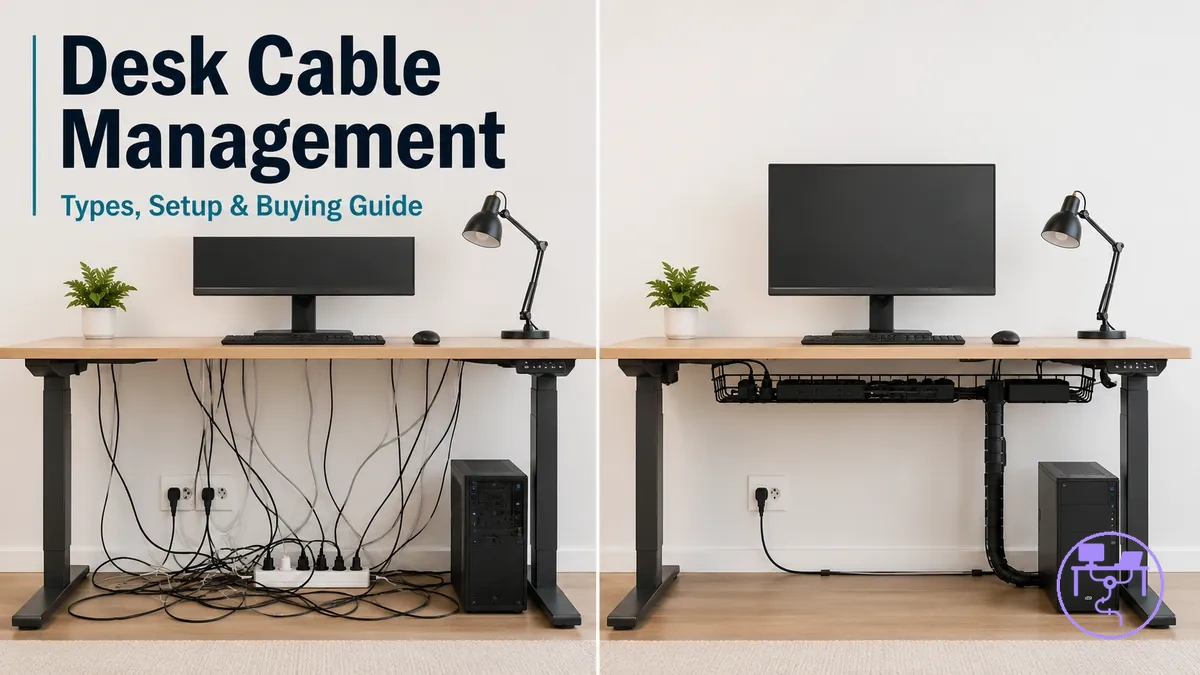
Desk Cable Management System Guide for Organized Workstations
A desk cable management system is a cable organization framework that helps route, support, secure, and manage workstation cables within and around a desk setup. It creates a structured approach to cable visibility, under-desk storage, and cable routing so that cables remain easier to access and manage as workstation needs change. The central challenge it addresses is the workstation organization problem created by visible, tangled, or difficult-to-manage cables.
Desk Cable Management System Guide for Organized Workstations becomes easier to understand when the entire cable path is viewed as one connected system rather than as separate accessories. The page focuses on how organized workstation cables, under-desk storage, cable routing, and access work together to support a cleaner and more manageable workspace. Key evaluation variables include cable visibility, cable load, desk fit, mounting method, access requirements, and practical value.
A complete desk cable management system is not simply a clip, sleeve, or tie used in isolation. A system combines parts and routing logic so that workstation cables follow a more organized path between devices, power sources, and work areas. This boundary helps distinguish a cable control system from individual accessories that address only one part of cable organization.
- Cable visibility: how much of the cable path remains exposed or concealed.
- Under-desk storage: how cables, adapters, and related accessories are supported beneath the work surface.
- Cable load: the volume and weight of cables that the setup may need to manage.
- Desk fit and mounting method: whether the system suits the available mounting area and attachment preference.
- Access: how easily cables can be reached for maintenance, updates, or reconfiguration.
- Practical value: how well the setup aligns with long-term workstation organization needs.
Understanding these decision variables provides a grounded view of desk wire management before considering deeper topics such as components, solution types, compatibility, setup considerations, or buying criteria. Outcomes related to neatness, fit, access, and practical value can vary depending on desk condition, cable load, and mounting method.
What a Desk Cable Management System Does
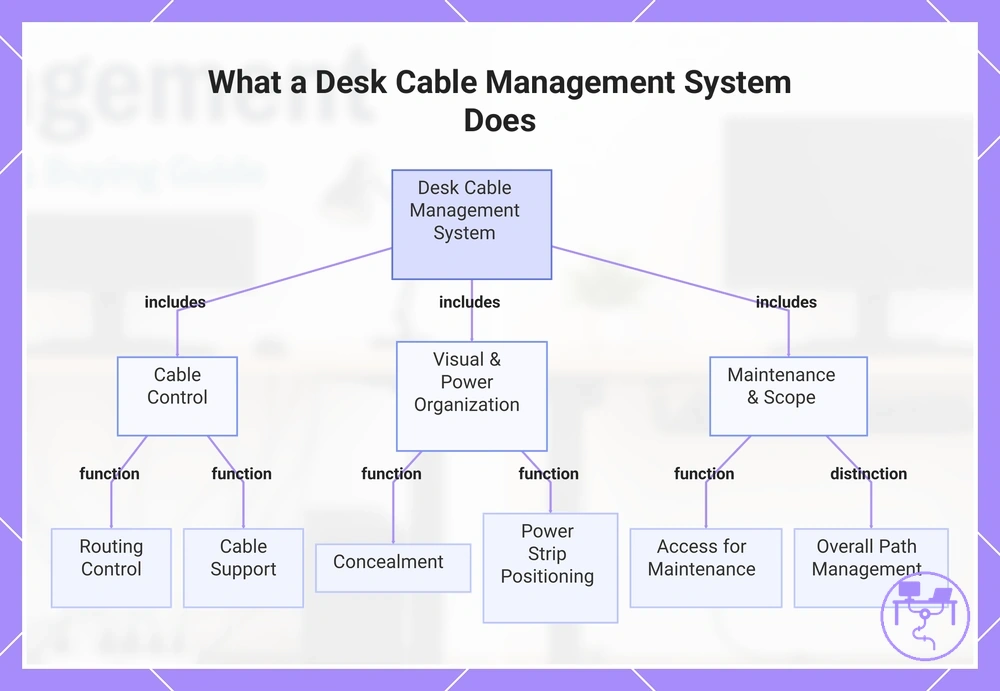
A desk cable management system is a cable organization framework that organizes, routes, secures, and hides workstation cables within a desk setup. A desk cable management system helps control how cables move between devices, power sources, and work areas while supporting a more structured workspace. Its primary role is to manage cable routing, support, visibility, and organization across the workstation.
- Routing control: organizes cable paths to reduce unnecessary cable spread across the desk area.
- Cable support: helps hold workstation cables in planned positions instead of leaving them unsupported.
- Concealment: hides cables where appropriate to reduce visual clutter.
- Power strip positioning: supports more organized placement of a power strip and connected adapters.
- Access: helps keep cables reachable for maintenance, updates, and reconfiguration.
A desk cable management system combines cable control, cable support, cord routing, concealment, and power-strip organization into a single management approach. It can contribute to safety-aware organization when the desk layout, cable volume, and overall setup are suitable for the intended use. Access remains important because workstation cables often need adjustment, inspection, replacement, or reconfiguration over time.
A complete desk cable management system differs from a loose one-off cable accessory because it manages the overall cable path rather than addressing only a single cable location.
This chart shows the core functions and key distinction of a desk cable management system, explaining how it organizes, routes, secures, and hides workstation cables.
What Belongs Inside a Desk Cable Management System
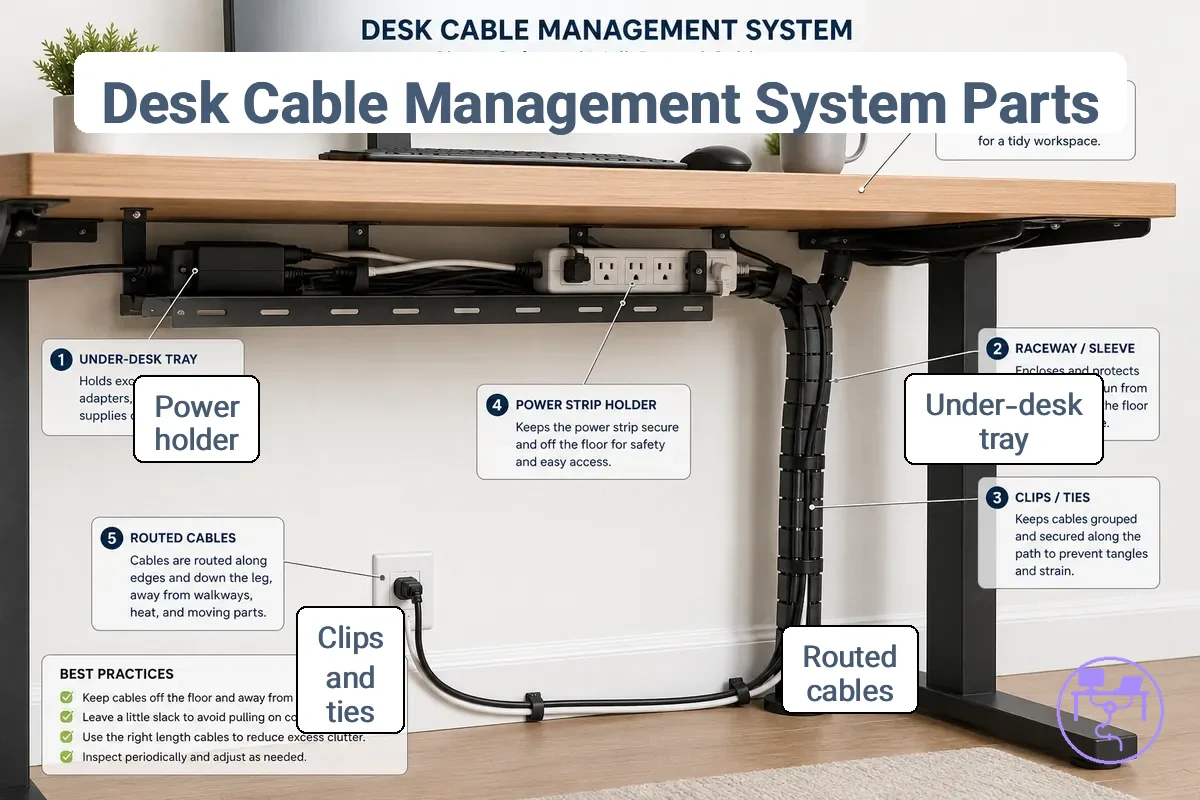
What Belongs Inside a Desk Cable Management System includes components that support cable control through storage, routing, securing, and concealment functions. Common parts include a tray, raceway, sleeve, clips, ties, power strip holder, and cable box, but the exact combination depends on workstation needs. These components serve as system parts because each part connects a mounting role with a specific cable-control purpose.
What Belongs Inside a Desk Cable Management System becomes clearer when components are organized by attribute, condition, and effect. The image below labels common parts and shows how storage parts, routing parts, and securing parts work together within a workstation layout.
| Component | Main attribute | Fit condition | Practical effect |
|---|---|---|---|
| Tray | Under-desk storage capacity | Depends on available underside space and cable load | Supports grouped cable storage and helps manage cable volume |
| Raceway | Concealment and routing path | May suit a wall or desk edge when cable routing requires coverage | Helps route cables while preserving access |
| Sleeve | Cable grouping | Useful when multiple cables follow the same path | Supports cleaner cord routing and bundle control |
| Clips | Route stability | Effectiveness depends on the desk underside and mounting surface | Help hold cables in a planned route |
| Ties | Cable securing | Useful when cable bundles require organization | Help secure grouped cables and limit movement |
| Power strip holder | Power strip support | Depends on adapter size, access needs, and mounting location | Supports positioning of power strips and connected adapters |
| Cable box | Accessory concealment | May suit setups with exposed adapters or excess cable length | Helps contain visible cable-related accessories |
Storage parts hold cable load, routing parts guide cable paths, and securing parts support route stability. For a deeper explanation of individual desk cable management system parts, it is useful to examine how each component supports access, cable load management, and overall system completeness within a specific workstation setup.
Main Types of Desk Cable Management Solutions
Main Types of Desk Cable Management Solutions include trays, baskets, channels, raceways, sleeves, clips, ties, holders, and cable boxes. These solution types differ by visibility, capacity, access, mounting method, and how they manage cable organization within a workstation. Different types solve different cable-control jobs rather than serving the same purpose.
Main Types of Desk Cable Management Solutions can be compared by how they store, conceal, support, or hold cables. The table below compares type-level use cases and highlights where each solution type may fit based on cable load, visibility preferences, access needs, and mounting conditions.
| Solution type | Main job | Strong fit | Limitation to check |
|---|---|---|---|
| Trays and baskets | Store and support cable load under a desk | May suit setups with multiple cables, adapters, and power strips | Available under-desk space and capacity requirements |
| Channels and raceways | Route and conceal cables along a defined path | May suit workstations where cable visibility is a priority | Access can vary depending on routing location |
| Sleeves | Group routed cables into a single bundle | May suit cables that follow a common route | Access may be less convenient when cables change frequently |
| Clips and ties | Hold cables in position and support route-holding | May suit small cable paths and localized cable organization | Support level depends on cable volume and routing needs |
| Holders and cable boxes | Support accessories and conceal cable-related items | May suit setups with adapters, power strips, or visible cable clusters | Fit depends on available space and access requirements |
Capacity-focused types such as trays and baskets emphasize storage and support, while concealment-focused types such as raceways, channels, sleeves, and cable boxes emphasize visibility control. For a deeper comparison of types of desk cable management systems, it helps to evaluate how each option balances capacity, visibility, access, and mounting conditions within a specific workstation setup.
Under-Desk Trays, Baskets, and Channels
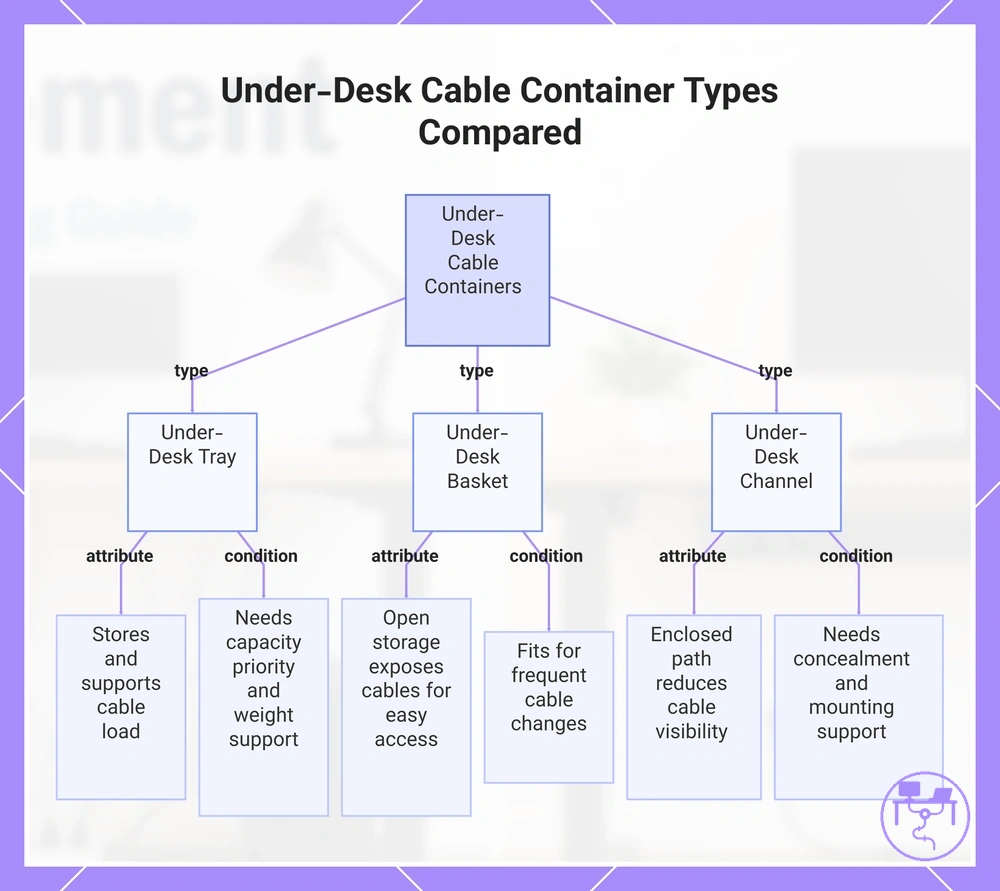
Under-desk trays, baskets, and channels support higher-capacity cable storage by containing, routing, and organizing cables beneath a workstation. These container types differ in capacity, cable access, visibility, and mounting conditions, but they share the same goal of under-desk clutter control.
- Under-desk tray: Stores and supports cable load beneath the desk surface. An under-desk tray may fit when cable capacity is a priority and the mounting method can support the intended cable weight.
- Basket: Provides open storage and exposes cables, adapters, and accessories for easier access. A cable basket may fit when frequent cable changes or access needs are expected.
- Channel: Routes cables through a more enclosed path and helps reduce cable visibility. A cable channel may fit when mounting conditions support the routing path and concealment is preferred.
Capacity, stability, and access can vary based on desk material, cable load, mounting conditions, and cable-management requirements. Tray, basket, and channel solutions each support under-desk containment while balancing storage and access differently.
This chart compares three types of under-desk cable storage—trays, baskets, and channels—based on their key attributes and ideal fit conditions.
Raceways, Sleeves, Clips, and Ties
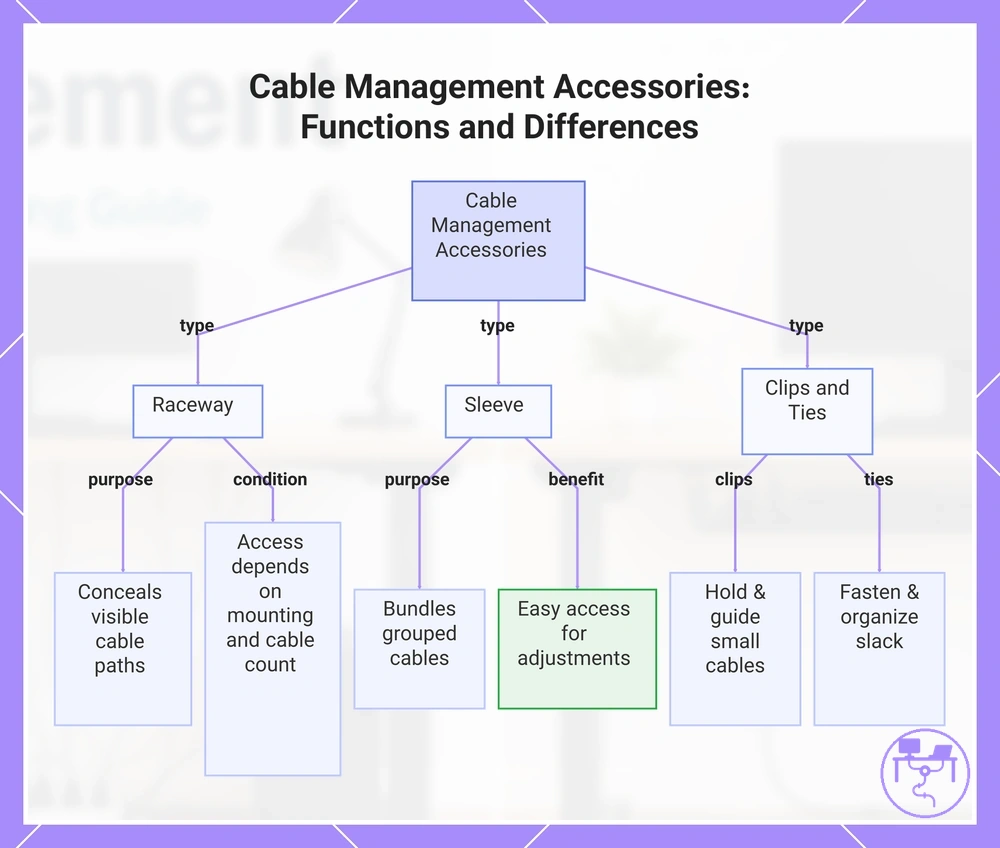
Raceways, sleeves, clips, and ties manage visible runs, grouped cables, and smaller cable paths by controlling how cables are concealed, bundled, guided, and fastened. These accessories support route-holding and cable organization, but their primary role is route control rather than high-capacity cable storage.
- Raceway: Conceals visible cable paths inside a cable cover and guides cables along a defined route. Concealment and access can depend on mounting method, surface condition, cable count, and future access needs.
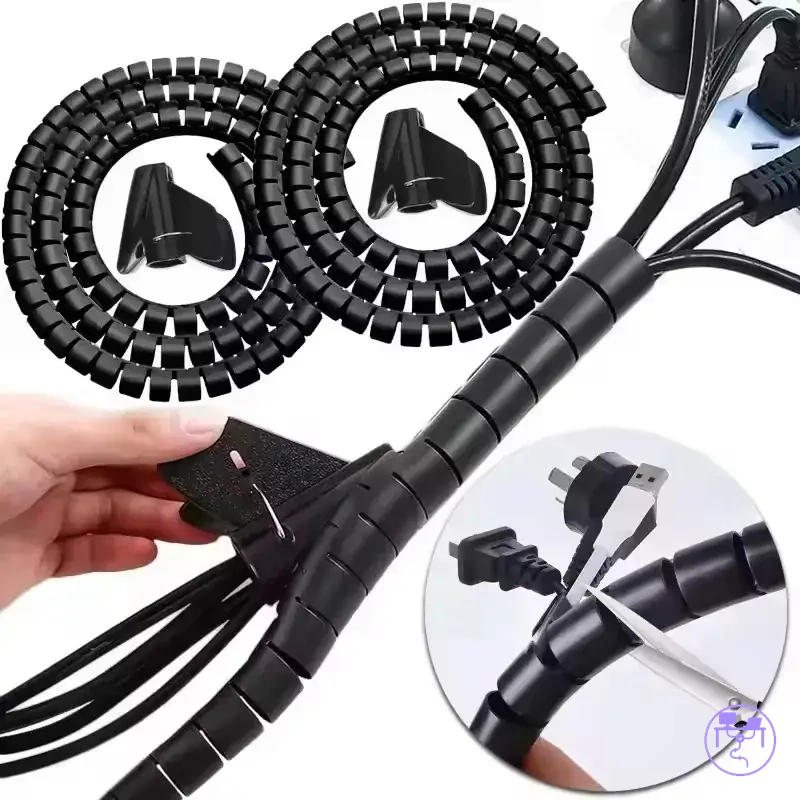
- Sleeve: Bundles grouped cables inside a cable wrap and supports flexible cable routing. Access may remain easier when cables require occasional adjustment or replacement.
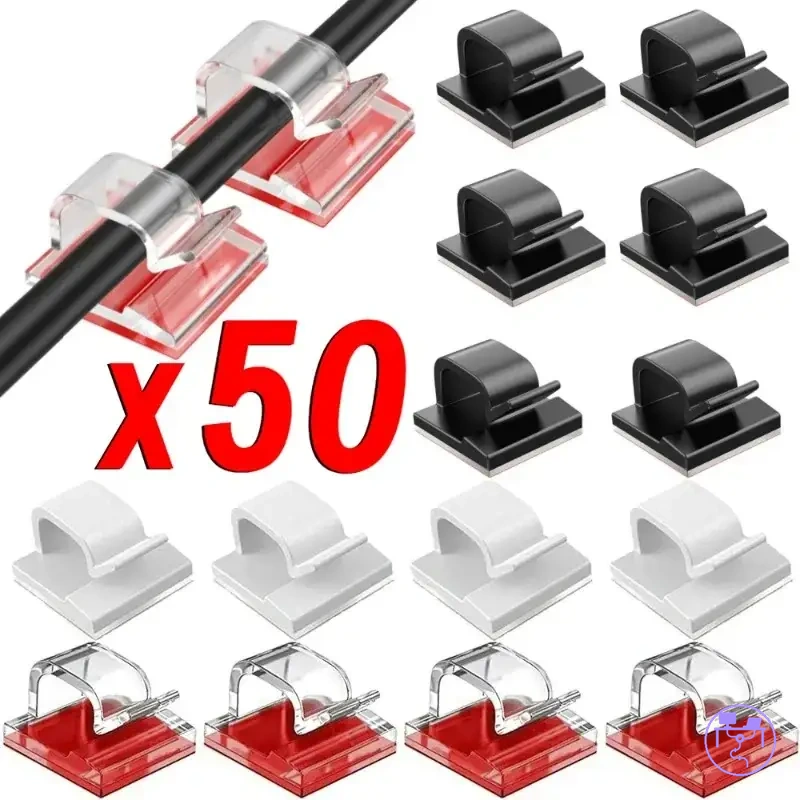
- Clips: Hold and guide small cables along desk edges, surfaces, or routing points. Route-holding performance can vary based on placement method, cable volume, and surface compatibility.
- Ties: Fasten grouped cables, organize slack, and support cable grouping. Reusability and access can depend on how frequently cables need to be added, removed, or repositioned.
Raceways emphasize concealment, sleeves emphasize bundling, and clips and ties emphasize holding and guiding. Together, these accessories help manage visible cable routes without replacing capacity-focused under-desk storage solutions.
This chart shows the main types of cable management accessories – raceways, sleeves, clips, and ties – and their primary functions: concealment, bundling, and holding/guiding.
Power Strip Holders and Cable Boxes
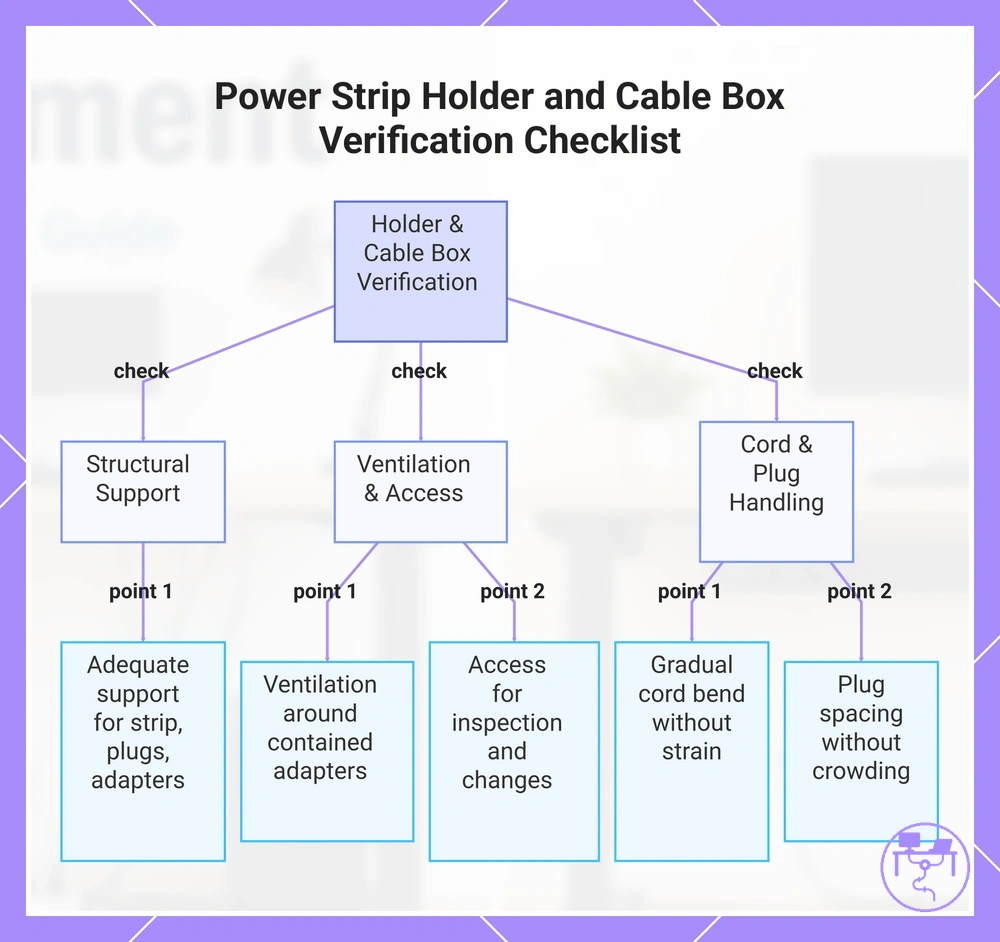
Power strip holders and cable boxes help manage adapters, plugs, and power concentration within a desk cable management setup. A power strip holder can support a power strip in an under-desk position, while a cable box can contain adapters, plugs, and excess cable length while preserving access for cable management tasks.
The checklist below verifies organization and placement conditions related to support, ventilation, access, cord bend, and plug spacing. These checks may help evaluate whether a holder or cable box remains practical when mounted under the desk or placed on the floor.
- Verify that the power strip holder provides adequate support for the power strip, plugs, and connected adapters.
- Verify that the cable box allows ventilation around contained adapters and plugs.
- Verify that cord bend remains gradual and does not create unnecessary strain near cable exits or plug connections.
- Verify that plug spacing allows access to connected plugs and adapters without excessive crowding.
- Verify that under-desk or floor placement still allows access for inspection, cable changes, or repositioning.
When adapters and plugs are concealed inside a cable box, ventilation and access may depend on placement, cable volume, and available space around the enclosure.
This chart shows the key verification checks for organization and placement of power strip holders and cable boxes, covering support, ventilation, access, cord bend, and plug spacing.
Desk Fit, Mounting, and Cable Load Factors
Desk fit depends on desk surface, cable load, and access conditions before a cable management system can be considered compatible with a workstation. Underside space, mounting surface condition, cable volume, and access needs can affect which mounting approach may be practical. Fit depends on desk and cable conditions rather than on a single product feature.
Desk Fit, Mounting, and Cable Load Factors can be easier to evaluate visually. The image below clarifies how underside space, mounting area, cable bundle position, power-strip clearance, and access space may affect physical fit and cable-load conditions.
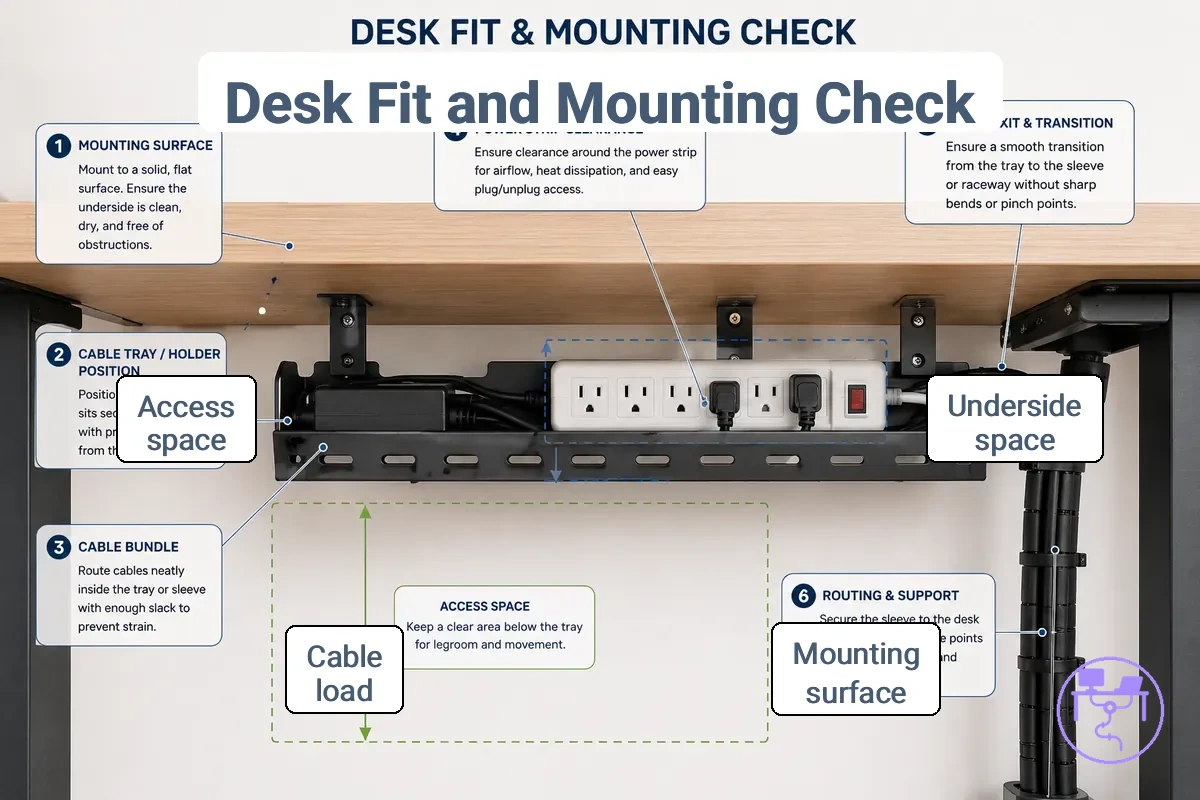
- Verify that underside space can accommodate the intended tray, holder, or routing component.
- Verify that the mounting surface and desk material are suitable for the selected mounting method.
- Verify that desk thickness does not limit clamp-on, adhesive, or other no-drill mounting options.
- Verify that cable load, adapters, and power-strip size remain appropriate for the available mounting area.
- Verify that cable slack allows movement without creating unnecessary strain or restricting access.
- Verify that leg movement and access space remain available after cables and accessories are positioned.
Underside space, mounting surface, desk thickness, and material can affect compatibility because they may limit attachment locations. In rented spaces, a no-drill approach may be preferred when permanent modification is not desirable. Thick desks may reduce compatibility with certain mounting methods if clamping or attachment space is limited.
Cable load, power-strip size, adapters, and cable volume can affect system choice because larger bundles may require more support area. Access needs can also influence suitability when cables are updated, inspected, or repositioned regularly. Heavier cable bundles may require a solution that better matches the available mounting area and cable-management requirements.
Choosing the Right System for a Computer Desk
Choosing the right system for a computer desk depends on cable count, desk type, visibility tolerance, and update frequency. A cable management setup that suits one workstation setup may be less suitable for another when device count, cable volume, or access needs differ. The main selection variables are cable count, desk type, visibility tolerance, and update frequency.
The criteria below connect workstation needs to selection factors and system direction. Matching a need to the appropriate criterion can help separate basic cable tidying from a fuller under-desk system.
| Need | Useful criterion | Better-fit system direction |
|---|---|---|
| Few devices and limited cable count | Basic cable organization | Simple cable organizer with clips, ties, or a sleeve |
| Moderate cable count | Visibility tolerance and route control | Combination of routing accessories and partial under-desk support |
| Multiple devices and adapters | Higher tray capacity and cable volume management | More complete under-desk system with storage support |
| Visible cables are a concern | Concealment preference | Raceway, sleeve, or another cable-covering direction |
| Frequent cable changes | Access and update frequency | Removable ties, clips, or solutions that allow easier access |
Device count often affects cable count and tray capacity requirements. For example, a computer desk with a monitor, laptop, and a few accessories may require only basic cable control, while a setup with more devices and adapters may benefit from greater under-desk storage and cable support.
Update frequency can affect how access and concealment are balanced. When cables are moved, replaced, or added regularly, easier access may be prioritized over maximum concealment. To choose a desk cable management system, match workstation needs to the criteria that most directly affect organization, visibility, and access.
Tray Capacity, Access, and Update Needs
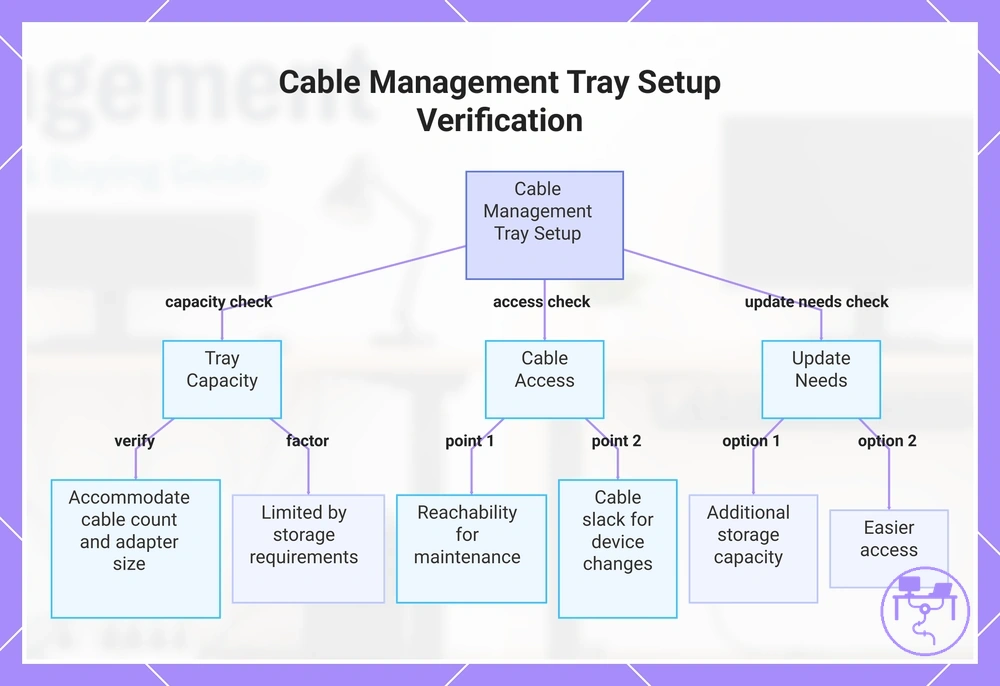
Tray capacity, cable access, and update needs determine whether a cable management setup can support current cables while remaining practical for future device changes. Tray capacity may be limited by cable count, adapter size, and storage requirements, while cable access depends on reachability, opening style, and maintenance frequency.
The checklist below verifies tray capacity, access, and update needs before confirming that capacity and reachability are sufficient for ongoing use.
- Verify that tray capacity can accommodate the current cable count and adapter size.
- Verify that cable access allows reachability for maintenance, inspection, or cable updates.
- Verify that cable slack remains available when devices are repositioned or replaced.
- Verify that the opening style supports the expected access frequency.
- Verify that cable separation remains manageable when update needs introduce additional cables or adapters.
Update needs can require additional storage capacity or easier access when device changes occur over time. Tray capacity and cable separation should be considered together because future changes may be easier to manage when reachability and access remain available.
This chart shows the three main verification areas for a cable management tray: tray capacity, cable access, and update needs, along with specific checks and considerations.
No-Drill, Clamp-On, and Screw-Mounted Options
Mounting choice affects the suitability of a desk cable management system because permanence, load support, desk damage risk, and adjustability can vary by attachment method. No-drill, clamp-on, and screw-mounted options each involve different trade-offs, with permanence and support forming the main comparison point.
Desk material, surface condition, clamp area, and cable load can influence how each mounting option performs. Removability, adjustability, and support should be evaluated against workstation conditions rather than assumed from the mounting method alone.
| Mounting option | Trade-off | Check before choosing |
|---|---|---|
| No-drill adhesive mount | May allow easier removability, but support can depend on surface condition and cable load | Check adhesive compatibility, cable weight, and mounting surface condition |
| Clamp-on option | May allow adjustability and removal, but support depends on desk edge design and clamp area | Check desk edge clearance, clamp fit, and expected cable load |
| Screw-mounted option | May provide greater permanence, but removability and desk damage risk depend on desk material and mounting location | Check desk material, mounting position, and future removal considerations |
Basic Setup Flow for Organized Desk Cables
Basic Setup Flow for Organized Desk Cables starts with planning cable paths before fastening hardware. A setup flow is easier to organize when cable paths, power location, mounting points, and access needs are considered first, allowing routing decisions to be made before cables are secured.
Basic Setup Flow for Organized Desk Cables is shown below as a high-level setup sequence that organizes planning, routing, and checking stages. The visual demonstrates planned cable paths, grouped cables, power-strip placement, cable support points, and final access checks.
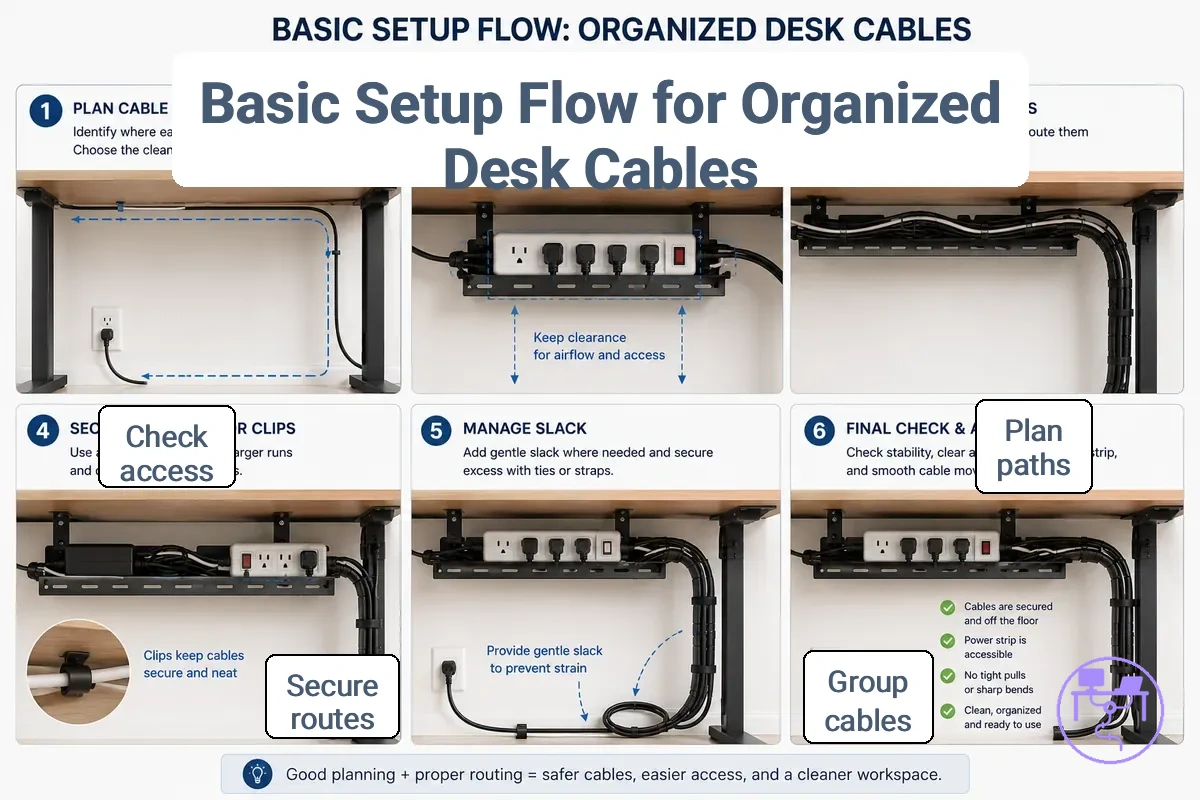
Setup choices should preserve cable access and avoid unnecessary strain rather than focus only on hiding wires. Cable length, power location, mounting points, and access needs can influence grouping, securing, slack control, and future cable changes.
- Plan cable paths, power location, and mounting points.
- Group related cables by route and destination.
- Route cables through the selected support points.
- Secure grouped cables while maintaining slack control.
- Check access and review cable strain.
For deeper installation detail beyond this installation overview, see how to install a desk cable management system.
Plan Cable Paths and Power Strip Position
Planning cable paths and power strip position starts before routing begins by identifying cable origin, cable destination, outlet reach, and device locations. Cable paths, power strip position, cable length, adapter bulk, and access needs should be reviewed together so the routing path can support organized cable movement before cables are secured.
Cable paths and power strip position are the primary planning targets at this stage. The mini-checklist below helps verify route conditions before routing begins, helping prevent cable strain and blocked access.
- Verify that outlet reach allows the planned power strip position based on cable length and power location.
- Verify that device locations create a clear route between cable origin and cable destination.
- Verify that cable length allows slack for movement, repositioning, and future access needs.
- Verify that adapter bulk and plug spacing fit the planned power strip location without limiting access.
- Verify that power and device cables can follow organized paths when separation improves cable organization or access.
Planning cable paths and power strip position before routing helps reduce unnecessary strain and can keep access available when cables, adapters, or devices need adjustment later.
Secure, Route, and Group Cables Under the Desk
Securing, routing, and grouping cables under the desk starts with organizing related cables before they are fastened into a routing path. Clips, ties, sleeves, and trays can help secure, route, and group cables while maintaining cable separation, bend room, slack, and future access.
Securing, routing, and grouping cables keeps the under-desk path controlled when cable weight, surface condition, bend room, and removability are considered during setup.
- Group cables by destination and organize them into manageable bundles.
- Secure grouped cables with clips, ties, or sleeves while allowing bend room and slack.
- Route grouped cables through trays or along the planned under-desk routing path while maintaining cable separation.
- Check access, slack, and future removability after cables are secured and routed.
For more detailed guidance on routing methods, see how to route cables under a desk. Route stability and removability may vary based on cable weight, surface condition, bend room, and future access needs.
Buying Signals That Affect Practical Value
Buying signals that affect practical value depend on how well a desk cable management system matches cable load, mounting conditions, access needs, and future changes. Practical value is usually influenced by capacity, material, mounting reliability, access, bundle completeness, and upgrade flexibility rather than by price alone, because value depends on fit and use conditions.
Buying signals become easier to evaluate when each value factor is connected to a condition and a likely outcome. The criteria below help assess practical value without relying on product rankings or price guarantees.
| Buying signal | Condition to check | Practical value effect | Risk if ignored |
|---|---|---|---|
| Capacity | Cable load, adapter count, and cable volume | Can improve support when capacity matches cable load | Limited space for cables and accessories |
| Material | Expected load and installation conditions | May affect support and durability | Reduced support under higher cable loads |
| Mounting reliability | Desk material, surface condition, and mounting method | Can improve route stability and retention | Less stable cable organization |
| Access | Frequency of cable changes and maintenance needs | May reduce effort during cable updates | More difficult cable adjustments |
| Bundle completeness | Included accessories compared with setup requirements | Can improve setup convenience when needed parts are included | Additional accessories may be required later |
| Upgrade flexibility | Future device additions and cable changes | May support easier expansion over time | Reduced adaptability for future changes |
Trade-offs can occur between mounting reliability, access, and upgrade flexibility. A solution focused on stronger support may require different access considerations, while a more flexible setup may prioritize easier cable changes over greater containment.
Bundle completeness can improve practical value when included accessories match actual setup needs. Unnecessary extras may add complexity without improving cable organization, so decision signals should be evaluated against workstation requirements rather than accessory count alone.
A price-check can help compare similar options, but practical value usually depends more on capacity, mounting reliability, access, bundle completeness, and upgrade flexibility than on price alone. For a final value review, see the desk cable management buying checklist before making a decision.
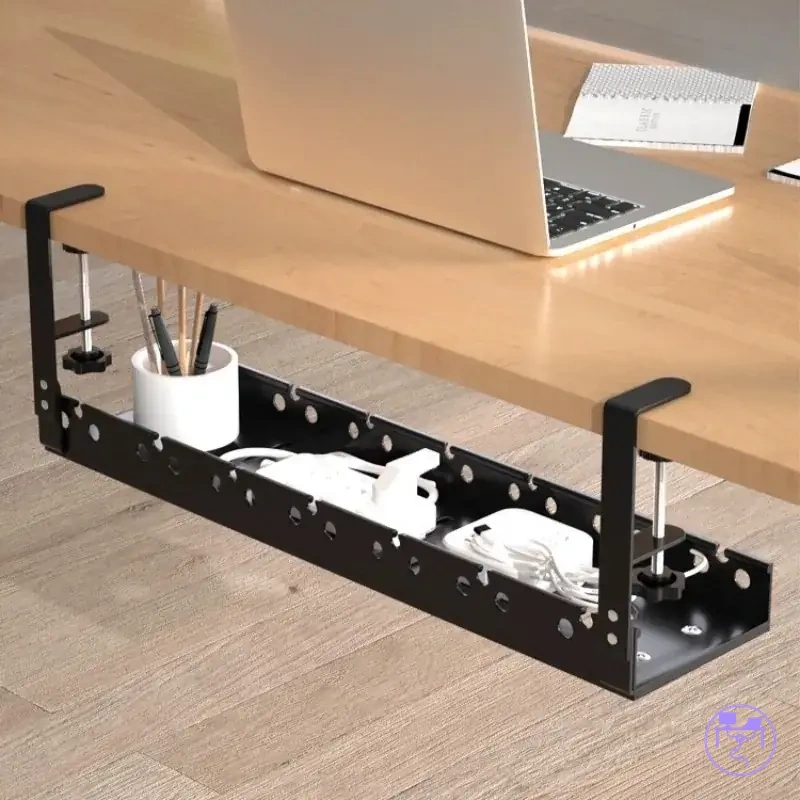
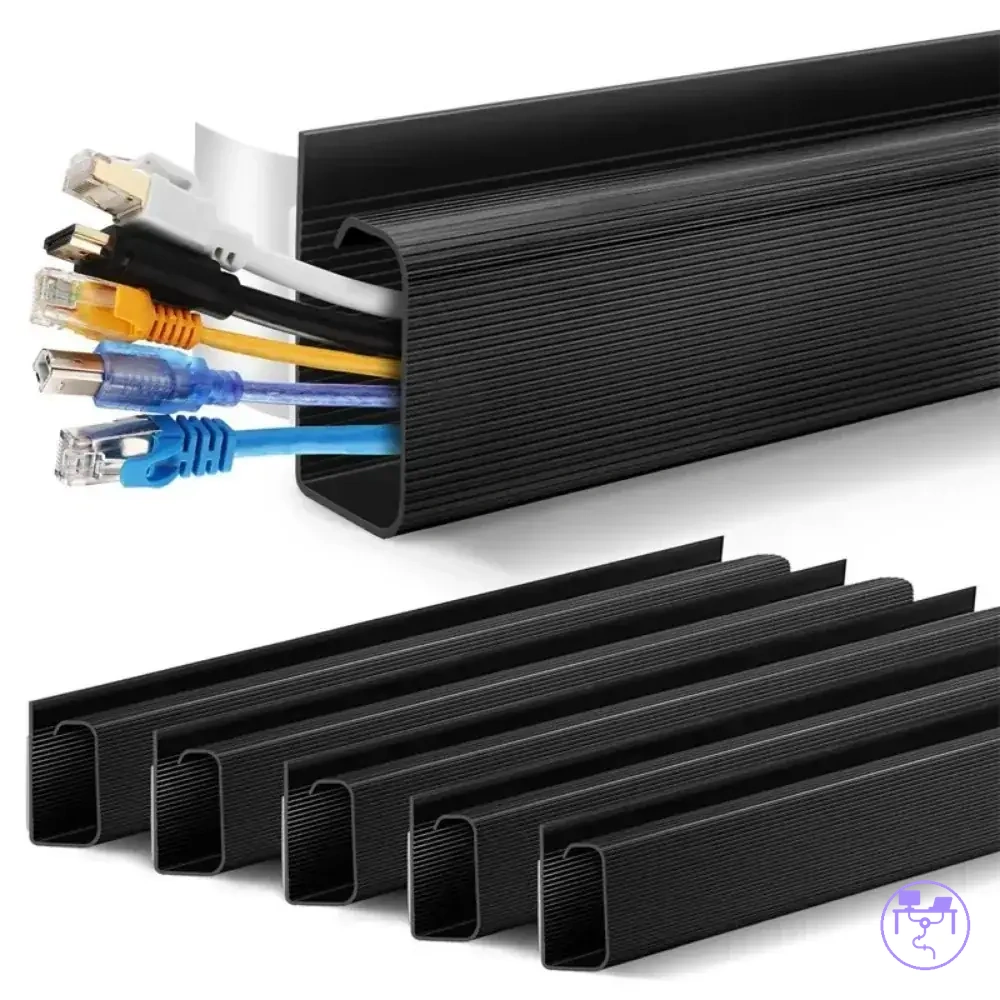
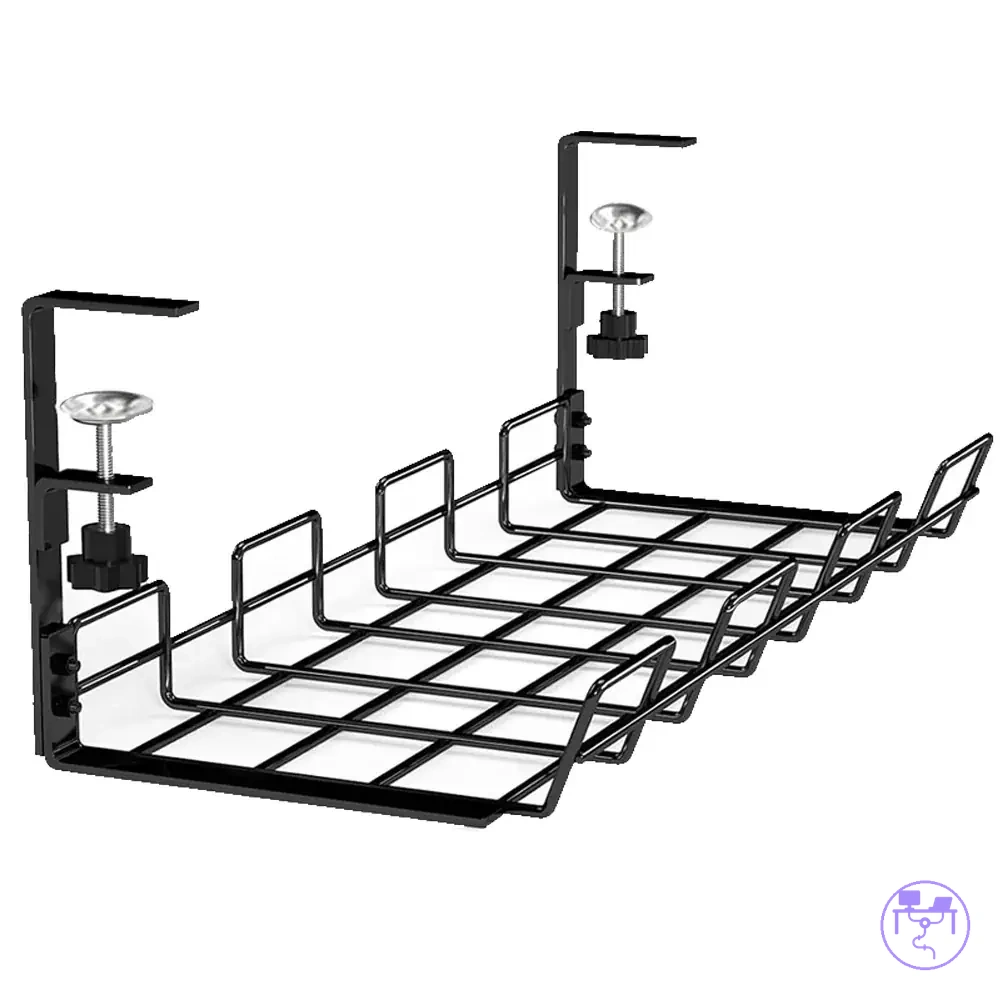
Here are product examples that may make comparison easier. Before buying, always review the compatibility criteria, essential features, and product details.
Common Desk Cable Management Problems Before Buying
When desk cable management problems appear before or shortly after setup, the likely cause is often a mismatch between desk conditions, cable load, and access needs. Common Desk Cable Management Problems Before Buying usually result from poor fit, weak mounting, low capacity, blocked access, or cable strain, especially when mounting conditions and cable requirements are not evaluated together.
Problem signals can help identify likely attribute issues before a purchase decision is made. The diagnostic table below diagnoses common symptoms, likely causes, prevention criteria, and decision outcomes so avoidable problems can be recognized earlier.
| Problem signal | Likely attribute issue | Check before buying | Decision impact |
|---|---|---|---|
| Dangling cables | Weak mounting or insufficient support | Check cable load, mounting method, and support area | May indicate a need for greater support capacity |
| Tangled adapters | Low capacity or poor grouping | Check adapter bulk, cable volume, and organization space | May suggest a solution with more organization capacity |
| Hard-to-access cables | Blocked access | Check maintenance frequency and access pattern | May affect future cable changes and adjustments |
| Adhesive attachment concerns | Adhesive failure risk related to desk surface condition or cable weight | Check desk surface condition, mounting method, and expected load | May influence mounting-method selection |
| Movement-related cable shifting | Cable strain caused by moving desks or limited slack | Check desk movement range, cable slack, and routing path | May require greater route flexibility |
| Heavy power strip support concerns | Weak support relative to cable load and accessory weight | Check power-strip size, accessory weight, and support capacity | May require a different support approach |
Prevention criteria are most useful before buying because problem signals often indicate conditions that require review in advance. Desk surface condition, mounting method, cable load, adapter bulk, and access pattern can influence outcomes, so warning signs should be interpreted as conditional risks rather than exact failure predictions.