Desk Cable Management System Cost and Value Guide
A desk cable management system cost depends on system type, material, capacity, mounting method, included accessories, and long-term adjustability. Cost and value are not always the same because a setup that works for one desk, cable load, or setup size may offer less value in a different environment. A larger system, a different mounting method, or added cable-control components can change the overall value outcome even when the initial cost appears similar.
This Desk Cable Management System Cost and Value Guide focuses on price variation through practical decision factors rather than product promotion. For broader context around system categories, use the desk cable management system hub. This page is value guidance, not a product catalog, and the goal is to help evaluate options according to setup requirements.
A lower cost option is not automatically the better value choice. In many cases, value depends on whether the desk cable management system matches cable load, desk dimensions, mounting preferences, and future workspace changes. Paying less for features that are not needed may improve value, while paying more for unused capacity may not.
Useful cost evaluation starts with the relationship between setup size and system requirements. Cable load, material selection, mounting method, included accessories, and available installation space can all influence how well a cable organizer system supports a workstation over time. These factors create the framework for comparing price variation and understanding where additional cost may or may not provide meaningful value.
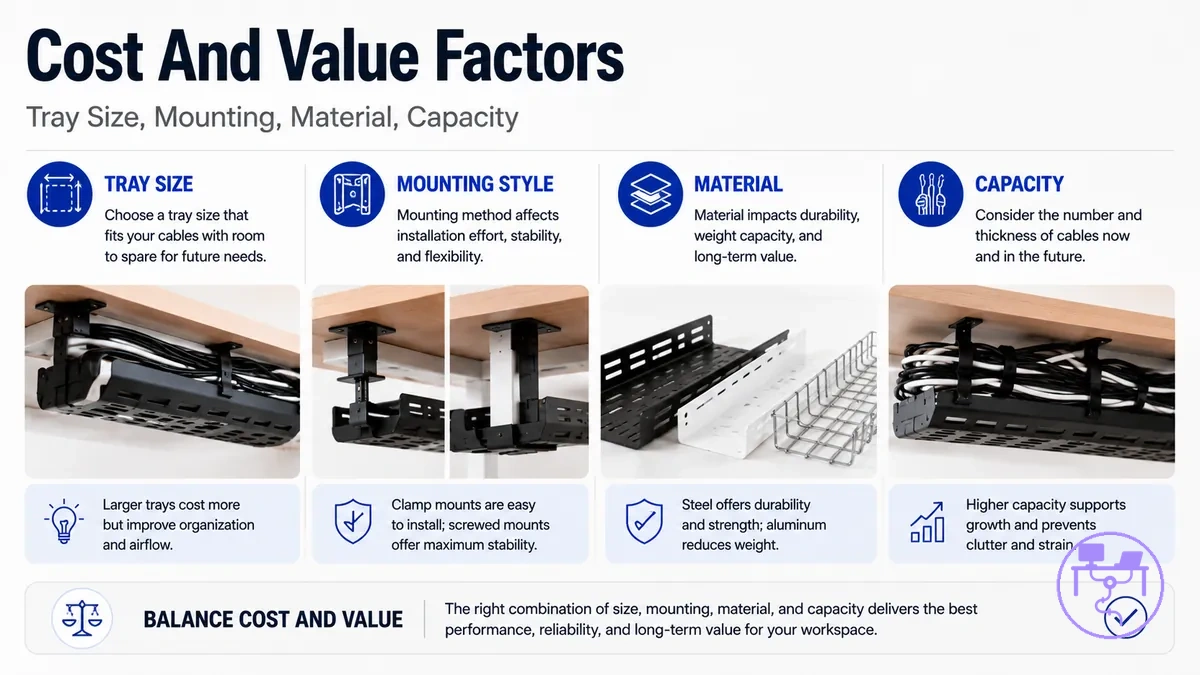
Desk Cable Management System Cost and Value Guide visuals can highlight the factors that influence value decisions. A supporting image for this section should label tray size, mounting style, material, cable capacity, and accessory considerations without merchant branding, product price labels, or catalog-style presentation.
How desk cable management system prices usually vary
System type drives most of the price spread because capacity, material, mounting, accessory inclusion, and setup demand often increase together as cable management solutions become more capable. Simple organizers generally sit in lower value tiers, while tray systems, raceways, and larger systems may occupy higher value tiers when they are intended to manage greater cable loads or support more demanding workstation layouts.
How desk cable management system prices usually vary is often easier to understand when system types are compared by their intended role and setup requirements. The table below provides a compact view of how common organizer categories fit into different value tiers.
| System type | Typical value driver | Better fit when | Cost caution |
|---|---|---|---|
| Simple organizers | Basic cable routing with limited accessory inclusion | Small desks with light cable load | Capacity may become limiting if setup demand increases |
| Tray systems | Greater cable capacity and centralized organization | Typical workstations with multiple connected devices | Mounting requirements may affect overall cost |
| Raceways | Structured cable routing and concealment | Workspaces with visible cable runs | Longer routing paths may require more material |
| Larger systems | Broader cable coverage and higher capacity | Heavier cable setups or expanded workstation layouts | Additional accessories may influence overall value |
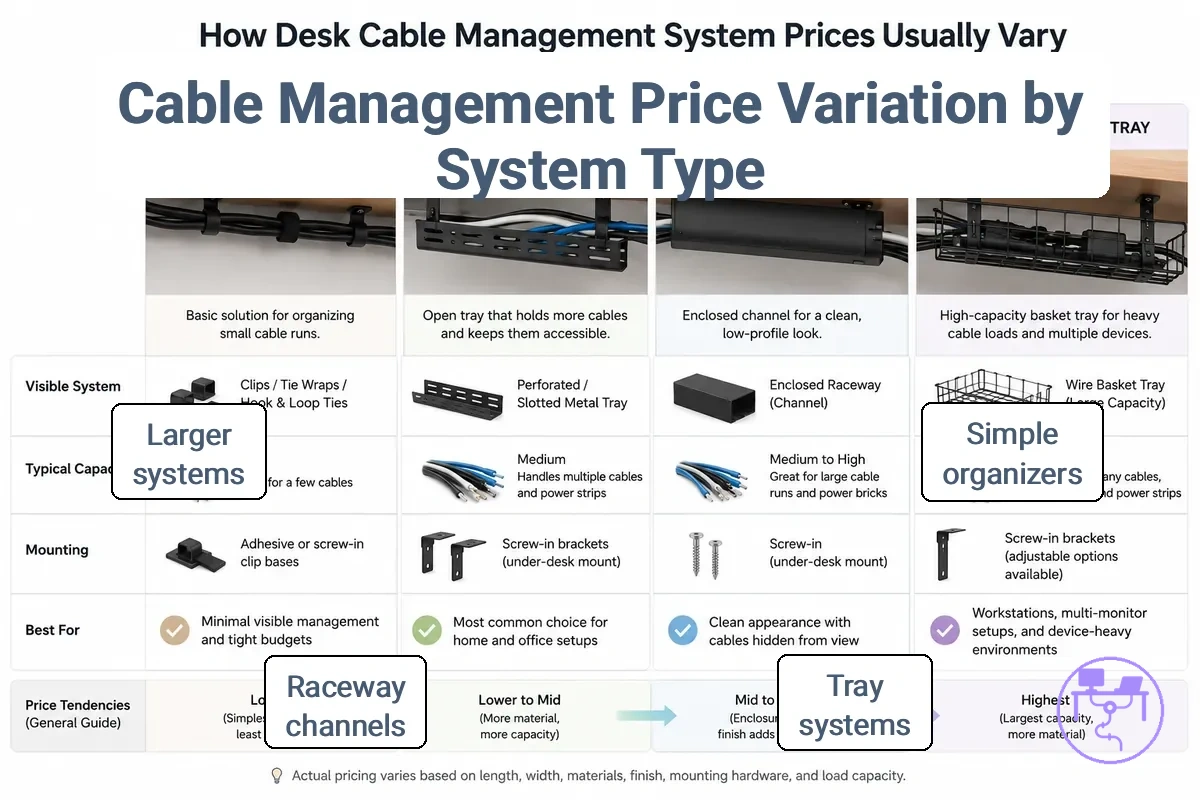
How desk cable management system prices usually vary can also be seen through visible capacity and mounting differences between common organizer types. The comparison image below highlights clips or ties, cable tray systems, raceway channels, larger trays, and simple labels without using prices, brand names, or ranking cues.
The table should be viewed as a cost-orientation guide rather than a fixed pricing rule. Simple organizers may provide suitable value for smaller desks, tray systems may fit average workstations, and larger systems may justify additional cost when cable load, capacity needs, and setup demand increase. Material, mounting, and accessory inclusion often influence where a system falls within different value tiers.
Low-cost clips, ties, sleeves, and simple organizers
Low-cost clips, ties, sleeves, and simple organizers can handle basic cable clutter when cable volume is low and a full tray or raceway system is not necessary. These accessories may be sufficient for light setups, but their value limit often appears as cable volume increases or cable routing requirements become more demanding.
Clips, ties, sleeves, and simple organizers each serve a different holding method or concealment role. These accessories are supportive components rather than complete heavy-capacity systems, and their suitability depends on cable volume and workspace conditions.
- Clips: Hold individual cables in place; suitable for low cable volume; value limit appears when multiple cables require centralized management.
- Ties: Group cables into bundles; suitable for low to moderate cable volume; value limit appears when concealment or guided routing is needed.
- Sleeves: Provide concealment for bundled cables; suitable for moderate cable volume along a visible path; value limit appears when cable separation or broader support is required.
- Simple organizers: Keep cables contained within a small area; suitable for basic cable clutter; value limit appears when cable density increases.
A light desk with a laptop, charger, and a small number of peripheral cables may only need clips, ties, sleeves, or simple organizers to stay organized. When cable volume grows, these accessories may still help, but additional cable management components can become necessary.
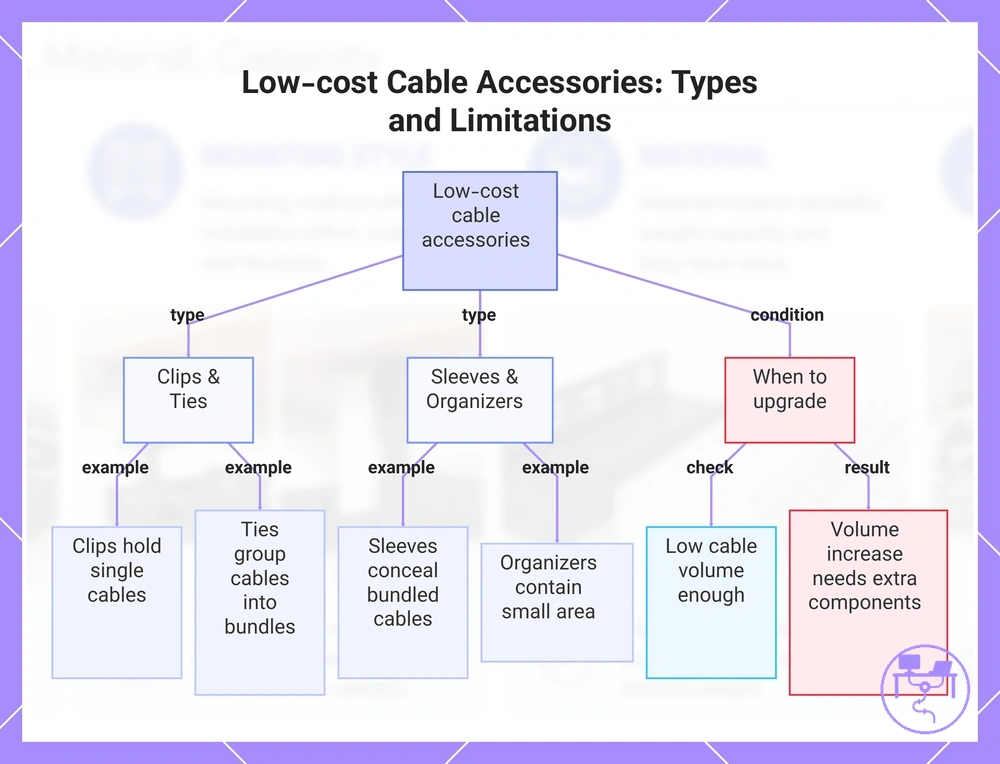
This chart shows the main types of low-cost cable accessories (clips, ties, sleeves, organizers), their holding or concealment roles, and the condition under which they are sufficient or require additional components.
Mid-range trays, raceways, and no-drill options
Mid-range systems often balance cost, cable control, and setup ease because trays, raceways, and no-drill options provide a practical middle ground between basic accessories and larger cable-management solutions. For typical desks, value often comes from matching mounting effort, capacity, visibility, and removability to the workspace rather than maximizing a single feature.
Trays, raceways, and no-drill options differ in how they manage cables and how much installation effort they require. The comparison below highlights the local trade-offs that commonly influence value outcomes.
| Option | Main value driver | Trade-off |
|---|---|---|
| Trays | Higher capacity with centralized cable storage | Usually requires greater mounting effort |
| Raceways | Lower cable visibility through guided routing | Capacity may be lower than larger tray-based setups |
| No-drill options | Easy removability and reduced installation effort | Stability may depend on desk surface, cable load, and use case |
Mid-range systems may provide balanced value because each subtype combines mounting effort, capacity, visibility, and removability in a different way. No-drill options can improve value even when upfront cost is not the lowest, particularly when desk modifications are undesirable. For a broader category-level comparison, compare system types, but the key consideration here is how these mid-range choices can suit typical desks under different conditions.
Higher-cost large-capacity and premium systems
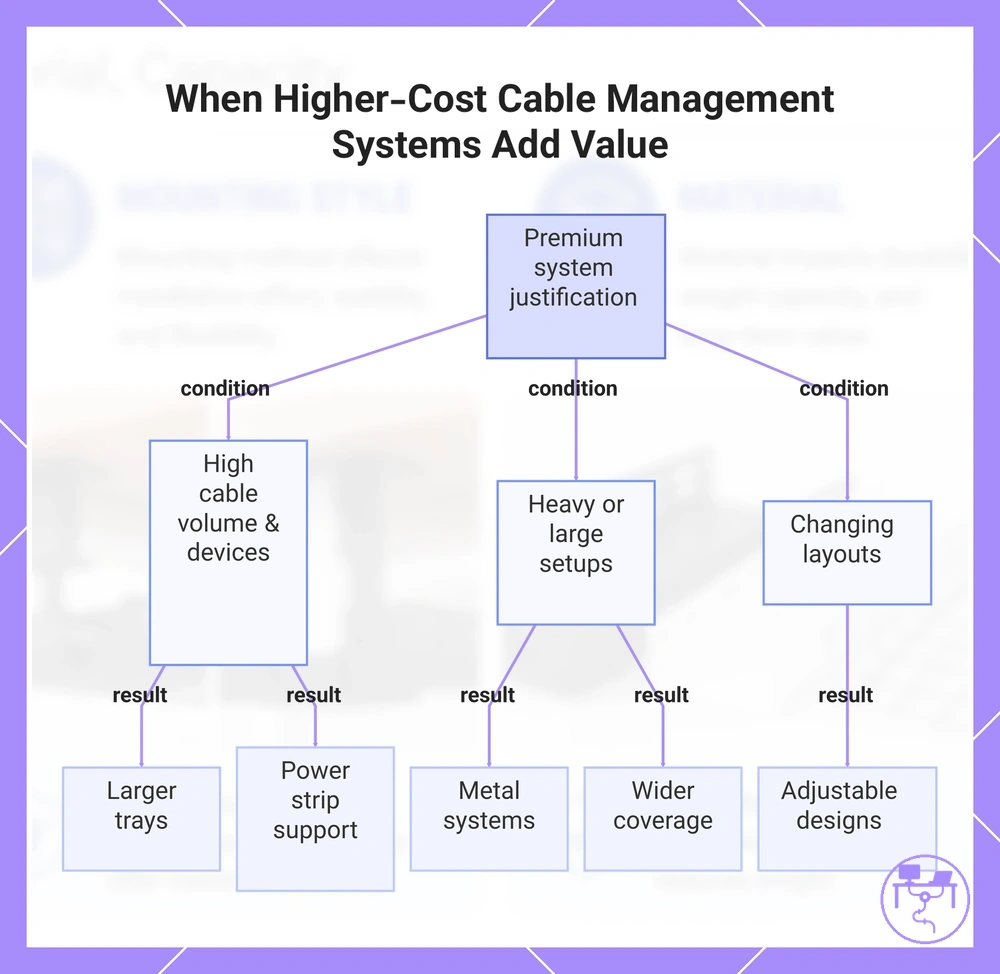
For heavier setups with higher cable volume, more connected devices, or greater power strip support needs, higher-cost large-capacity and premium systems may be justified because they are designed to manage broader support requirements. Larger trays, metal systems, and adjustable designs are not necessarily the right choice for every desk, but they can provide additional value when desk width, device count, and future adjustment needs exceed what simpler solutions may comfortably support.
Higher cost is often linked to support capacity, workspace scale, and adjustment flexibility. The checklist below highlights conditions where added features may contribute to value.
- Larger trays: When cable volume is high, greater capacity may help organize more cables within a single management area.
- Metal systems: When heavier setups require increased support, stronger construction may help reduce replacement risk over time.
- Adjustable designs: When equipment layouts change, adjustment features may improve long-term usefulness.
- Power strip support: When multiple devices share centralized power, dedicated support features may improve cable organization.
- Wider coverage: When desk width increases, large-capacity systems may provide more consistent cable management across the workspace.
A larger workstation with multiple connected devices and a mounted power strip may benefit from these features when support needs grow beyond basic cable-control solutions. Long-term value, durability, and replacement-risk reduction depend on cable load, workspace demands, and future adjustment requirements rather than premium positioning alone.
This chart shows the conditions under which premium cable management features add value and justify higher cost.
Cost factors that change desk cable management value
Cost factors that change desk cable management value are tied to fit, capacity, installation, and future use rather than price alone. Value increases when a desk cable management system matches cable load, mounting method, included parts, and desk compatibility requirements, while cost risk may increase when these conditions do not match the intended setup.
The criteria below connect each cost factor to an attribute, a value condition, and a decision effect. Using these relationships makes it easier to evaluate real value without relying only on price comparisons.
| Cost factor | Attribute to check | Value condition | Decision effect |
|---|---|---|---|
| Cable load | Capacity | Capacity suits cable volume and device count | May reduce cost risk from overcrowding or later upgrades |
| Mounting method | Installation | Installation approach suits desk structure | May improve usability and setup suitability |
| Included parts | Accessory coverage | Required components are already included | May reduce additional accessory costs |
| Desk compatibility | Fit | Dimensions and attachment style suit the desk | May help avoid unsuitable configurations |
| Future use | Adjustment potential | System can accommodate likely workspace changes | May extend value as requirements evolve |
Decision signals help clarify value outcomes. A cheaper system may create cost risk when cable load exceeds available capacity, when the mounting method does not suit the desk, or when necessary included parts are missing. A higher-cost system may be unnecessary when capacity needs are modest, desk compatibility is straightforward, and future use is unlikely to change significantly.
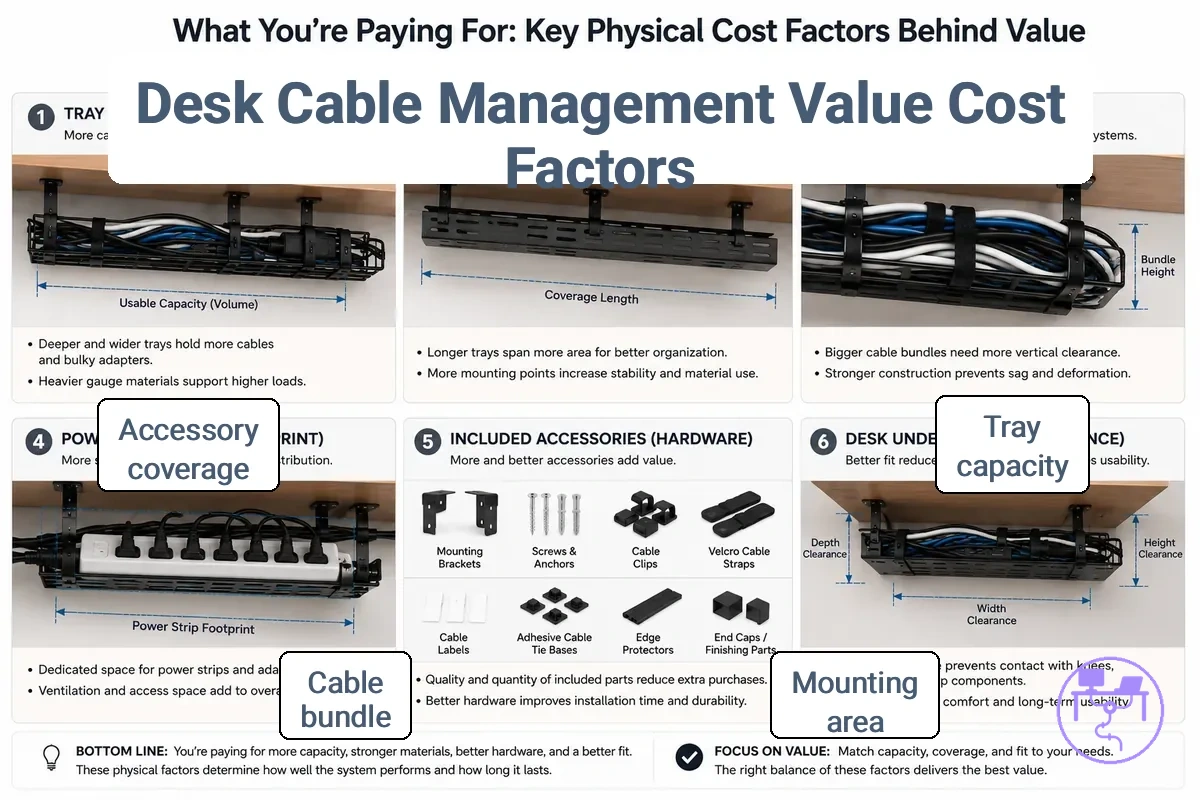
Cost factors that change desk cable management value are easier to understand when the physical attributes behind value decisions are visible. The image below highlights tray capacity, mounting area, cable bundle size, power strip area, included accessory examples, and desk underside fit without relying on brand, price, or ranking cues.
Cable load, tray capacity, and desk setup size
Cable load changes value when tray capacity matches cable volume, desk setup size, and access needs, because fit depends on how much equipment the organizer must support. Light cable bundles, such as a charger and a few device cables, may require less tray width and tray depth than heavier workstation cable groups that include multiple adapters and a power strip. Weight support and available underside space can also affect whether a cable management system remains practical for the intended setup.
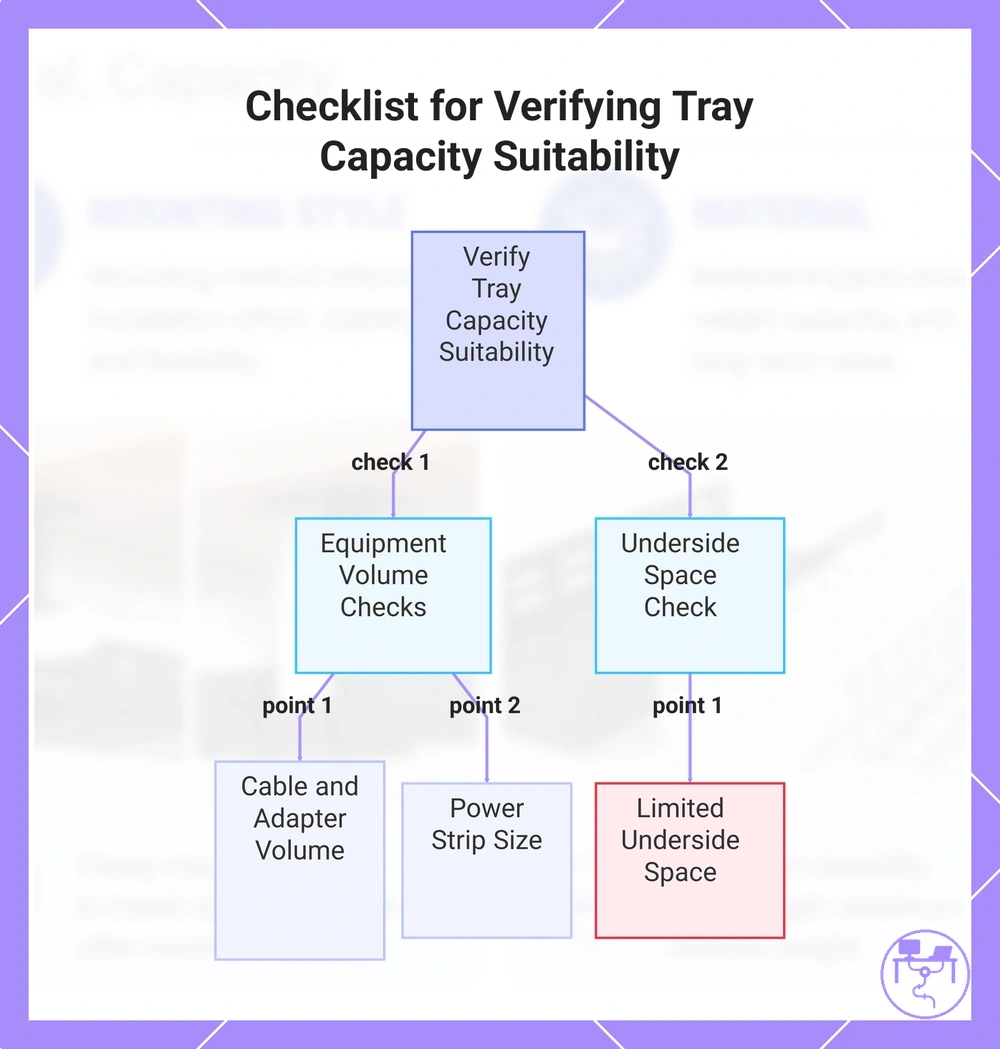
The checklist below helps verify whether tray capacity is likely to suit the workspace before capacity-related value decisions are made.
- Cable count: Higher cable volume may require greater tray width to maintain organization and improve cable access.
- Adapter bulk: Larger adapters may require additional tray depth, which can affect usable capacity and access needs.
- Power strip size: A larger power strip may increase tray capacity requirements and reduce available organizer space.
- Underside space: Limited underside space may affect fit, weight support suitability, and overall value for the desk setup size.
This chart shows the key factors to check when verifying whether a cable management tray has sufficient capacity for a desk setup.
Mounting method, hardware, and no-drill installation
Mounting method affects value because installation effort, removability, desk damage risk, and stability can vary by attachment type. Required hardware, desk surface condition, load tolerance, and long-term suitability influence whether a desk cable management system fits the workspace effectively. A no-drill installation may provide better value for rented spaces or desks where drilling is unsuitable, although stability and load tolerance still depend on the mounting system and desk conditions.
The comparison below shows how screw mount, clamp, adhesive, and no-drill options can change the cost-value equation through different trade-offs in suitability, risk, and removability.
| Mounting option | Value advantage | Fit caution |
|---|---|---|
| Screw mount | May provide strong stability on suitable desk surfaces | Desk damage risk may increase when drilling is required |
| Clamp | Usually supports removability without permanent modification | Fit depends on desk edge shape, thickness, and available space |
| Adhesive | Often reduces hardware requirements and installation effort | Stability may vary by surface condition and load tolerance |
| No-drill installation | May suit spaces where permanent changes are undesirable | Load tolerance and stability depend on the attachment method used |
Included components and accessory coverage
Included components affect kit value only when accessory coverage matches the intended setup. Clips, ties, sleeves, screws, adhesive pads, and power strip holders each perform a specific function, while missing add-ons may increase total cost if additional parts are needed to complete the installation. Kit value depends on setup completeness rather than the number of included items, and cost savings are more likely when the included components match actual requirements.
The functions below show how included components contribute to accessory coverage and where missing add-ons may affect setup completeness and total cost.
- Clips: Guide and secure individual cables; value improves when cable routing points are needed and separate cable holders are unnecessary.
- Ties and sleeves: Bundle and organize cable groups; value depends on whether cable containment or cable concealment is required for the setup.
- Screws: Support mounting systems that rely on fixed hardware; missing add-ons may create extra cost when compatible hardware is not included.
- Adhesive pads: Provide attachment on suitable surfaces without drilling; value depends on whether the mounting method requires adhesive support.
- Power strip holders: Secure power distribution equipment within the cable management area; missing add-ons may reduce setup completeness when centralized power organization is needed.
For example, included components such as clips, adhesive pads, and power strip holders may reduce separate accessory purchases when those parts are already required for the planned cable management layout.
Material choices that affect price and durability
Material choices affect price and durability because strength, load support, flexibility, finish, cable protection, and wear resistance can vary by material type and desk environment. Material value depends on matching these attributes to cable volume, mounting conditions, and long-term use rather than assuming that a higher-cost material provides better results in every situation.
The table below compares common material choices by cost tendency, durability factors, and use conditions that may influence long-term value.
| Material | Cost tendency | Durability factor | Better use case | Caution |
|---|---|---|---|---|
| Metal | Often higher | May provide greater load support under heavier cable conditions | Setups with larger cable bundles or mounted accessories | Weight, finish wear, and desk compatibility may affect suitability |
| Plastic | Often lower | May provide suitable durability for lighter cable loads | Basic cable routing and lighter desk setups | Load support and wear resistance may vary by design and material type |
| Wire or mesh | Usually moderate | Can balance strength and flexibility depending on construction | Workspaces that benefit from cable visibility and access | Open designs may provide less cable protection and concealment |
| Sleeve material | Usually moderate | Focuses on cable protection, grouping, and flexibility | Visible cable runs that benefit from coverage | May not provide structural load support |
Material choices that affect price and durability become easier to evaluate when visible differences are compared directly. The image below compares material characteristics that can influence cost and long-term use decisions.
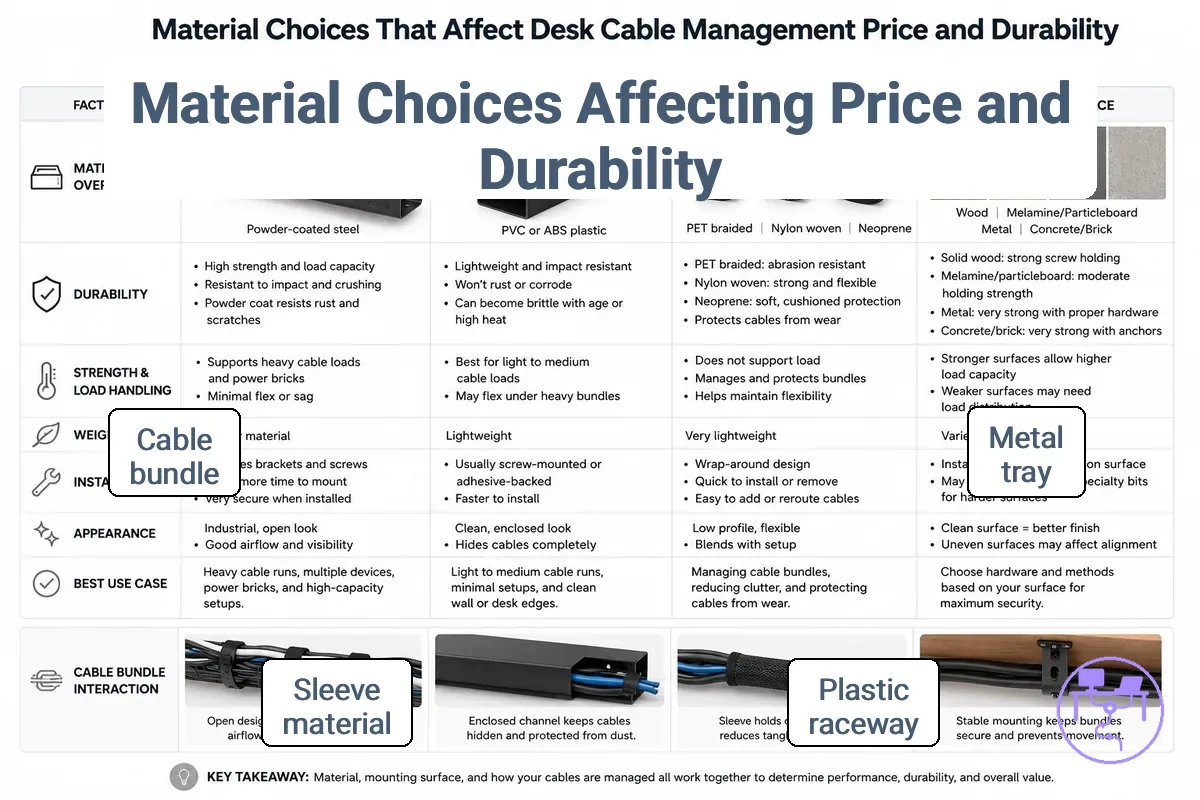
Material trade-offs are most useful when viewed as condition-based decisions rather than rankings. Metal may offer additional strength and load support in certain desk environments, while plastic may provide sufficient flexibility and cable protection for lighter setups. Wire, mesh, and sleeve materials introduce different balances between finish, wear resistance, accessibility, and cable coverage, so long-term value depends on how the material aligns with workspace requirements.
Metal trays for heavier cable loads and longer use
Metal trays may justify higher cost when heavier cable loads require greater load support, rigidity, and mounting stability over time. A metal tray is not necessary for every desk, but it can provide better value when cable volume, power accessories, or equipment changes place additional demands on weight support and adjustment tolerance. Longer use depends on tray construction, mounting quality, load conditions, and the desk environment rather than material alone.
The checks below help identify situations where metal trays may align more closely with heavier-load value requirements.
- Weight support: A metal tray may provide additional support when multiple device cables, adapters, or a mounted power strip increase cable-management load.
- Rigidity and mounting strength: Greater rigidity may help maintain tray shape and mounting stability when cable bundles become denser or equipment changes occur.
- Ventilation: Open metal tray designs may improve airflow around cable bundles and power accessories when heat buildup is a consideration.
- Adjustment tolerance: A metal tray may remain suitable through layout changes when cables, adapters, or connected devices are added or reorganized over time.
For example, a workstation that includes a power strip, multiple adapters, and several connected devices may benefit from a metal tray when cable-management demands exceed what lighter-duty solutions are intended to support. The value outcome depends on load conditions, mounting strength, adjustment tolerance, and longer-use expectations rather than on material type alone.
Plastic raceways for lighter and lower-cost routing
Plastic raceways are often a cost-effective choice when lighter routing, cable concealment, and lower upfront cost are the primary goals. A plastic raceway may suit desks with lighter load requirements and visible cable runs that benefit from cleaner visual control, while suitability depends on cable volume, surface condition, and the intended routing objective.
The comparison note below helps define where plastic raceways fit relative to solutions designed for greater cable capacity.
- Use case: A plastic raceway focuses on concealment and lighter routing, while tray-based solutions may be more suitable when larger cable groups need organized storage.
- Strength: Adhesive mounting may provide suitable support for lighter load conditions when the mounting surface is appropriate and cable weight remains moderate.
- Limitation: Plastic raceways often support appearance and routing more than high-capacity storage, particularly when power strips, multiple adapters, or dense cable bundles are involved.
Plastic raceways can improve concealment by guiding cables through a defined path while reducing visible clutter. Adhesive mounting may simplify installation on suitable surfaces, but lighter load handling and long-term hold can vary with cable weight, surface condition, and routing layout. For example, a raceway may suit monitor, keyboard, and charging cables, while a tray may be more appropriate when cable management includes heavier accessory loads.
When a larger or adjustable cable tray gives better value
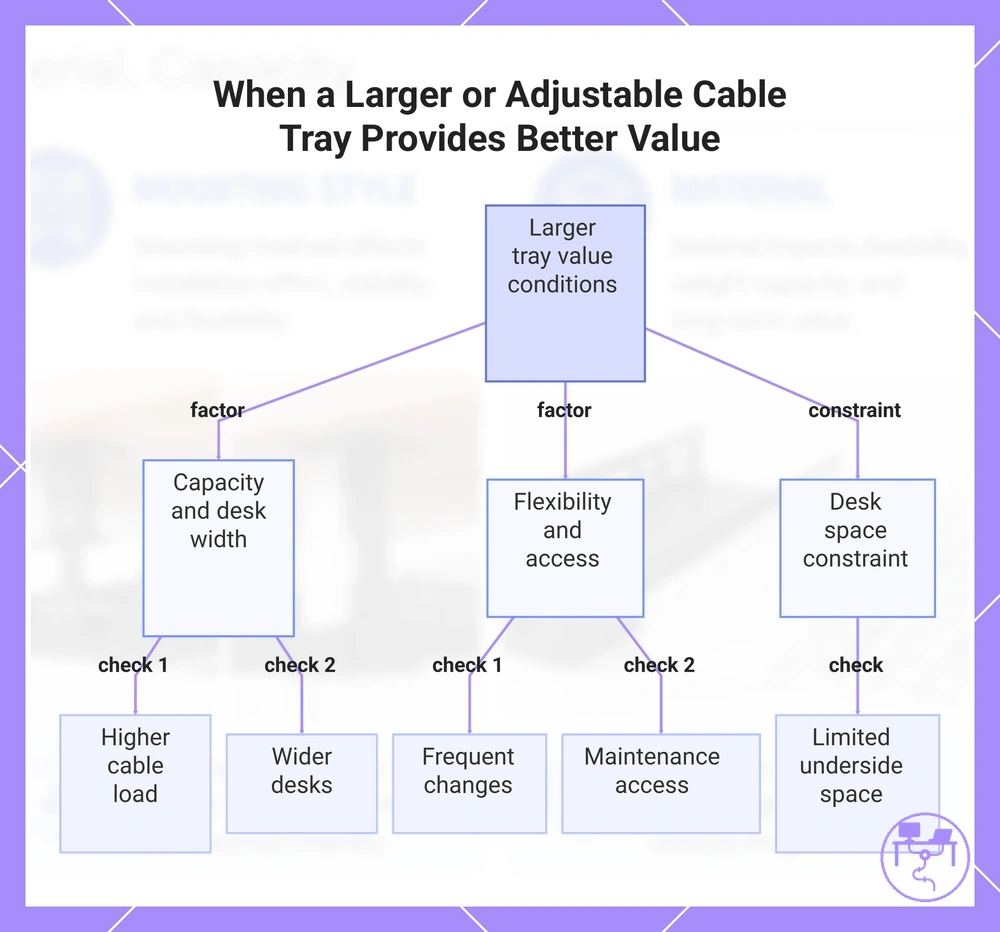
A larger cable tray or adjustable cable tray can provide better value when cable load, desk width, device count, and future setup changes are likely to increase beyond current requirements. Paying more is often justified when additional capacity, maintenance access, slack control, or reconfiguration flexibility may reduce the need for replacement or reorganization later. Fit and value still depend on available desk space and the intended cable-management layout.
The checklist below helps determine whether added size or adjustability is likely to improve long-term value.
- Higher cable load: A larger cable tray may provide additional capacity for cable storage and slack control when device count increases.
- Wider desks: Greater tray size may improve cable organization across a broader desk width when cable runs become longer or more distributed.
- Frequent changes: An adjustable cable tray may improve reconfiguration ease when future setup changes are expected.
- Power-strip storage: Additional tray space may improve organization when a power strip and multiple adapters need centralized placement.
- Maintenance access: Adjustable positioning may make cable access easier when cables require periodic updates or replacement.
For example, a growing workstation that adds peripherals over time may benefit from extra upgrade room, while a desk with limited underside space may require careful evaluation before choosing a larger tray. When assessing larger multiple monitor setups, tray size or adjustability may support cable organization more effectively when cable load, access requirements, and future changes justify the additional cost.
This chart shows the key conditions that determine whether a larger or adjustable cable tray will improve long-term value.
How kits and bundles change the total cost
Kits and bundles can change total cost when the included accessories contribute to a complete setup and reduce the need for separate purchases. A kit or bundle may provide better value when included accessories have strong desk-fit relevance, while missing-part risk and duplicate-part waste often determine whether the package improves overall cost efficiency.
The comparison below shows how different buying routes can influence total cost through inclusion, completeness, and potential waste.
| Buying route | Value advantage | Cost risk | Better when |
|---|---|---|---|
| Kit | Included accessories may support a more complete setup | Duplicate-part waste may increase if included items are unnecessary | Multiple required components are not already available |
| Bundle | Grouped accessories may reduce missing-part risk | Desk-fit relevance may be lower if included parts do not match the setup | Most included components are likely to be used |
| Single item | Focuses spending on one specific requirement | Additional purchases may increase total cost later | Existing accessories already support a complete setup |
A single item may be the better choice when only one component is needed or when current accessories already cover most requirements. Kits and bundles may improve total cost outcomes when included accessories match actual needs, but duplicate-part waste and low desk-fit relevance can reduce the value advantage that a larger package might otherwise provide.
Cable clips, ties, sleeves, and starter-kit coverage
Starter-kit coverage supports routing, grouping, hiding, and adjusting cables because each component serves a different cable-management role within the same setup. Cable clips, ties, sleeves, and related components contribute value when they help complete specific cable jobs without requiring additional accessories, provided the included items match the setup's needs.
The component roles below show how starter-kit coverage contributes to cable organization and setup completeness.
- Cable clips: The component supports routing and path control by holding individual cables along a planned cable route, which may improve organization when cable direction matters.
- Ties: The component supports grouping by securing multiple cables into a bundle, which can simplify cable handling and reduce cable spread.
- Sleeves: The component supports hiding by covering grouped cables, which may improve concealment when cable bundles remain visible.
- Mixed starter-kit extras: The component supports adjusting cables through accessories such as reusable fasteners or mounting aids, which may add value when cable layouts change over time.
For example, starter-kit coverage that includes cable clips, ties, and sleeves may prevent separate purchases when the same setup requires routing, grouping, and hiding cables within a single cable bundle.
Power strip holder inclusion and practical value
Power strip holder practical value depends on compatibility conditions such as size fit, weight support, plug access, heat clearance, cable path, and desk layout. A power strip holder is most useful when these conditions match the actual power strip and workspace arrangement, because support, access, and cable grouping benefits depend on fit rather than on holder inclusion alone.
The checklist below highlights the main conditions to verify before treating a power strip holder as a practical advantage.
- Size fit: If the component matches the power strip dimensions, the holder may improve organization and support placement more effectively.
- Weight support: If the component can support the combined weight of the power strip and connected cables, the holder may remain more practical during everyday use.
- Plug access: If the holder position maintains convenient plug access, the component may make device connections and cable changes easier to manage.
- Heat clearance and cable path: If adequate heat clearance and a suitable cable path are maintained, the component may improve cable grouping while supporting access within the desk layout.
A power strip holder increases practical value only when its size fit, weight support, plug access, heat clearance, and cable path conditions align with the actual power strip and desk layout. Compatibility should be verified before assuming the holder will improve a specific setup.
Budget options versus long-term value
Budget options versus long-term value depends on desk conditions, cable load, adjustment needs, and setup stability rather than upfront cost alone. A lower-cost solution may provide suitable usefulness for light-duty setups, while a higher-cost solution may offer better long-term value when cable-management demands, future changes, or replacement risk are more significant.
Comparing user situations instead of product price helps clarify when paying less or investing more aligns with actual requirements.
| Scenario | Budget option advantage | Long-term value risk | Better decision cue |
|---|---|---|---|
| Short-term workspace | Lower upfront cost | Usefulness may decline if requirements change | Choose based on expected duration of use |
| Rented desk setup | Removability may be easier to prioritize | Replacement risk may increase if future needs expand | Match the solution to desk restrictions and flexibility needs |
| Light-use cable load | Capacity may already be sufficient | Future adjustment needs may exceed available capacity | Evaluate likely cable growth before deciding |
| Heavier long-term setup | Lower initial spending | Setup stability, capacity, or adjustment needs may require later changes | Consider long-term use conditions and cable load |
Long-term value is often tied to how well a cable-management solution handles future adjustment needs, capacity changes, and ongoing setup stability. Budget options can remain practical when cable load is limited and workspace requirements are unlikely to change, while longer-use environments may benefit from features that reduce replacement risk.
The comparison becomes more useful when the expected use period, removability requirements, and cable-management demands are evaluated together rather than separately. A lower upfront cost may be appropriate for temporary or light-use conditions, while a solution with greater capacity or flexibility may provide stronger long-term value when cable load and adjustment needs are expected to increase. Readers who want a broader selection framework can choose by value and fit.
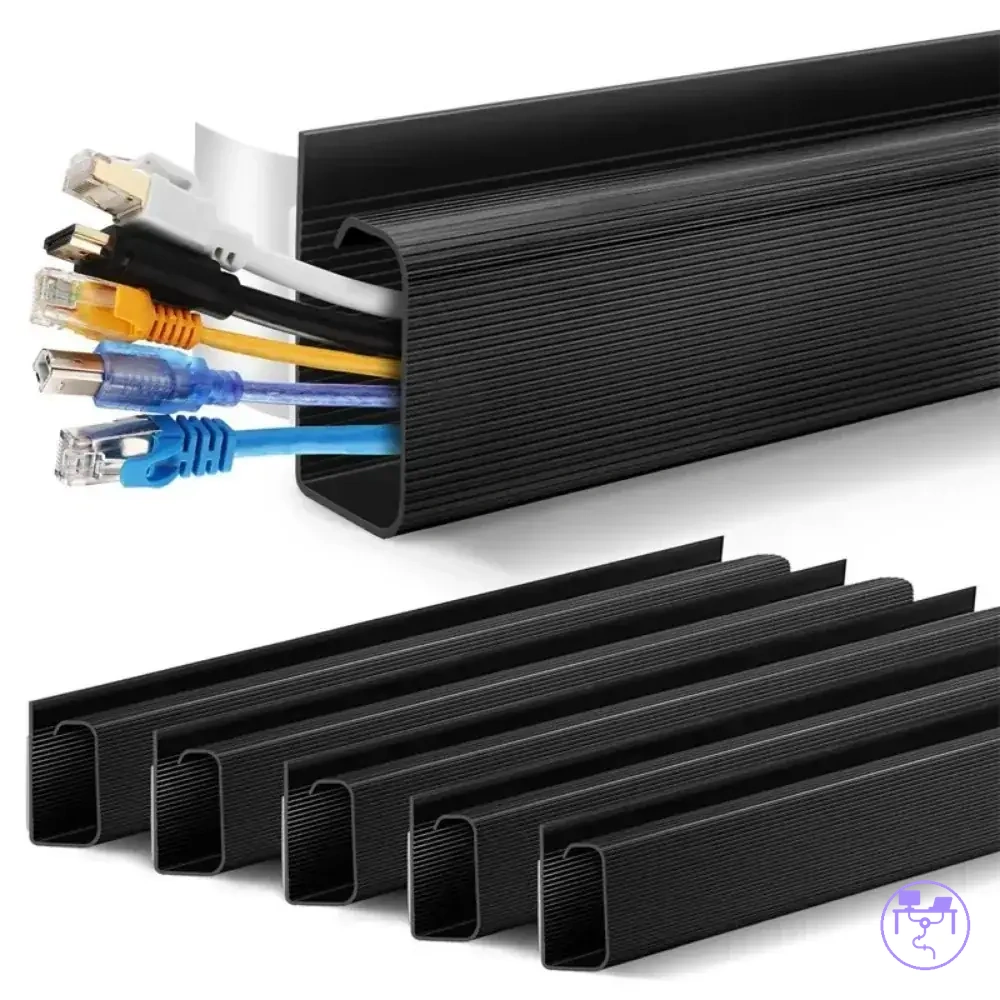
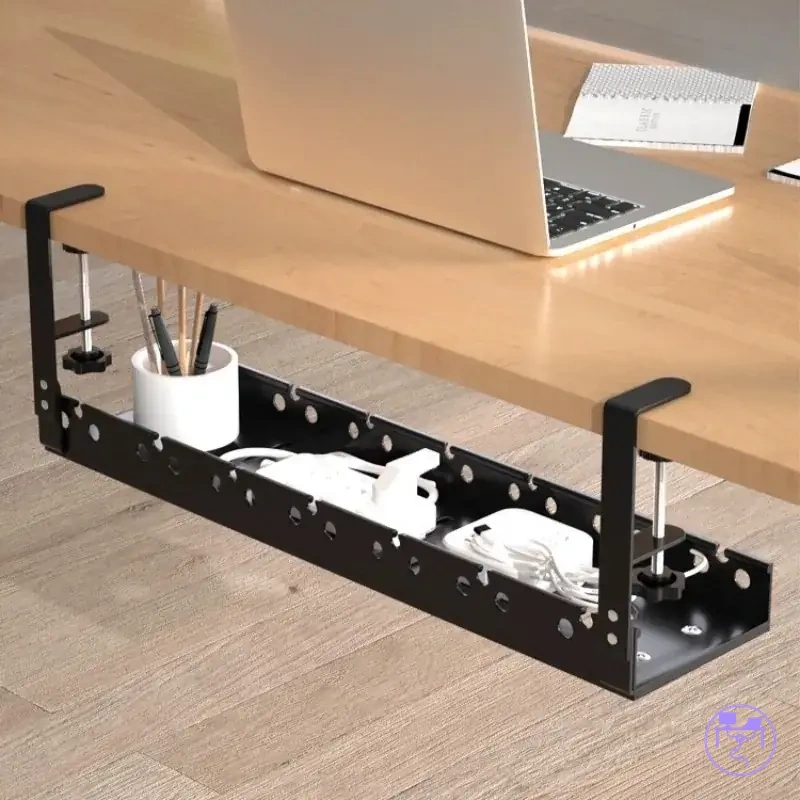
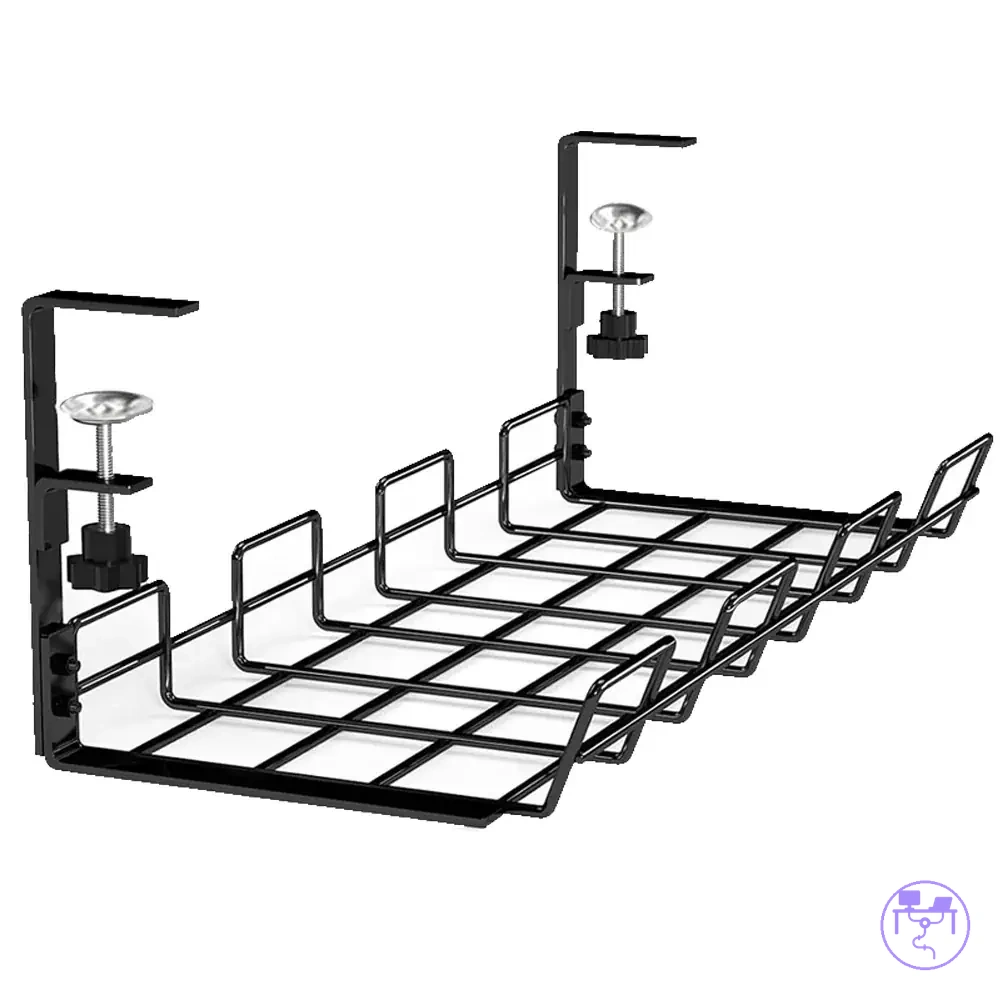
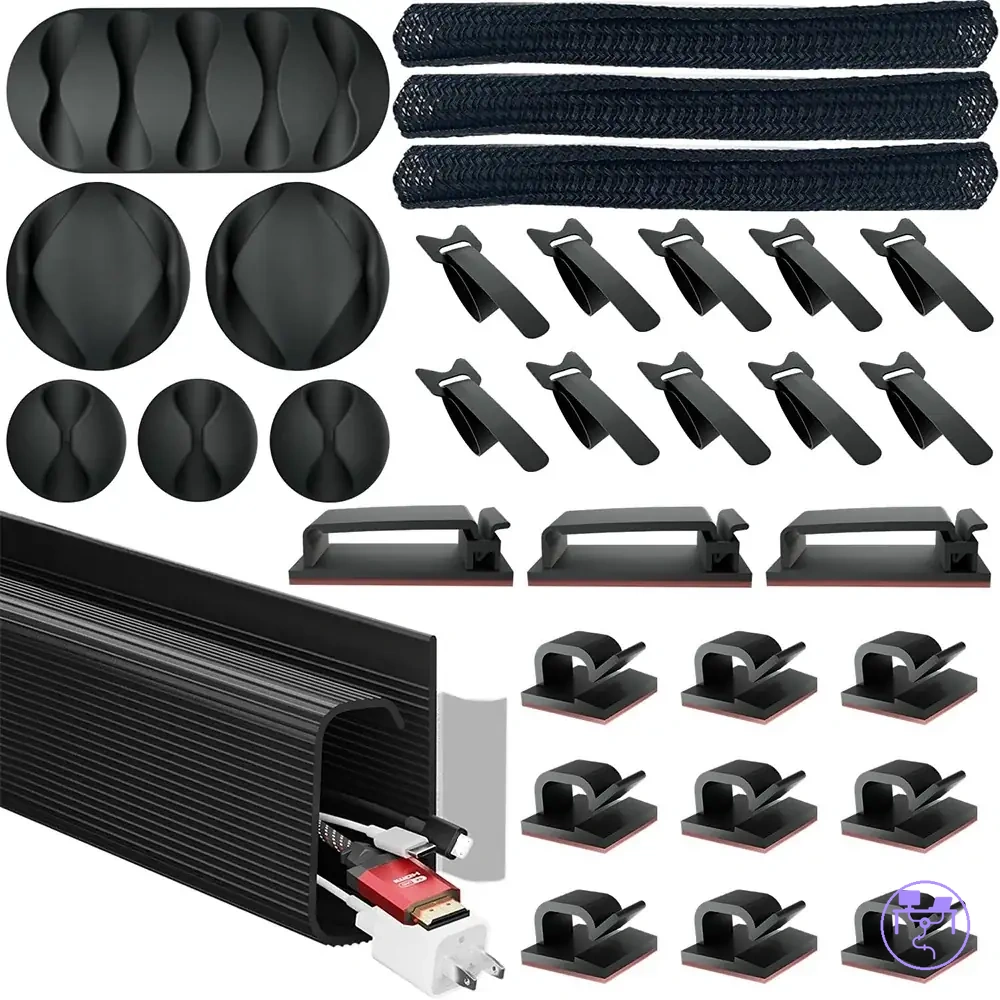
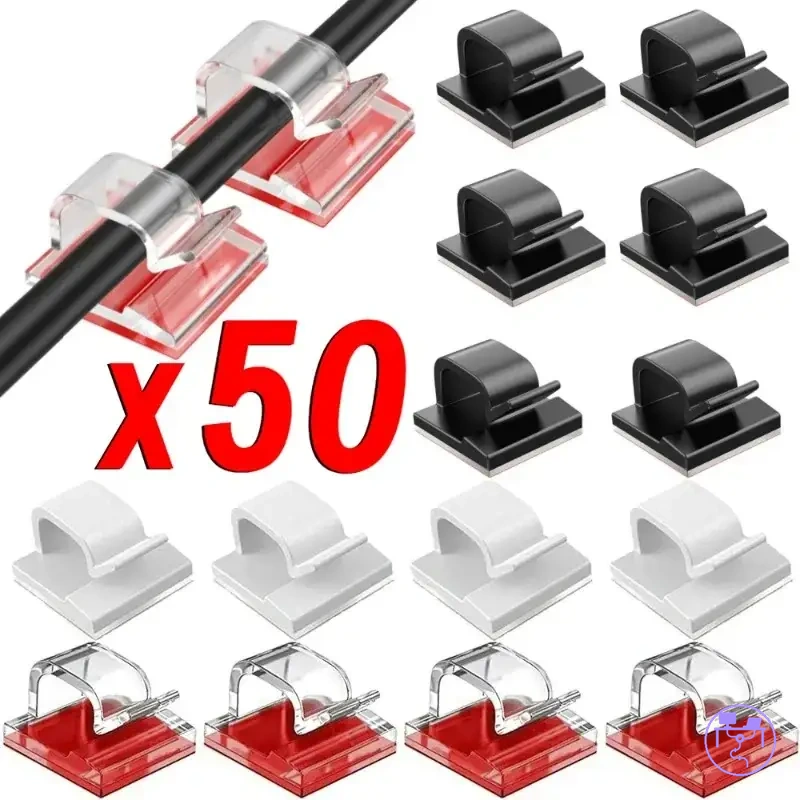
The products below are useful examples for comparing available options. Before buying, check that the compatibility criteria, key features, and product details match your needs.
When cheap desk cable management is enough
Cheap desk cable management can be sufficient when the setup has a light cable load, low movement, simple routing needs, and low visibility requirements. A low-cost option may suit a stable desk with a laptop charger, one peripheral cable, and a fixed power connection, but suitability becomes less certain when cable count increases, devices move often, or future clutter is likely.
The checklist below helps verify whether a cheap option is likely to stay practical for the current setup.
- Light cable load: A small cable count may make low-cost clips, ties, or simple organizers sufficient without requiring larger cable storage.
- Low movement: A setup with devices that rarely move may reduce strain on basic cable holders and improve suitability.
- Simple routing: A clear cable path and available desk underside space may allow a basic organizer to manage cables without creating access issues.
- Low visibility: A desk with limited aesthetic need may not require more concealed or higher-capacity cable management.
When paying more reduces replacement or adjustment needs
Paying more may reduce replacement needs, adjustment needs, or add-on purchases when the higher upfront cost provides durability, adjustability, capacity, mounting strength, or accessory completeness that better matches the setup. The benefit depends on future cable-management demands, because higher-cost features are most useful when cable load, device count, or access requirements are likely to change over time.
The scenarios below show when a higher-cost feature may reduce future friction under specific setup conditions.
- Higher durability: Greater durability may reduce replacement needs when cables and accessories remain in regular use over a longer period.
- More adjustability: Additional adjustability may reduce adjustment needs when a growing device setup is likely to require cable-route or equipment changes.
- Larger capacity: Increased capacity may reduce add-on purchases when heavier adapters or additional cables are expected to be added later.
- Stronger mounting strength: Greater mounting strength may reduce future repositioning needs when cable weight or accessory load increases.
- Better accessory completeness: More complete accessory coverage may reduce add-on purchases when repeated cable access requires supporting cable-management components.
Higher-cost features do not guarantee savings or permanent performance, but they may reduce future friction when setup growth, heavier adapters, or repeated cable access make basic solutions less suitable over time.
Cost-value checks before choosing a desk cable management system
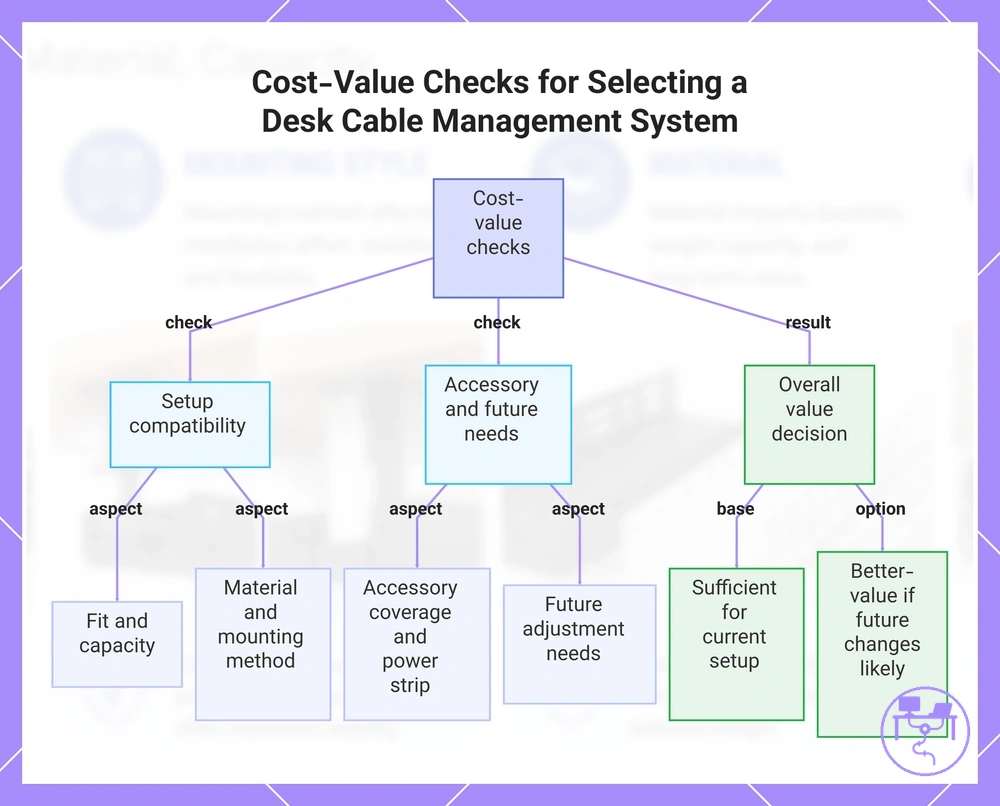
Cost-value checks help prevent choosing a desk cable management system that is either too limited for the setup or more complex than necessary. The final selection depends on whether fit, capacity, material, mounting method, accessory coverage, power strip support, and future adjustment needs align with actual workspace requirements.
Use the checklist below to confirm that the desk cable management system matches current needs and likely future changes before choosing.
- Fit: Verify that the system suits the available desk space; if fit is limited, installation or cable access may become more difficult.
- Capacity: Check that cable capacity matches the current cable load and any expected additions; insufficient capacity may increase future adjustment needs.
- Material: Confirm that the material matches the intended load and usage conditions; heavier setups may benefit from greater durability when needed.
- Mounting method: Ensure the mounting method suits the desk surface and installation restrictions; suitability depends on desk conditions and modification limits.
- Accessory coverage: Verify that included accessories support the planned cable-management layout; missing components may lead to add-on purchases.
- Power strip support: Check whether power strip support is needed and whether the system can accommodate it under the intended setup conditions.
- Future adjustment: Consider whether device additions, cable changes, or repeated access are likely; greater adjustability may reduce future friction when changes are expected.
A desk cable management system often provides enough value when it meets the current setup without creating obvious limitations. Better-value choices may offer additional capacity, adjustability, or accessory completeness when future changes are likely, while overbuilt choices may include features that are unlikely to be used.
For a broader decision framework that complements these cost-value checks, review the buying checklist before making a final selection.
The products below are useful examples for comparing available options. Before buying, check that the compatibility criteria, key features, and product details match your needs.
This chart shows the key cost-value checks to perform before choosing a desk cable management system, grouped by setup compatibility, accessory needs, and overall value assessment.