Desk Cable Organizer Types Compared: Tray, Raceway, Sleeve, and Clips
Desk cable organizer types differ by the kind of cable control they provide. A cable tray gives open cable support for heavier under-desk cable load. A cable raceway creates a closed channel for concealment, a cable sleeve groups moving cables with flexibility, and cable clips hold small leads at a fixed point. The main comparison axes are support, concealment, flexibility, and point holding.
A desk cable organizer is a cable management part that keeps desk cables supported, covered, grouped, or fixed depending on the cable condition. A tray usually suits open support and access when the cable load needs space. A raceway usually suits visible cords when concealment matters, while a sleeve suits a cable group that may need movement, and clips suit small leads that need adhesive hold at a fixed point. For the broader category context, see the desk cable management system overview.
A power-heavy under-desk setup may need tray support before appearance is considered, while visible edge cables may need a raceway before open access matters. A moving cable group may fit a sleeve when flexibility is more useful than rigid storage. Small charger, keyboard, or peripheral leads may need clips when point holding matters more than bundle capacity. The sections below compare each type by role and use condition without ranking products.
What trays, raceways, sleeves, and clips do for desk cables
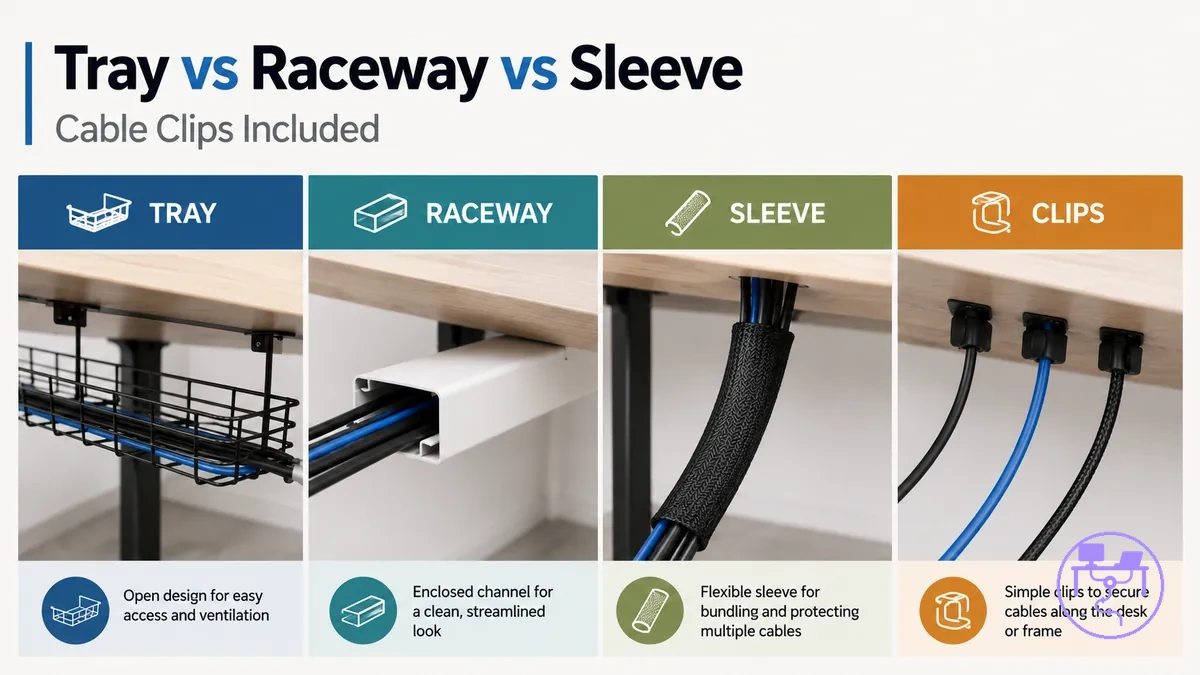
Tray, raceway, sleeve, and clips are desk cable organizer parts that control desk cables in different ways. A tray supports a cable bundle under the desk, a raceway covers a visible cable path, a sleeve groups cables into a flexible bundle, and clips hold small leads at fixed points. The useful part depends on the cable condition, such as weight, visibility, movement, or access need.
Each organizer has a specific cable-control role inside a larger setup, and the same desk may use more than one part when cable load, visibility, and access needs differ. A tray can support cables below the desk surface, a raceway can reduce exposed cords along a visible edge, a sleeve can keep a moving group together, and clips can keep small leads from slipping away from the access point. These cable management system parts work as separate roles, not as the same solution.
What trays, raceways, sleeves, and clips do for desk cables is easier to compare when the visible cable-control role is labeled before the table. The image clarifies how tray support, raceway concealment, sleeve bundling, and clip point holding differ in a simple desk cable context.
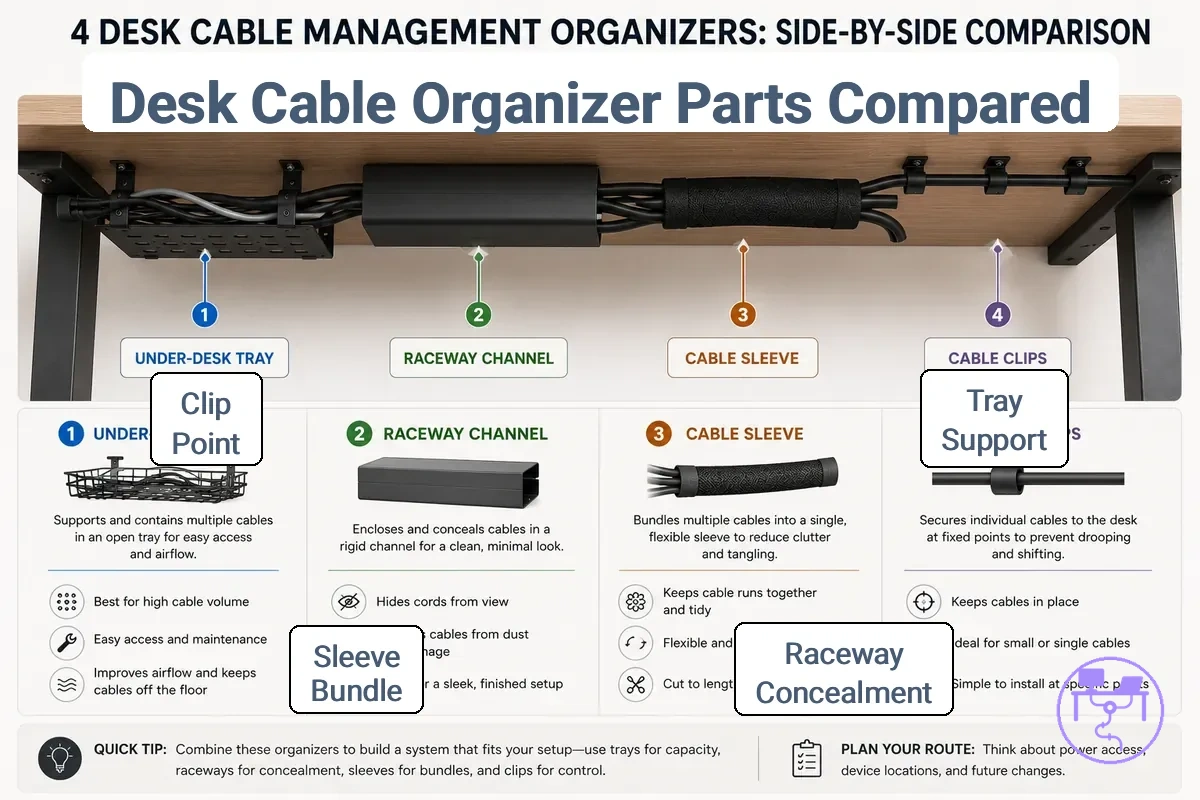
The table compares each option by main role, strength, limitation, and the condition where it usually fits better.
| Option | Main role | Strength | Limitation | Best-fit condition |
|---|---|---|---|---|
| Tray | Supports a cable bundle under the desk | Provides open cable support with easier access | May leave cables visible if the desk underside is exposed | Cable load needs space, support, and access |
| Raceway | Covers a cable path in a channel | Improves concealment for visible edge cords | May limit quick access compared with open support | Visible cords need a cleaner covered path |
| Sleeve | Groups cables into one flexible bundle | Keeps a cable group together while allowing movement | May not support bulky adapters or heavy cable load by itself | Cables move together and need flexible bundling |
| Clips | Hold small leads at fixed points | Create a clip point for light access cables | Adhesive hold may depend on surface condition and cable tension | Small leads need point holding near an access area |
Cable tray vs raceway for open support and closed concealment
Cable tray vs cable raceway depends on cable access, visibility needs, cable load, and the mounting surface available in the desk setup. A cable tray provides open support, while a cable raceway provides closed concealment through an enclosed channel. The right option can vary when desk layout, cable count, and access requirements change.
Cable tray and cable raceway serve different cable-control priorities. A cable tray keeps cables more accessible and may suit setups that include a power strip or changing cable connections. A cable raceway guides cables through a closed channel and may suit a visible edge where concealment is more important. Open support and closed concealment address different conditions, and the mounting surface can influence how each option fits within a desk layout.
Cable tray vs raceway for open support and closed concealment is easier to understand when the visible differences are shown side by side. The image compares cable access gaps, concealed cable paths, and the contrast between open support and closed concealment.
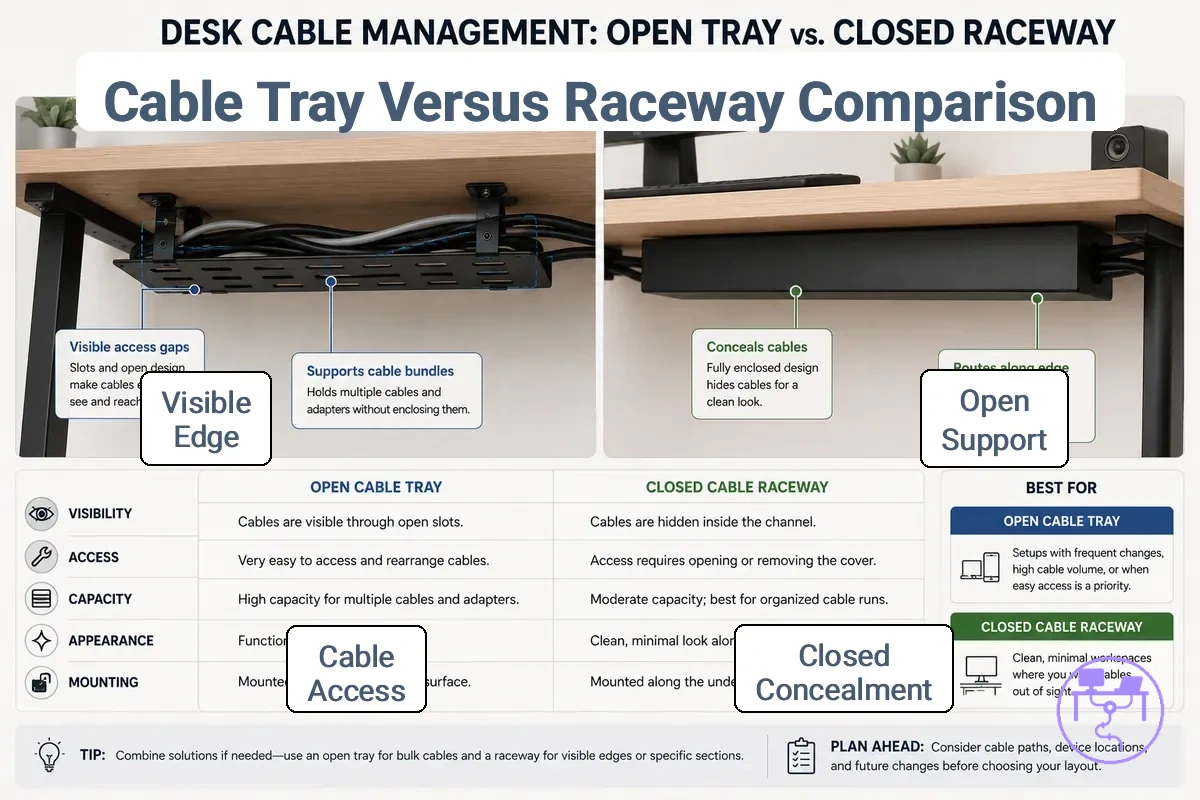
The table compares each option by role, strength, limitation, and the condition where it may fit more effectively.
| Option | Main role | Strength | Limitation | Best-fit condition |
|---|---|---|---|---|
| Cable tray | Open support | Provides easier cable access | May leave cables more visible | Power-heavy under-desk setup with changing cable load |
| Cable raceway | Closed concealment | Improves concealment along a visible cable path | Access may be less direct than with a cable tray | Visible edge-routing setup where cable exposure matters |
A cable tray may fit when cable access and support are higher priorities, while a cable raceway may fit when cable concealment along a visible route matters more. Within broader types of cable management systems, the decision depends on desk layout, cable load, mounting surface, and visibility requirements rather than a single preferred option.
Cable tray vs sleeve for capacity, flexibility, and access
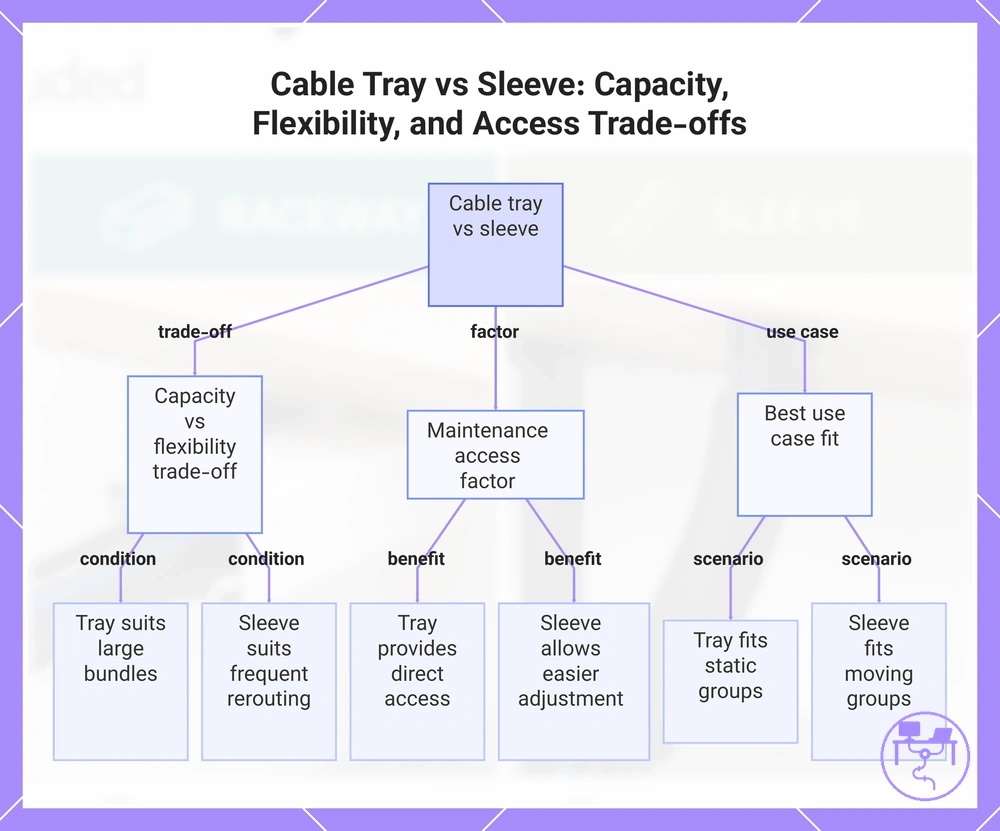
Cable tray vs cable sleeve depends on the balance between capacity, flexibility, and maintenance access. A cable tray provides fixed storage for a cable bundle, while a cable sleeve provides flexible bundling that can move with cables. The better fit usually depends on bundle size, rerouting frequency, and how often cable access is needed.
A cable tray may suit larger cable bundle conditions when monitor cables, power cables, and a power strip need organized under-desk storage. A cable sleeve focuses on keeping a cable bundle together while allowing bend movement and easier adjustment when device leads change position. Capacity and flexibility create the main trade-off because a larger bundle may benefit from fixed storage, while frequent rerouting may favor a flexible sleeve. Maintenance access can also influence the decision when cables need periodic inspection, replacement, or reorganization.
- Cable tray: Fixed storage that may support larger cable bundle capacity and more direct maintenance access.
- Cable sleeve: Flexible bundling that may simplify movement and rerouting of grouped cables.
- Static cable groups: Power strips and monitor cables may fit a cable tray when the bundle changes infrequently.
- Moving cable groups: Device leads may fit a cable sleeve when adjustment and bend movement occur more often.
A cable tray may fit better when underside space is available and the cable bundle remains relatively stable. A cable sleeve may fit better when flexibility, movement, and rerouting are more important than storing a larger cable bundle. The decision depends on capacity needs, maintenance access requirements, and how frequently the cable bundle changes over time.
This chart compares cable tray and cable sleeve based on capacity, flexibility, maintenance access, and recommended use cases.
Cable clips vs trays for point holding and cable bundles
Cable clips vs cable tray depends on whether cables need point holding or bundle-level storage. Cable clips secure small leads at a fixed point, while a cable tray supports cable bundles across a larger under-desk area. The better choice usually depends on cable quantity, cable weight, and access frequency.
Cable clips may help keep small leads accessible when cables need to stay within reach. A cable tray is designed for bundle storage and may suit heavier under-desk cable groups that are difficult to manage through point holding alone. Adhesive hold can vary with surface material, cable tension, and cable weight, so clip performance depends on the installation condition. A cable tray may also help keep multiple cables organized in one location when clutter is more likely to return.
Cable clips vs trays for point holding and cable bundles becomes easier to evaluate when cable quantity and holding role are compared directly. The table highlights the trade-off between fixed-point cable control and bundle-level cable storage.
| Option | Main role | Strength | Limitation | Best-fit condition |
|---|---|---|---|---|
| Cable clips | Point holding | Keeps small leads accessible at a fixed point | Adhesive hold may vary with surface material, cable tension, and cable weight | One or a few small leads need frequent access |
| Cable tray | Bundle storage | Supports cable bundles in a shared under-desk area | May be less useful for managing a single cable at a fixed point | Multiple cables need organized storage and access |
Cable clips may fit when a small number of cables need consistent point holding, while a cable tray may fit when cable bundles require centralized storage. The decision depends on cable quantity, cable weight, access frequency, and whether the setup needs fixed-point control or broader bundle organization.
Comparison factors that change the best desk cable organizer choice
Comparison factors that change the best desk cable organizer choice depend on multiple criteria rather than a single feature. Criteria such as cable load, visibility, access, mounting method, desk fit, and change frequency can affect organizer selection. The correct choice usually depends on how these conditions interact within the desk setup.
Comparison factors that change the best desk cable organizer choice become easier to understand when the decision variables are organized side by side. The image clarifies how cable load, visibility, access, mounting method, desk fit, and change frequency influence organizer choice.
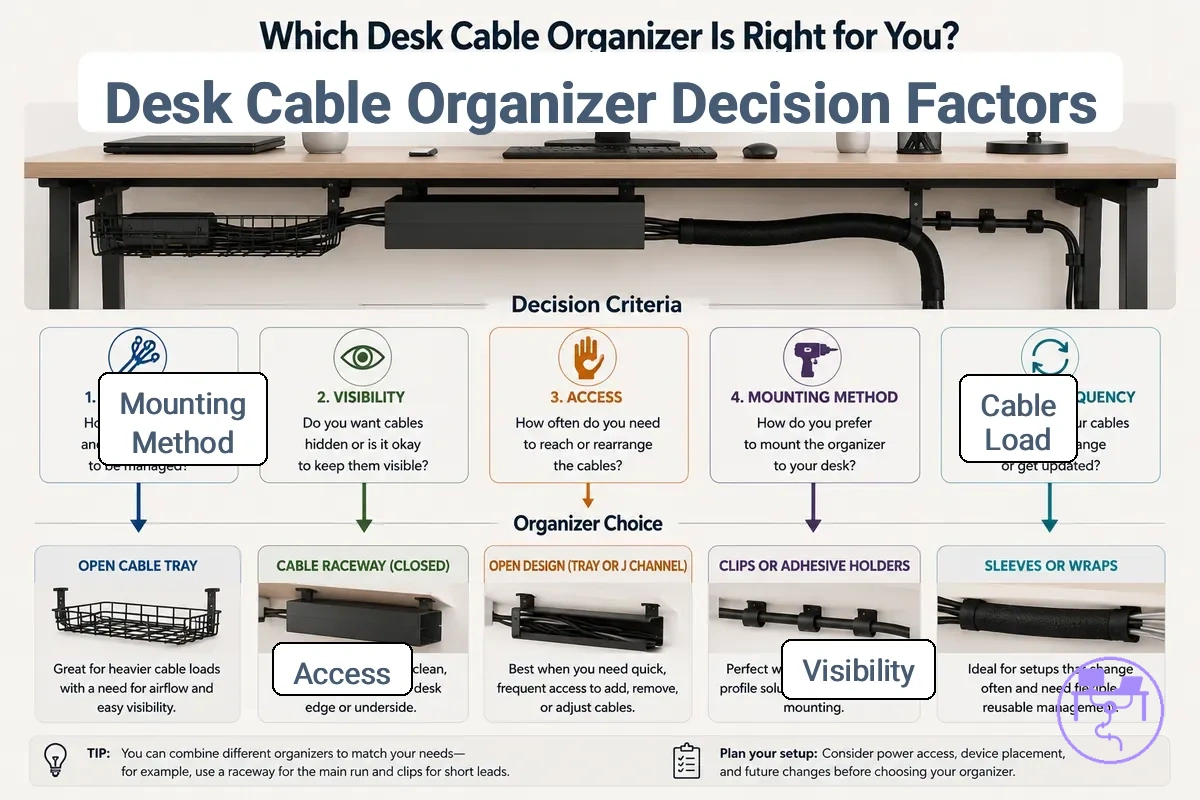
The table organizes each criterion, the condition that changes the answer, the decision effect, and a safer decision direction.
| Criterion | Condition | Effect on choice | Safer decision |
|---|---|---|---|
| Cable load | Larger cable bundles or added power strip connections | Higher capacity needs may influence organizer selection | Choose an organizer designed for broader cable support |
| Visibility | Exposed cables remain noticeable around the desk | Concealment may become a stronger decision factor | Choose an organizer that can reduce visible cable exposure |
| Access | Cables require regular adjustment or inspection | Access convenience may become more important than concealment | Choose an organizer that allows easier cable access |
| Mounting method | Desk surfaces and attachment options vary | Installation constraints may affect organizer suitability | Match the organizer to the available mounting method |
| Desk fit | Available under-desk space differs by setup | Physical fit may limit organizer size or placement | Confirm desk fit before selecting an organizer type |
| Change frequency | Cables are added, removed, or rerouted often | Frequent changes may favor flexibility over permanence | Choose an organizer that accommodates ongoing adjustments |
These criteria separate must-have constraints from preference-based factors and connect each condition to a decision effect. For a deeper framework on how to choose the right cable organizer, focus first on cable load, mounting method, and desk fit before weighing visibility, access, and change frequency. The most suitable organizer depends on how these conditions combine within the desk setup.
Cable load and power strip space
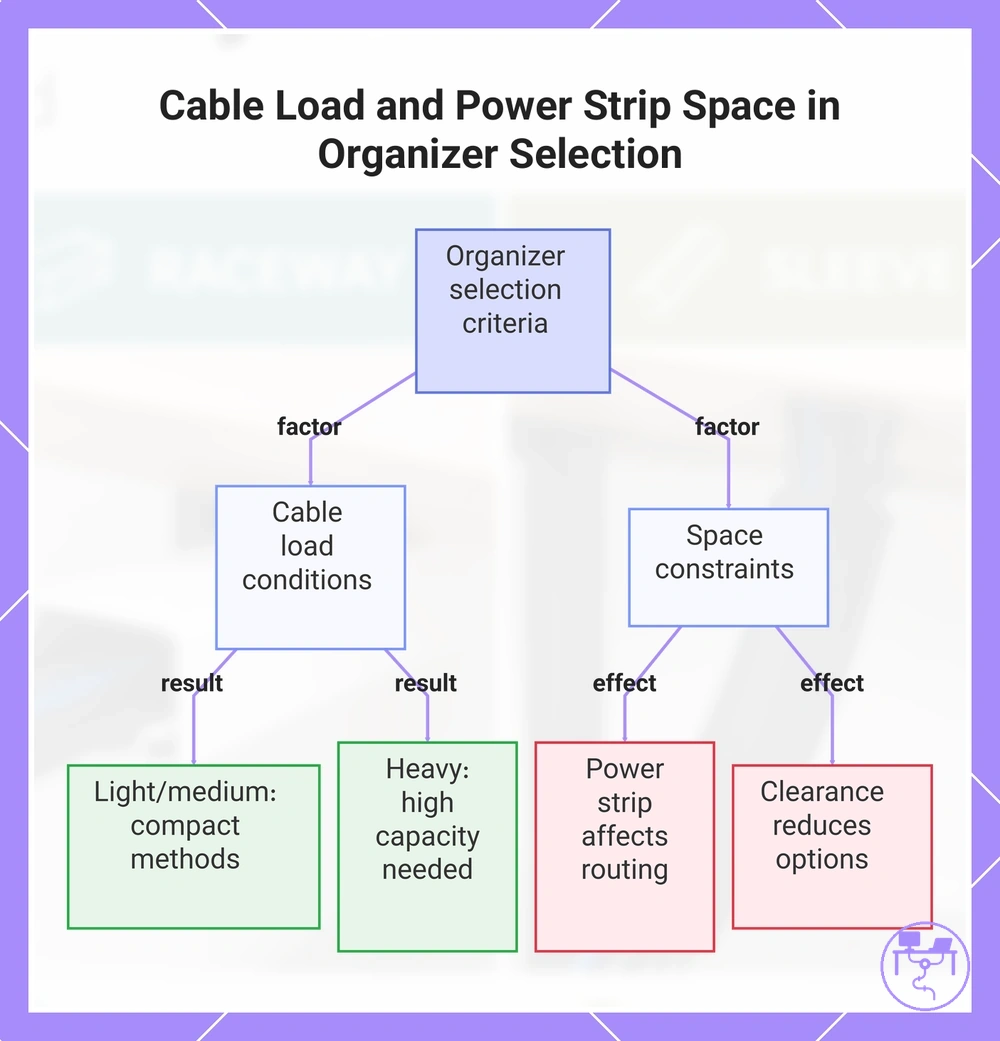
Cable load and power strip space affect organizer choice because greater cable quantity and adapter bulk require more room for routing, storage, and access. Larger cable bundles increase space demands, while power strip space can influence tray capacity needs and under-desk clearance requirements. The main condition is whether the available space can accommodate the cable load without limiting access.
Cable quantity, power strip space, adapter bulk, tray capacity, and under-desk clearance work together as selection criteria. A larger cable bundle may need more support area, while bulky adapters can affect placement options. Power strip position can influence access and available clearance when cables need adjustment. The decision usually depends on matching cable load and available space to the organizer arrangement.
- Light load: A small cable bundle with limited adapter bulk may suit compact cable management methods when under-desk clearance is limited.
- Medium load: Moderate cable quantity and shared power strip space may favor solutions that balance cable support with ongoing access.
- Heavy load: Larger cable bundles and greater adapter bulk may require more tray capacity and additional under-desk clearance when space allows.
- Power strip position: A power strip that occupies more adapter space may influence organizer placement and available routing paths.
- Clearance constraint: Limited under-desk clearance may reduce organizer options even when cable load would otherwise support a larger arrangement.
This chart shows how cable load and space constraints determine the appropriate organizer solution.
Visibility, concealment, and clean desk appearance
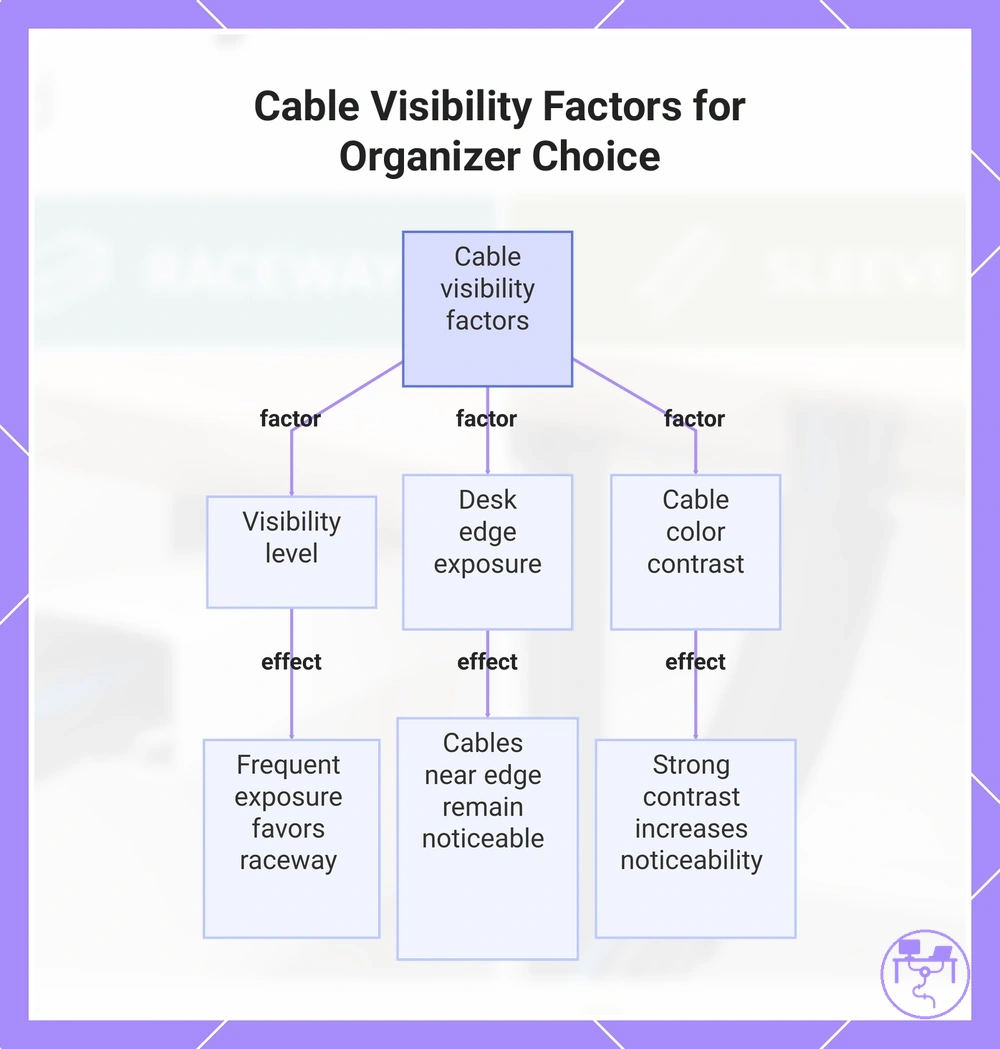
Visibility, concealment, and clean desk appearance affect organizer choice because visible cords, desk edge exposure, and cable color contrast can change how noticeable cables appear. Covered organizers generally reduce visible cable exposure, while clean appearance results may vary by cable path, viewing angle, and desk layout. The main condition is how much cable visibility is acceptable within the desk setup.
Visibility, concealment, and clean desk appearance can be evaluated through the checklist below. The checklist verifies whether visibility conditions are more likely to favor raceway concealment, sleeve bundling, or clip placement. Hiding cables and preserving cable access are related but not identical goals, and the trade-off may vary by cable path and maintenance needs. For situations where appearance is the primary concern, the question of how to hide desk cables cleanly is a separate consideration from maintaining convenient cable access.
- Visibility level: Frequent exposure of visible cords may increase the value of raceway concealment.
- Desk edge exposure: Cables near a desk edge may remain more noticeable and can influence organizer selection.
- Cable color contrast: Strong contrast between cables and desk surfaces may make cables easier to notice, even when bundled.
- Sleeve bundling: Sleeve bundling may improve appearance by grouping cables into a more unified path.
- Clip placement: Clip placement may help reduce scattered cable positions when only a few cables remain visible.
This chart shows the three main visibility conditions that influence which cable organizer (raceway, sleeve, or clip) is most suitable.
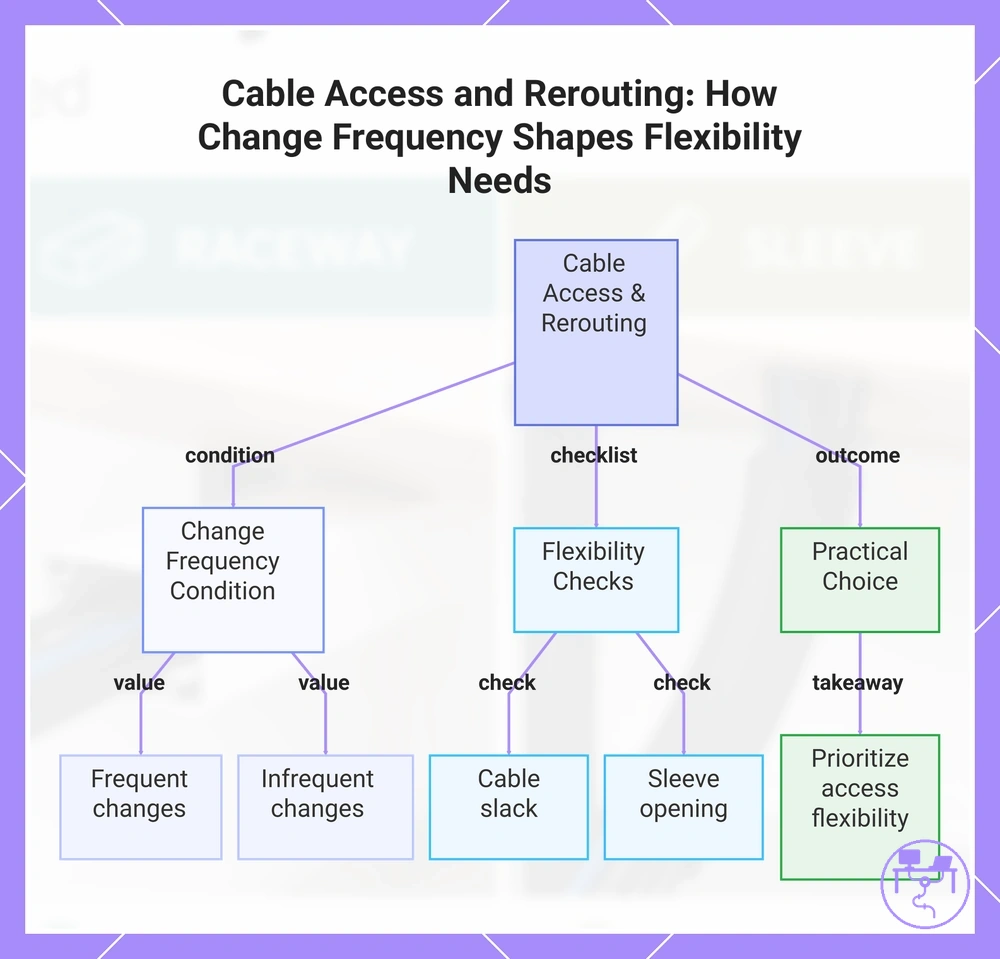
Cable access, rerouting, and setup changes
Cable access, rerouting, and setup changes depend on how often cables are added, removed, or adjusted after installation. Frequent setup changes make access frequency more important because removable cables, cable adjustment, and future rerouting may require easier reach. The main condition is how often the cable arrangement is expected to change.
Cable access, rerouting, and setup changes can be evaluated through the checklist below. The checklist verifies whether a fixed setup or a change-heavy setup places greater value on access and adjustment flexibility. A practical choice may differ from the neatest-looking choice when future cable access becomes a regular requirement.
- Access frequency: Frequent cable access may increase the importance of reachable cable paths.
- Removable cables: Device connections that change often may benefit from easier adjustment and rerouting.
- Cable slack: Extra slack may support future setup changes when cable positions are likely to move.
- Sleeve opening: Sleeve opening may affect how easily grouped cables can be adjusted.
- Tray openness: Tray openness may simplify rerouting when cable bundles change over time.
- Clip repositioning: Clip repositioning may be useful when individual cable paths need occasional adjustment.
This chart shows how the frequency of cable changes determines the importance of cable access, which flexibility checks to consider, and the practical trade-off between access and neatness.
Mounting method and desk surface fit
Mounting method and desk surface fit depend on whether the desk can accommodate the organizer before preference is considered. Adhesive, screw, and clamp options rely on different compatibility conditions, and desk surface characteristics can limit which mounting method is practical. The main condition is whether the desk surface and available mounting area support the selected attachment method.
Mounting method and desk surface fit can be evaluated through the checklist below. The checklist verifies which desk-fit conditions may affect surface compatibility, attachment suitability, and organizer placement. Adhesive reliability may vary with surface texture and cable tension, while screw and clamp options depend on underside space, desk thickness, and edge access. A compatible mounting method is usually determined by desk conditions rather than organizer preference alone.
- Adhesive: Adhesive mounting may depend on desk surface texture, available contact area, and cable tension.
- Screw: Screw mounting may depend on underside space and whether the desk surface is suitable for that attachment method.
- Clamp: Clamp mounting may depend on desk edge access, desk thickness, and available clearance.
- Desk thickness: Desk thickness may affect whether certain clamp or screw-based options can fit.
- Surface texture: Surface compatibility may vary when desk texture affects mounting contact.
- Cable tension: Higher cable tension may influence mounting stability regardless of mount type.
Best organizer type by desk cable problem
Best organizer type by desk cable problem depends on matching the cable issue to the organizer role rather than choosing a single organizer for every situation. Different desk cable problems call for different organizer types, and the likely outcome can vary with desk size, cable load, mounting limits, and available space. The main condition is whether the organizer type matches the specific cable problem and setup constraints.
Best organizer type by desk cable problem is easier to evaluate when common cable issues are organized by condition and organizer role. The table below maps each problem to the organizer type that may provide the most suitable solution fit under typical conditions.
| Problem | Condition | Organizer type | Likely outcome |
|---|---|---|---|
| Dangling bundles | Cable groups hang below the desk and need support clearance | Cable tray | May improve bundle support and reduce cable sag when space allows |
| Visible edge cables | Cables remain exposed along a desk edge or routing path | Cable raceway | May improve concealment along a defined cable path |
| Loose device leads | Small device cables move out of reach frequently | Cable clips | May keep individual leads accessible at fixed points |
| Bulky power strips | Adapters and power connections require shared storage space | Cable tray | May provide centralized support when under-desk clearance is available |
| Change-heavy setups | Cables are added, removed, or rerouted often | Cable sleeve | May simplify grouped cable adjustment and rerouting |
A combined setup may be useful when one desk cable problem creates a second constraint. For example, dangling bundles and visible edge cables may benefit from a tray for support and a raceway for concealment when both conditions exist. The most suitable organizer type depends on the cable problem, available space, cable load, and mounting limitations rather than a universal match.
Large under-desk cable bundles
Large under-desk cable bundles usually need an organizer with support, space, and under-desk clearance. A cable tray is often the most suitable role when heavy bundles, bulky adapters, or power-strip storage need a shared support area. The main condition is whether the tray capacity and available clearance can handle the large bundle without blocking access.
Large bundles can include cable weight, adapter bulk, and power-strip storage needs at the same time. A raceway may be too limited when the enclosed path cannot comfortably hold the cable group. A sleeve may help group cables, but sleeve flexibility may not provide enough support for heavy bundles by itself. Clips are usually insufficient for large under-desk cable bundles when cable weight and bundle size exceed point holding needs.
- Heavy bundles: A tray may provide better support when the large bundle needs capacity and under-desk clearance.
- Bulky adapters: Adapter clusters may require open storage space where access and support remain available.
- Power-strip storage: A tray may suit power-strip storage when clearance allows a shared support area.
- Raceway limit: A raceway may be less suitable when enclosure space restricts the cable bundle.
- Clip insufficiency: Clips may not be enough when cable weight and bundle size need broader support.
Visible cords around the desk edge or leg
Visible cords around the desk edge or leg depend on the cable path because different organizers address visibility in different ways. Raceway concealment is usually the strongest option when a visible cable path follows a desk edge, desk leg, or wall-facing route. Sleeve grouping and clip path control can also reduce visual distraction, but the main condition is whether the goal is hiding the path or organizing the cables along it.
Visible cords around the desk edge or leg are easier to evaluate when the cable path is reviewed before choosing an organizer. The checklist below verifies whether raceway concealment, sleeve grouping, or clip path control matches the visibility problem.
- Desk edge path: Raceway concealment may reduce visible cords when the cable route follows a desk edge.
- Desk leg routing: Clip path control may help keep cables aligned along a desk leg when the visible cable path needs direction.
- Wall-facing path: Raceway concealment may provide a cleaner outcome when cables remain exposed along a wall-facing route.
- Sleeve grouping: Sleeve grouping can combine cables into a single bundle, but grouped cables may still remain visible when the path is exposed.
- Tray placement limits: A tray may support cables under the desk, but it may have less effect on visible cords that travel along a desk edge or desk leg.
Small device cables that need fixed holding points
Small device cables that need fixed holding points usually depend on clips when consistent access to a cable end is more important than cable storage. Clips are suited to small device cables such as charger leads, keyboard cables, mouse cables, and light peripheral cords that need a predictable access point. The main condition is whether cable thickness, cable tension, and the adhesive surface support reliable fixed holding points.
Small device cables that need fixed holding points are easier to evaluate when cable type and access requirements are organized by condition. The table below shows when clips may suit light-cable access needs while keeping their role focused on fixed-point cable management.
| Problem | Condition | Organizer type | Likely outcome |
|---|---|---|---|
| Charger leads move out of reach | Small lead needs a fixed access point | Clips | May keep charger leads easier to reach |
| Keyboard cables shift position | Light cable needs consistent routing | Clips | May improve fixed-point cable control |
| Mouse cables cross the desk edge | Cable path benefits from local guidance | Clips | May help maintain a predictable cable path |
| Peripheral cords need organization | Adhesive surface supports cable holders | Clips | May keep small leads positioned at access points |
| Frequent repositioning | Cable tension or surface conditions change | Clips | Suitability may vary depending on adhesive surface and repositioning needs |
When to combine trays, raceways, sleeves, and clips
Combine trays, raceways, sleeves, and clips when a single organizer cannot address support, concealment, access, and routing needs at the same time. Combined roles can reduce trade-offs by assigning each organizer a specific job instead of expecting one solution to handle every cable condition. A mixed setup may add value when cable load, visibility, and access requirements overlap, but it can create unnecessary complexity when one organizer already satisfies the main need. The main condition is whether the additional organizer solves a separate cable-management problem.
When to combine trays, raceways, sleeves, and clips becomes easier to evaluate when each combination is matched to a specific condition. The table below organizes common combined organizer roles, the condition that supports them, and the likely outcome.
| Problem | Condition | Organizer type | Likely outcome |
|---|---|---|---|
| Supported bundles with accessible cable ends | Large bundle plus frequent cable access | Tray plus clips | May combine bundle support with fixed access points |
| Visible cable paths and grouped cables | Concealment and bundling are both needed | Raceway plus sleeve | May balance concealment with cable grouping |
| Large grouped cable runs | Bundle support and organization are both priorities | Tray plus sleeve | May improve cable grouping within a supported area |
| Visible edge cords with access needs | Cable path needs guidance and concealment | Clips plus raceway | May improve path control while reducing cable exposure |
Tray plus clips often suits setups where cable bundles need support while charger leads or peripheral cords need fixed access points. The tray handles bundle storage, while clips assist with access. The benefit depends on whether cable ends require frequent reach, and the limitation is that clips remain suited to light-cable point holding rather than broader bundle support.
Raceway plus sleeve may suit cable routes where both concealment and grouping matter. Raceway concealment can reduce exposure along a visible path, while sleeve grouping keeps related cables together before they enter or leave the route. Tray plus sleeve may suit larger cable groups that benefit from organized bundling inside a supported storage area. In both combinations, the benefit depends on whether concealment and grouping solve separate problems rather than repeating the same role.
Clips plus raceway may suit desk edge paths where cables need both direction and reduced visibility. Decision signals for a combined organizer setup include multiple cable-management goals that cannot be addressed by one organizer alone. If support, access, grouping, and concealment overlap, combined roles may add value. If only one condition is driving the decision, a single organizer may be the simpler choice.
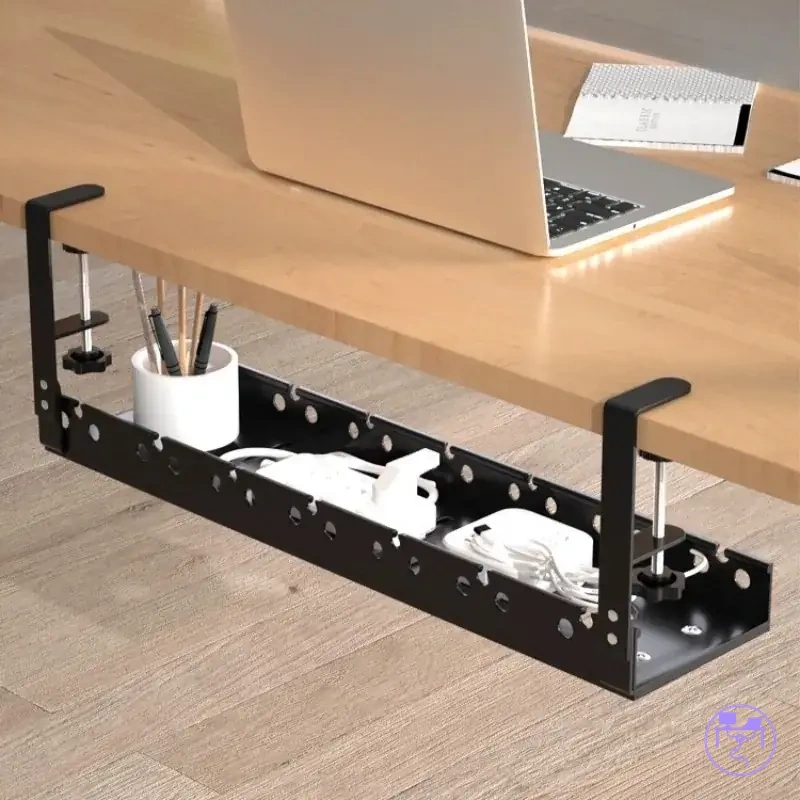
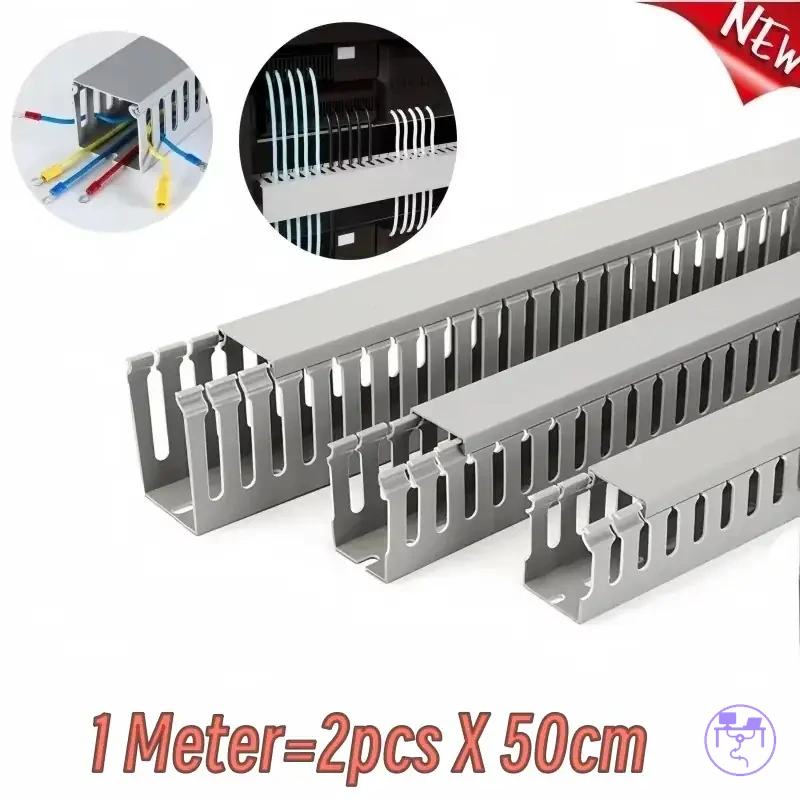
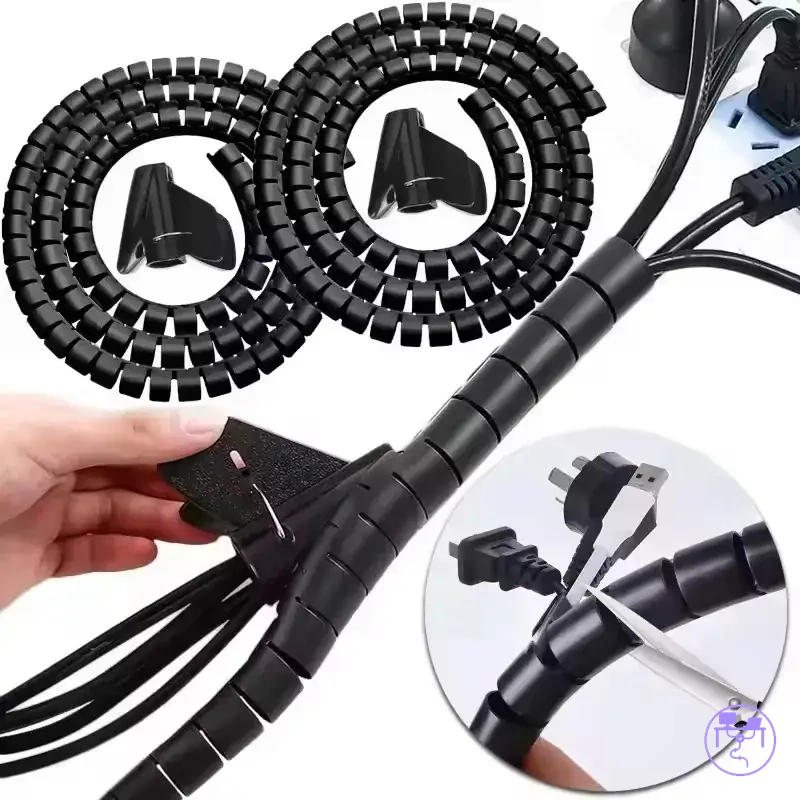
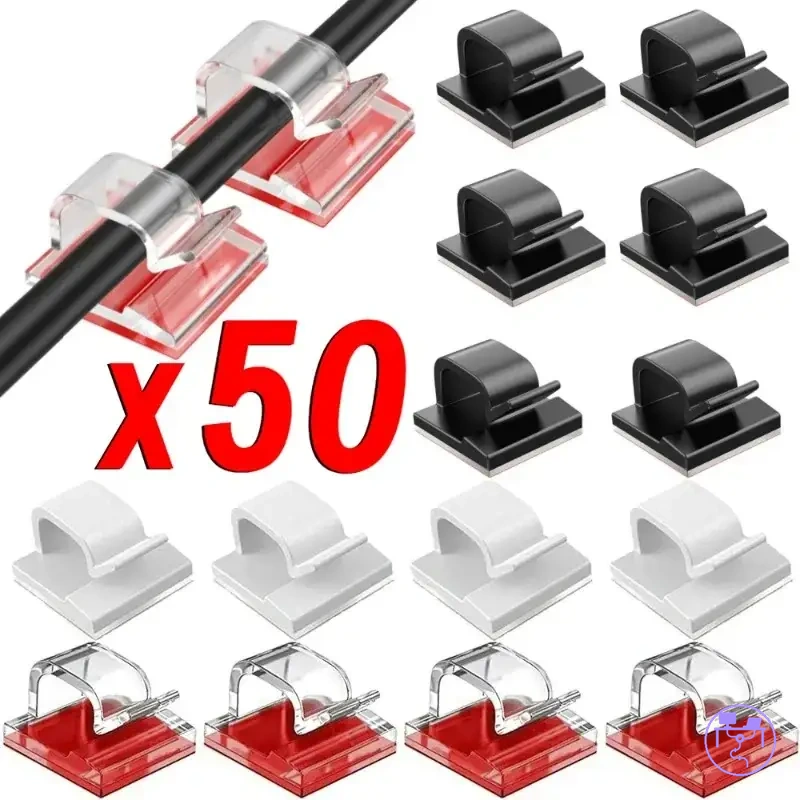
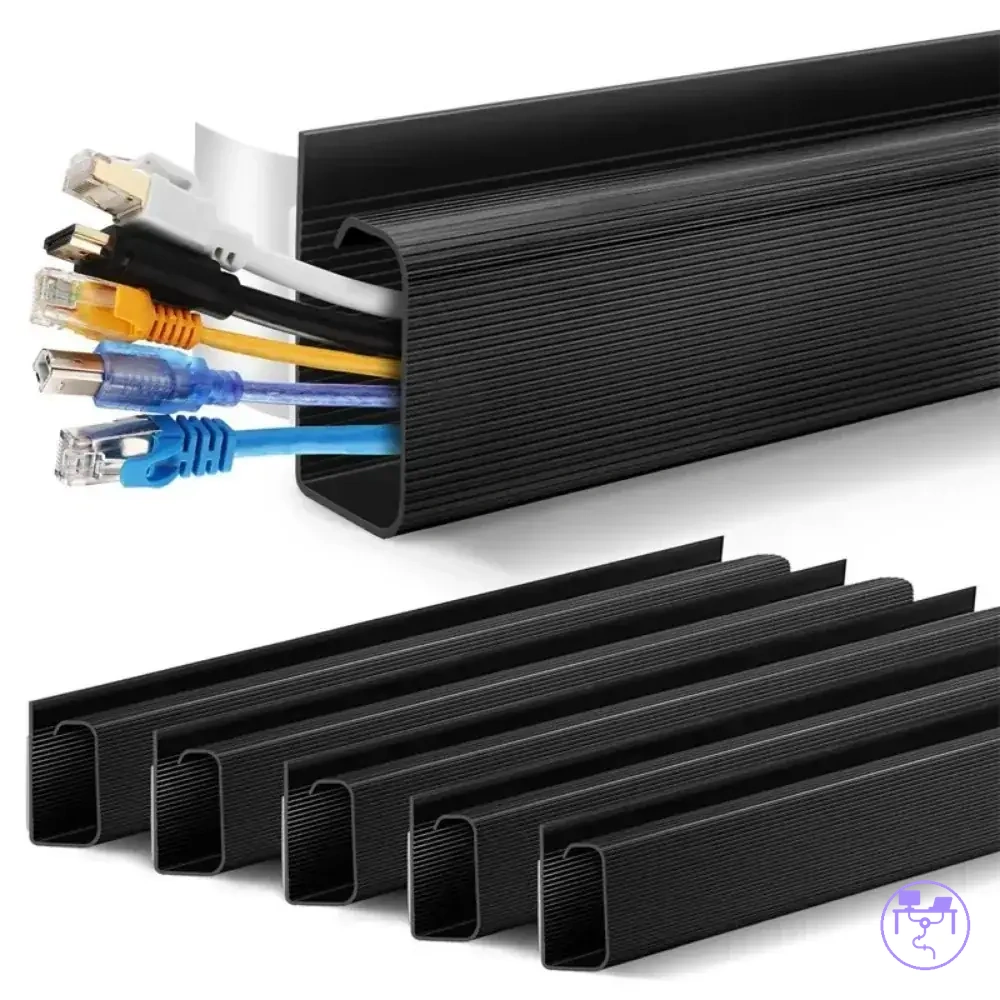
The products below are useful examples for comparing available options. Before buying, check that the compatibility criteria, key features, and product details match your needs.
Choose by cable load, visibility, and change frequency
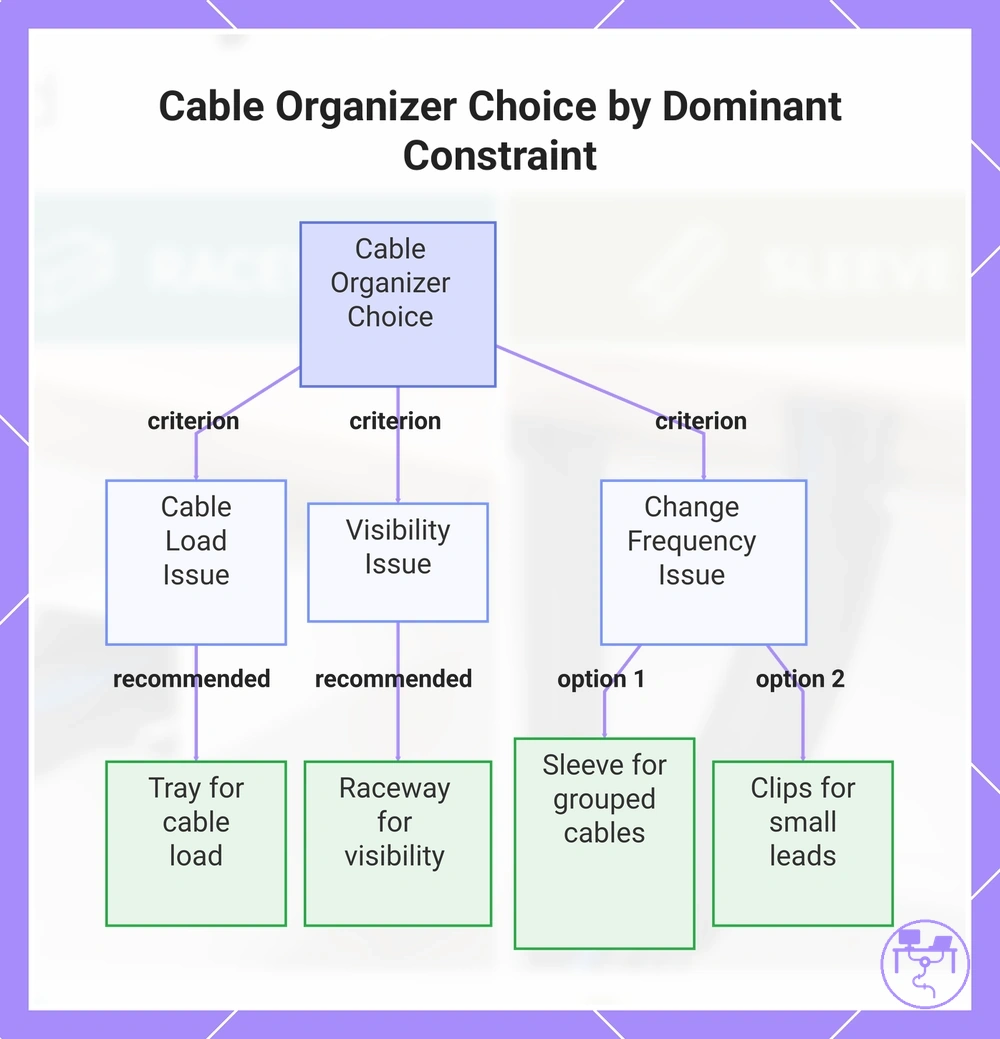
Choose by cable load, visibility, and change frequency when making the final choice between tray, raceway, sleeve, and clips. Cable load points toward support, visibility points toward concealment, and change frequency points toward access or flexibility. The final choice should follow the strongest condition in the desk setup rather than a universal winner.
Choose by cable load, visibility, and change frequency becomes easier when each organizer type is checked against its strongest condition and weaker condition. The decision checklist below verifies whether the organizer type fits the main cable problem without adding unnecessary trade-offs.
- Tray: Stronger when cable load and under-desk bundle support matter; weaker when the main issue is a visible edge path.
- Raceway: Stronger when visibility and covered routing matter; weaker when frequent cable access is needed.
- Sleeve: Stronger when grouped cables need flexibility; weaker when bulky adapters or power-strip storage need support.
- Clips: Stronger when small leads need fixed access points; weaker when cable bundles are heavy or numerous.
A qualified recommendation starts with the dominant constraint. Choose a tray when cable load is the main issue, choose a raceway when visibility is the main issue, choose a sleeve when grouped movement is the main issue, and choose clips when small access points are the main issue. For a broader decision framework, use choose the right cable organizer as the next selection step.
The final decision should also account for the weaker condition of each organizer type. A tray may still need clips for access points, a raceway may need planning for future access, a sleeve may need support when the bundle is heavy, and clips may need a suitable surface and light cable tension. The strongest choice is the organizer type that matches the main condition while leaving fewer practical conflicts.
If cable load, visibility, and change frequency all matter at the same time, a combined setup may be more useful than forcing one organizer to handle every role. If only one condition clearly dominates, one organizer type may be simpler and more responsive. The final choice should remain conditional on the desk setup, cable quantity, visible path, and expected changes.
The products below are useful examples for comparing available options. Before buying, check that the compatibility criteria, key features, and product details match your needs.
This chart shows the three main decision criteria and the recommended organizer type for each dominant condition.